. 2019 Jan 1;26(1):103-117.
doi: 10.1530/ERC-17-0399.

GnRH antagonist treatment of malignant adrenocortical tumors

Affiliations

GnRH antagonist treatment of malignant adrenocortical tumors

Milena Doroszko et al. Endocr Relat Cancer. .

Abstract

Aberrantly expressed G protein-coupled receptors in tumors are considered as potential therapeutic targets. We analyzed the expressions of receptors of gonadotropin-releasing hormone (GNRHR), luteinizing hormone/chorionic gonadotropin (LHCGR) and follicle-stimulating hormone (FSHR) in human adrenocortical carcinomas and assessed their response to GnRH antagonist therapy. We further studied the effects of the GnRH antagonist cetrorelix acetate (CTX) on cultured adrenocortical tumor (ACT) cells (mouse Cα1 and Y-1, and human H295R), and in vivo in transgenic mice (SV40 T-antigen expression under inhibin α promoter) bearing Lhcgr and Gnrhr in ACT. Both models were treated with control (CT), CTX, human chorionic gonadotropin (hCG) or CTX+hCG, and their growth and transcriptional changes were analyzed. In situ hybridization and qPCR analysis of human adrenocortical carcinomas (n = 11-13) showed expression of GNRHR in 54/73%, LHCGR in 77/100% and FSHR in 0%, respectively. CTX treatment in vitro decreased cell viability and proliferation, and increased caspase 3/7 activity in all treated cells. In vivo, CTX and CTX+hCG (but not hCG alone) decreased ACT weights and serum LH and progesterone concentrations. CTX treatment downregulated the tumor markers Lhcgr and Gata4. Upregulated genes included Grb10, Rerg, Nfatc and Gnas, all recently found to be abundantly expressed in healthy adrenal vs ACT. Our data suggest that CTX treatment may improve the therapy of human adrenocortical carcinomas by direct action on GNRHR-positive cancer cells inducing apoptosis and/or reducing gonadotropin release, directing tumor cells towards a healthy adrenal gene expression profile.

Keywords: GNRHR; GnRH antagonist; LHCGR; cetrorelix; therapy.


Figures

Figure 1
Figure 1
Localization of gonadotropin receptors in human and mouse adrenocortical tumors/cancer. Representative images of hematoxylin and eosin, immuno-localization of MKI67, in situ RNA/protein localization of GNRHR, LHCGR and FSHR in human adrenocortical carcinoma sections from Patient 11 (panel A) or adrenocortical tumor sections of inhα/Tag mouse (panel B). Bar = 50 µm.
Figure 2
Figure 2
mRNA levels of GNRHR/Gnrhr and LHCGR/Lhcgr in normal and adrenal tumor/cancer tissues and cell lines. Expression of GNRHR (A) and LHCGR (B) in normal human adrenals (ADR) (n = 3), adrenocortical carcinomas (ACC) (n = 11) and H295R cell line (n = 3). Expression of Gnrhr (C) and Lhcgr (D) in normal mouse ADR (n = 5), ACT (n = 5) and cell lines Cα1 and Y-1. ACC, adrenocortical cancer, ACT, adrenocortical tumor; ADR, normal adrenal.
Figure 3
Figure 3
Cell viability, proliferation and caspase 3/7 activity in vitro. Viability (A) and proliferation (B) of Cα1, Y-1 and H295R cells after 48 h treatment with CT, CTX, CTX and hCG or hCG alone. Caspase 3/7 activity (C) in Cα1, Y-1 and H295R cells assessed after culture with CTX for 6 h (mean ± s.e.m.; *P ≤ 0.05. **P ≤ 0.01. ***P ≤ 0.001). CT, 0.1% DMSO as control; CTX, cetrorelix acetate; hCG, human chorionic gonadotropin.
Figure 4
Figure 4
CTX treatment efficacy in vivo. Adrenal tumor weights (A and B) and plasma LH (C and D) and progesterone (E and F) concentrations of mice treated for 21 days with saline as control (CT), CTX, CTX and hCG, or hCG. (n = 6–8/group; mean ± s.e.m.; *P ≤ 0.05. **P ≤ 0.01. ***P ≤ 0.001). CT, saline; CTX, cetrorelix acetate; hCG, human chorionic gonadotropin.
Figure 5
Figure 5
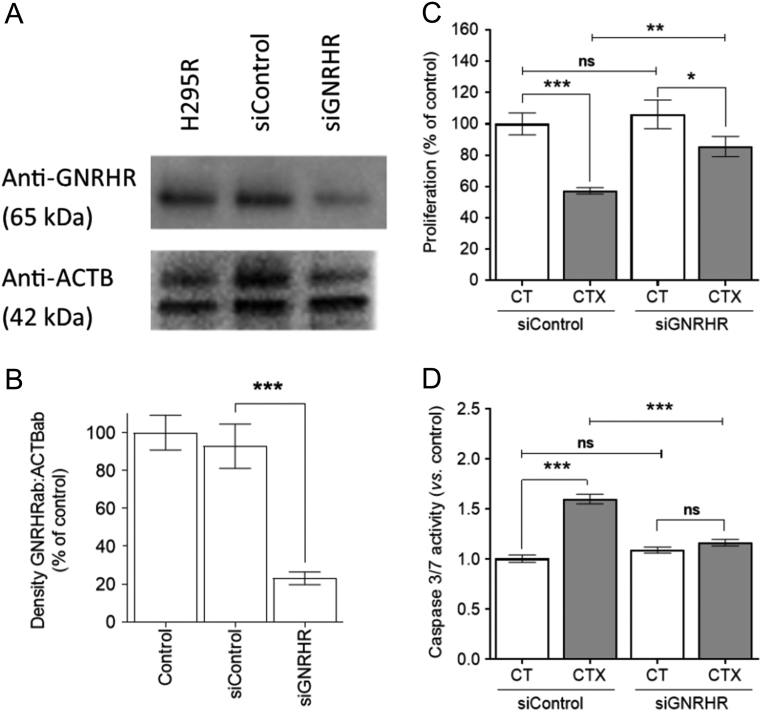
GNRHR knockdown in H295R adrenocortical carcinoma cells. Western blot analysis of GNRHR expression in WT (H295R), transfected with non-targeting (siControl) or GNRHR-targeting (siGNRHR) siRNA H295R adrenocortical carcinoma cells (A). Densitometric analysis of the GNRHR protein levels in H295R, siControl and siGNRHR cells (n = 3) (B). The effect of CTX treatment on proliferation (n = 12) (C) and caspase 3/7 activation (n = 9) (D) in siControl and siGNRHR cells (mean ± s.e.m.; *P ≤ 0.05. **P ≤ 0.01. ***P ≤ 0.001).
Figure 6
Figure 6
Gene ontology (GO) classification based on biological processes and pathways affected by CTX treatment in vivo. Venn diagram of upregulated and downregulated genes in the adrenal glands of male and female mice treated with CTX (cetrorelix acetate) or CT (saline as control) for 21 days (A). Significantly upregulated or downregulated genes were classified based on the biological processes (B) and pathways (C) they are involved in. The analysis shows the number of dysregulated genes in the adrenocortical tumors of inhα/Tag treated with CT vs CTX.
Figure 7
Figure 7
qPCR validation of selected genes from microarray study in inhα/Tag adrenal tumors and cell lines (Cα1 and Y-1) treated with CTX vs CT. Gene expression of Gata4 (A), Lhcgr (B), Ccna1 (C), Sgcd (D), Mmp24 (E), Grb10 (F), Rerg (G), G0s2 (H), Tusc5 (I), Rasgrf1 (J), Gnrhr (K), Nfatc2 (L), Gnas (M) in inhα/Tag adrenal tumors and Cα1 and Y-1 cell lines treated with CTX (cetrorelix acetate) vs CT (0.1% DMSO as control). (n = 3–5/group; mean ± s.e.m.; *P ≤ 0.05. **P ≤ 0.01. ***P ≤ 0.001).

References

    1. Albiger N, Sartorato P, Mariniello B, Iacobone M, Finco I, Fassina A, Mantero F.2011. A case of primary aldosteronism in pregnancy: do LH and GNRH receptors have a potential role in regulating aldosterone secretion? European Journal of Endocrinology of the European Federation of Endocrine Societies 164 405–412. (10.1530/EJE-10-0879) - DOI - PubMed
    1. Alevizaki M, Saltiki K, Mantzou E, Anastasiou E, Huhtaniemi I.2006. The adrenal gland may be a target of LH action in postmenopausal women. European Journal of Endocrinology of the European Federation of Endocrine Societies 154 875–881. (10.1530/eje.1.02165) - DOI - PubMed
    1. Allolio B, Fassnacht M.2006. Clinical review: adrenocortical carcinoma: clinical update. Journal of Clinical Endocrinology and Metabolism 91 2027–2037. (10.1210/jc.2005-2639) - DOI - PubMed
    1. Banerjee P, Fazleabas AT.2011. Extragonadal actions of chorionic gonadotropin. Reviews in Endocrine and Metabolic Disorders 12 323–332. (10.1007/s11154-011-9193-1) - DOI - PMC - PubMed
    1. Bernichtein S, Alevizaki M, Huhtaniemi IT.2008. Is the adrenal cortex a target for gonadotropins? Trends in Endocrinology and Metabolism 19 231–238. (10.1016/j.tem.2008.06.003) - DOI - PubMed

Publication types

MeSH terms