


Distinct White Matter Changes Associated with Cerebrospinal Fluid Amyloid-β1-42 and Hypertension
- PMID: 30400099
- PMCID: PMC6433595
- DOI: 10.3233/JAD-180663
Distinct White Matter Changes Associated with Cerebrospinal Fluid Amyloid-β1-42 and Hypertension
Abstract
Background: Alzheimer's disease (AD) pathology and hypertension (HTN) are risk factors for development of white matter (WM) alterations and might be independently associated with these alterations in older adults.
Objective: To evaluate the independent and synergistic effects of HTN and AD pathology on WM alterations.
Methods: Clinical measures of cerebrovascular disease risk were collected from 62 participants in University of Kentucky Alzheimer's Disease Center studies who also had cerebrospinal fluid (CSF) sampling and MRI brain scans. CSF Aβ1-42 levels were measured as a marker of AD, and fluid-attenuated inversion recovery imaging and diffusion tensor imaging were obtained to assess WM macro- and microstructural properties. Linear regression analyses were used to assess the relationships among WM alterations, cerebrovascular disease risk, and AD pathology. Voxelwise analyses were performed to examine spatial patterns of WM alteration associated with each pathology.
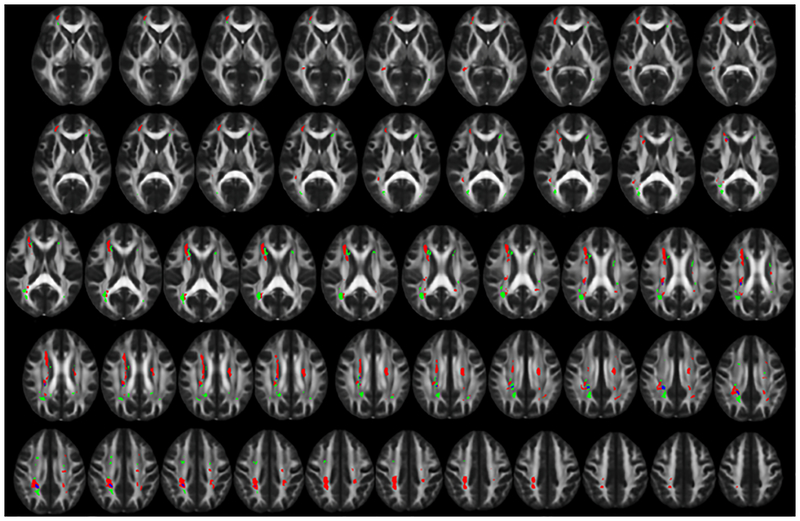
Results: HTN and CSF Aβ1-42 levels were each associated with white matter hyperintensities (WMH). Also, CSF Aβ1-42 levels were associated with alterations in normal appearing white matter fractional anisotropy (NAWM-FA), whereas HTN was marginally associated with alterations in NAWM-FA. Linear regression analyses demonstrated significant main effects of HTN and CSF Aβ1-42 on WMH volume, but no significant HTN×CSF Aβ1-42 interaction. Furthermore, voxelwise analyses showed unique patterns of WM alteration associated with hypertension and CSF Aβ1-42.
Conclusion: Associations of HTN and lower CSF Aβ1-42 with WM alteration were statistically and spatially distinct, suggesting independent rather than synergistic effects. Considering such spatial distributions may improve diagnostic accuracy to address each underlying pathology.
Keywords: Alzheimer’s disease; Aβ1-42; hypertension; white matter alteration.
Conflict of interest statement
Conflict of Interest:
The authors have no conflict of interest to report.
Figures
References
-
- Schneider JA, Arvanitakis Z, Bang W, Bennett DA (2007) Mixed brain pathologies account for most dementia cases in community-dwelling older persons. Neurology 69, 2197–2204. - PubMed
-
- Klunk WE, Engler H, Nordberg A, Wang Y, Blomqvist G, Holt DP, Bergström M, Savitcheva I, Huang GF, Estrada S (2004) Imaging brain amyloid in Alzheimer’s disease with Pittsburgh Compound‐B. Ann Neurol 55, 306–319. - PubMed
-
- Motter n, Vigo‐Pelfrey C, Kholodenko D, Barbour R, Johnson‐Wood K, Galasko D, Chang L, Miller B, Clark C, Green R (1995) Reduction of β‐amyloid peptide42 in the cerebrospinal fluid of patients with Alzheimer’s disease. Ann Neurol 38, 643–648. - PubMed
Publication types
MeSH terms
Substances
Grants and funding
LinkOut - more resources
Full Text Sources
Medical
