


Changes in Sport Nutrition Knowledge, Attitudes/Beliefs and Behaviors Following a Two-Year Sport Nutrition Education and Life-Skills Intervention among High School Soccer Players
- PMID: 30400200
- PMCID: PMC6266993
- DOI: 10.3390/nu10111636
Changes in Sport Nutrition Knowledge, Attitudes/Beliefs and Behaviors Following a Two-Year Sport Nutrition Education and Life-Skills Intervention among High School Soccer Players
Abstract
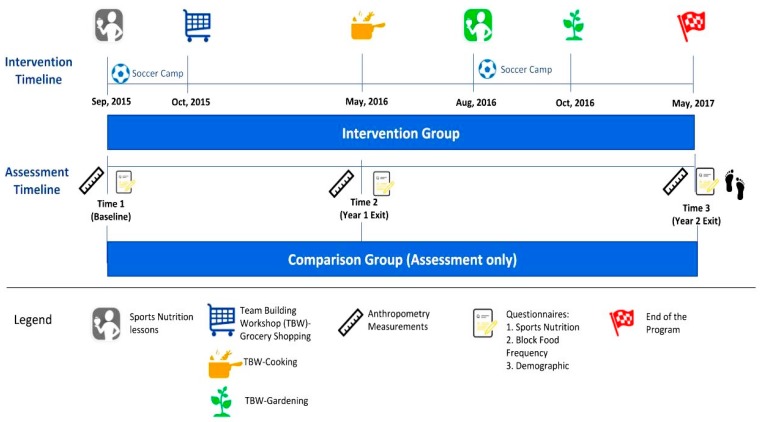
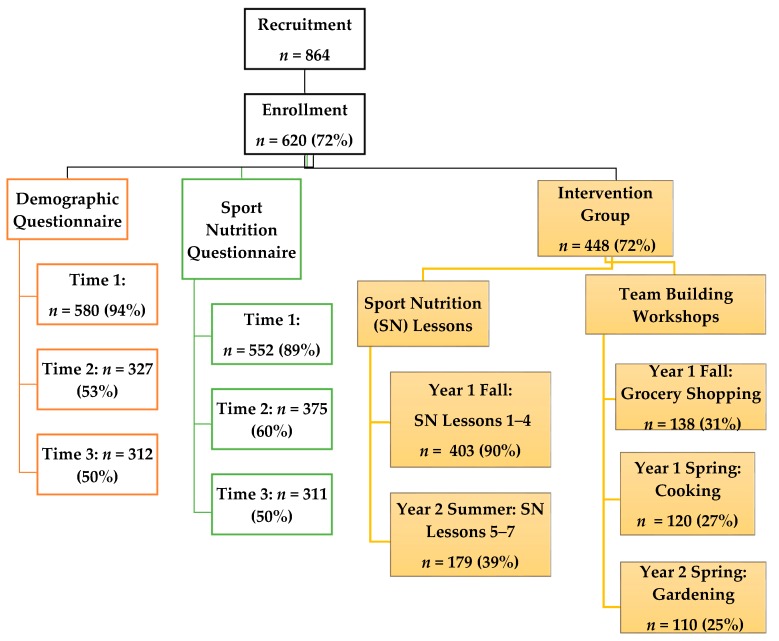
The purpose of this study was to examine the impact of a sport nutrition education and life-skills intervention on sport nutrition knowledge (SNK), attitudes/beliefs and dietary behaviors relevant to sport nutrition among high school (HS) soccer players. Three assessments were done over the 2-year intervention (baseline = time 1, end year 1 = time 2, end year 2 = time 3). Participants (n = 217; females = 64%; Latino = 47.5%; 14.9 ± 0.9-year; 46.5% National School Breakfast/Lunch Program) were assigned to an intervention group (IG, n = 153; 9 schools) or comparison group (CG, n = 64; 4 schools) based on geographical location. Differences over time were examined based on group, sex, socioeconomic status (SES) and race/ethnicity. The IG increased SNK scores by ~10% (time 1 = 51.6%; time 3 = 60.9%; p ≤ 0.001), with the greatest change in the female IG vs. CG and no differences in male IG vs. CG. Daily breakfast consumption was 53.7% in both groups. IG players were 3 times more likely (95%CI = 2.59, 7.77) to report trying to eat for performance (IG = 48.7% vs. CG = 30.2%). By time 3, IG players were less likely to report that 'diet met nutritional requirements' (31.6%) compared to CG (47.6%). For IG, the consumption of lunch (≥5-days/week) did not change (92.2⁻93.4%), but declined in the CG (90.6%) (p = 0.04). No other differences by sub-population (race/ethnicity, SES) were observed. Our findings indicate that HS athletes are motivated to learn and improve diet behaviors, and benefit from team-based nutrition interventions. Future interventions should consider delivery of curriculum/experiential learning during a defined training period, with messages reinforced with supports at home, school and athletic settings.
Keywords: Latino youth; adolescent; diet behaviors; low-income; obesity prevention; soccer; sport; sport nutrition.
Conflict of interest statement
The authors declare no conflict of interest.
Figures
References
MeSH terms
Grants and funding
LinkOut - more resources
Full Text Sources
Medical
Miscellaneous
