


Dietary Intake in Population with Metabolic Syndrome: Is the Prevalence of Inadequate Intake Influenced by Geographical Area? Cross-Sectional Analysis from PREDIMED-Plus Study
- PMID: 30400355
- PMCID: PMC6266979
- DOI: 10.3390/nu10111661
Dietary Intake in Population with Metabolic Syndrome: Is the Prevalence of Inadequate Intake Influenced by Geographical Area? Cross-Sectional Analysis from PREDIMED-Plus Study
Abstract
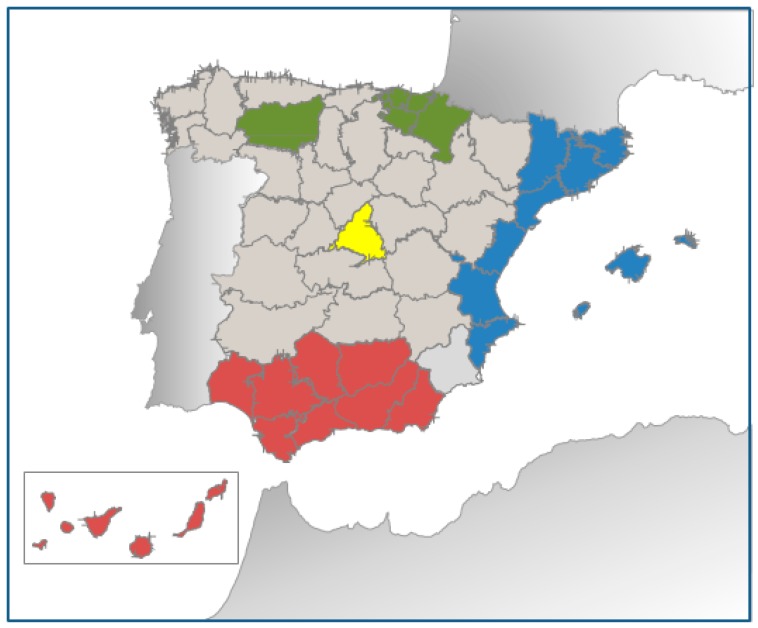
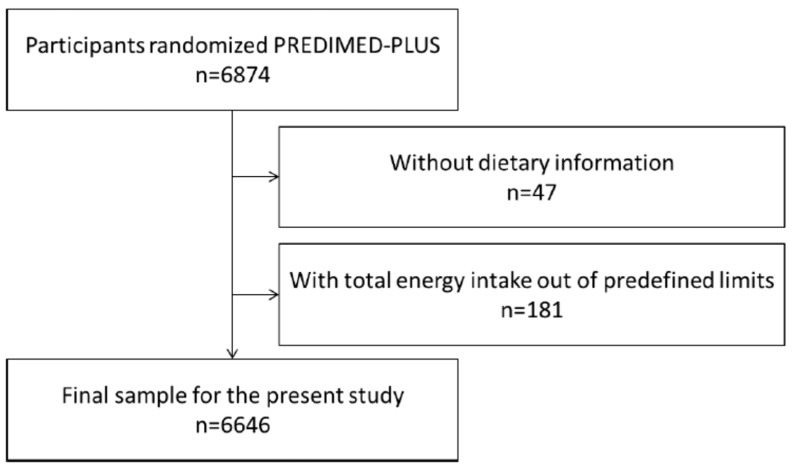
Inadequate diet influences chronic diseases such as cardiovascular disease (CVD), the leading cause of death in Spain. CVD figures vary from one geographical region to another; this could be associated with different food choices. Our aim was to analyse the influence of geographical area on nutrient intakes among the Spanish adult population with Metabolic Syndrome (MetS). We analysed cross-sectional baseline data from the PREDIMED-Plus study: 6646 Spanish adults, aged 55⁻75 years, with overweight/obesity and MetS in four geographical areas. A validated 143-item Food Frequency Questionnaire (FFQ) was used to assess energy and nutrient intakes. The prevalence of inadequate nutrient intake was estimated according to Dietary Reference Intakes (DRIs). Multivariable-adjusted logistic regression was used to assess the relationship between geographical area (North, Central, East and South areas) and inadequate nutrient intake. People in the North area consumed significantly lower amounts of vegetables and fish but more sugar and alcohol (p < 0.001) than other areas. Dietary fibre, vitamin A, E, calcium and magnesium intakes were all lower among men of North area than in the other areas (p < 0.001). Sex (women), non-smoker and physical activity were also associated to adequate nutrient intake. Geographical area influences nutrient intakes. Its effect on dietary quality should be taken into account when planning food policies.
Keywords: PREDIMED-Plus study; dietary intake; geographical area; metabolic syndrome; nutrient adequacy; place of residence.
Conflict of interest statement
J.S.-S. reports serving on the board of and receiving grant support through his institution from International Nut and Dried Fruit Council; receiving consulting personal fees from Danone, Font Vella Lanjarón, Nuts for Life and Eroski; and receiving grant support through his institution from Nut and Dried Fruit Foundation and Eroski. E.R., reports grants, non-financial support and other fees from California Walnut Commission and Alexion; personal fees and non-financial support from Merck, Sharp & Dohme; personal fees, non-financial support and other fees from Aegerion and Ferrer International; grants and personal fees from Sanofi Aventis; grants from Amgen and Pfizer and; personal fees from Akcea, outside of the submitted work. X.P., reports serving on the board of and receiving consulting personal fees from Sanofi Aventis, Amgen and Abbott laboratories; receiving lecture personal fees from Esteve, Lacer and Rubio laboratories. L.D. reports grants from Fundación Cerveza y Salud. J.J.G. reports receiving grants from the Diputación Provincial de Jaén and the Fundación Caja Rural de Jaén. All other authors declare no competing interests.
Figures
References
-
- Abarca-Gómez L., Abdeen Z.A., Hamid Z.A., Abu-Rmeileh N.M., Acosta-Cazares B., Acuin C., Adams R.J., Aekplakorn W., Afsana K., Aguilar-Salinas C.A., et al. Worldwide trends in body-mass index, underweight, overweight, and obesity from 1975 to 2016: A pooled analysis of 2416 population-based measurement studies in 128·9 million children, adolescents, and adults. Lancet. 2017;390:2627–2642. doi: 10.1016/S0140-6736(17)32129-3. - DOI - PMC - PubMed
MeSH terms
Substances
Grants and funding
- FPU14/03630/Ministerio de Educación, Cultura y Deporte
- PI13/00673, PI13/00492, PI13/00272, PI13/01123, PI13/00462, PI13/00233, PI13/02184, PI13/00728, PI13/01090, PI13/01056, PI14/01722, PI14/00636, PI14/00618, PI14-00696, PI14/01206, PI14/01919, PI14/00853/Instituto de Salud Carlos III
- Advanced Research Grant 2013-2018; 340918/European Research Council/International
- 2013ACUP00194/Recercaixa
- PI0458/2013/Consejería de Salud, Junta de Andalucía
