


Multiple myeloma: 2018 update on diagnosis, risk‐stratification, and management
- PMID: 30400719
- PMCID: PMC6223128
- DOI: 10.1002/ajh.25117
Multiple myeloma: 2018 update on diagnosis, risk‐stratification, and management
Abstract
Disease overview: Multiple myeloma accounts for approximately 10% of hematologic malignancies.
Diagnosis:
The diagnosis requires ≥10% clonal bone marrow plasma cells or a biopsy proven plasmacytoma plus evidence of one or more multiple myeloma defining events (MDE): CRAB (hyper
Risk stratification: Patients with del(17p), t(14;16), and t(14;20) have high-risk multiple myeloma. Patients with t(4;14) translocation and gain(1q) have intermediate-risk. All others are considered standard-risk.
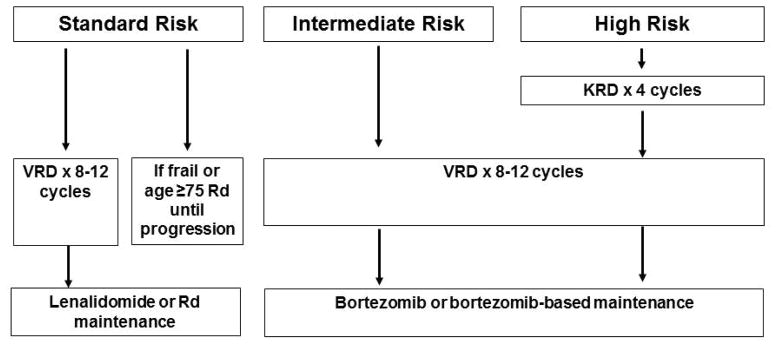
Risk-adapted initial therapy: Initial treatment consists of bortezomib, lenalidomide, dexamethasone (VRd). In high-risk patients, carfilzomib, lenalidomide, dexamethasone (KRd) is an alternative to VRd. In eligible patients, initial therapy is given for approximately 3–4 cycles followed by autologous stem cell transplantation (ASCT). Standard risk patients can opt for delayed ASCT at first relapse. Patients not candidates for transplant are treated with VRd for approximately 8–12 cycles followed by lenalidomide or lenalidomide plus dexamethasone.
Maintenance therapy: After ASCT, lenalidomide maintenance is recommended for standard risk patients, while maintenance with a bortezomib-based regimen is needed for patients with intermediate or high-risk disease.
Management of refractory disease: Most patients require a triplet regimen at relapse, with the choice of regimen varying with each successive relapse. Aggressive relapse with extramedullary plasmacytomas or plasma cell leukemia may require anthracycline containing combination chemotherapy regimens.
Conflict of interest statement
Conflict of interest: No conflicts of interest to be disclosed.
SVR declares no conflict of interest.
Figures



References
-
- Rajkumar SV, Dimopoulos MA, Palumbo A, et al. International Myeloma Working Group Updated Criteria for the Diagnosis of Multiple Myeloma. Lancet Oncol. 2014;15:e538–48. - PubMed
-
- Siegel RL, Miller KD, Jemal A. Cancer statistics, 2018. CA Cancer J Clin. 2018;68:7–30. - PubMed
-
- Kyle RA, Therneau TM, Rajkumar SV, Larson DR, Plevak MF, Melton LJ., 3rd Incidence of multiple myeloma in Olmsted County, Minnesota: Trend over 6 decades. Cancer. 2004;101:2667–74. - PubMed
-
- Landgren O, Weiss BM. Patterns of monoclonal gammopathy of undetermined significance and multiple myeloma in various ethnic/racial groups: support for genetic factors in pathogenesis. Leukemia. 2009;23:1691–7. - PubMed
-
- Kyle RA, Gertz MA, Witzig TE, et al. Review of 1,027 patients with newly diagnosed multiple myeloma. Mayo Clinic Proc. 2003;78:21–33. - PubMed
Publication types
MeSH terms
Substances
Grants and funding
LinkOut - more resources
Full Text Sources
Other Literature Sources
Medical
Research Materials