


Hepatocellular carcinoma is the most common liver-related complication in patients with histopathologically-confirmed NAFLD in Japan
- PMID: 30400829
- PMCID: PMC6219202
- DOI: 10.1186/s12876-018-0900-1
Hepatocellular carcinoma is the most common liver-related complication in patients with histopathologically-confirmed NAFLD in Japan
Abstract
Background: The incidence of liver-related events, cardiovascular events and type 2 diabetes mellitus in patients with histopathologically confirmed NAFLD remains unclear.
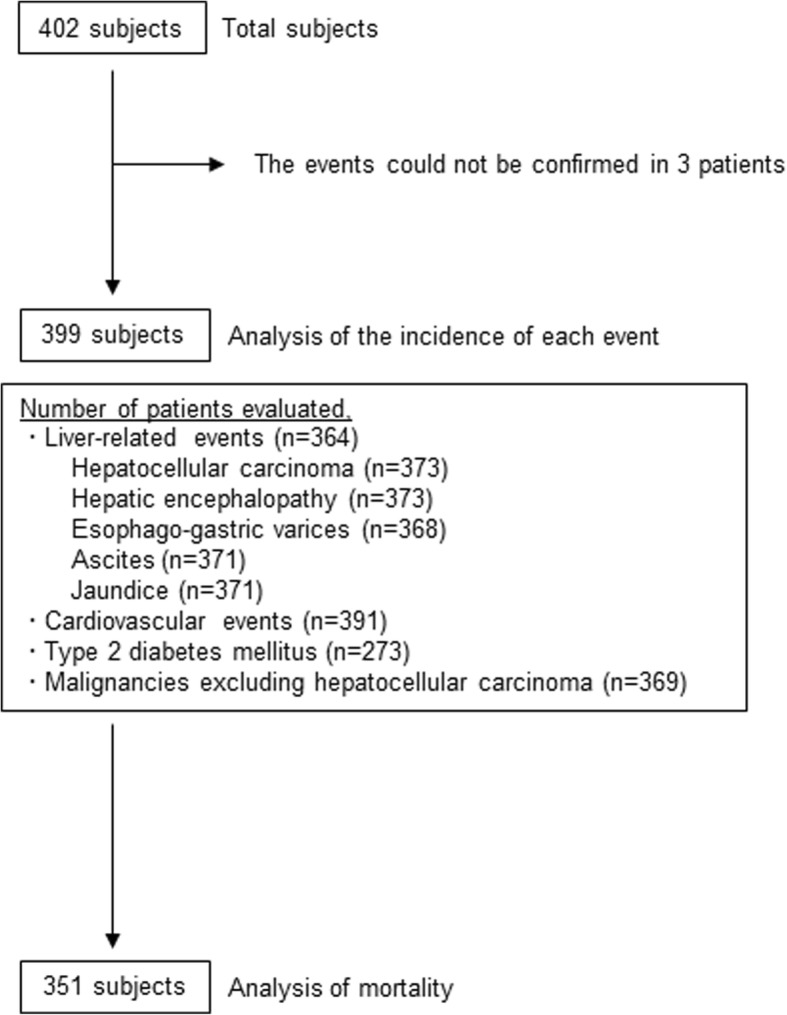
Methods: We retrospectively investigated the incidence of liver events, cardiovascular events, malignancy, and type 2 diabetes mellitus in 402 Japanese patients with histopathologically confirmed NAFLD for a median follow-up of 4.2 years. We also investigated predictors of the development of hepatocellular carcinoma and type 2 diabetes mellitus in these patients.
Results: The rate of liver-related events per 1000 person years was 4.17 (hepatocellular carcinoma, 3.67; hepatic encephalopathy, 1.60; esophago-gastric varices, 2.43; ascites, 0.80; and jaundice, 0.40). The rate of cardiovascular events and type 2 diabetes mellitus was 5.73 and 9.95, respectively. Overall mortality was 3.33 (liver-related events, 1.25; cardiovascular events, 0.42; and malignancies other than hepatocellular carcinoma, 0.83), in patients free of previous or current malignancies. Multivariate analyses identified old age (≥70 years) and advanced fibrosis stage 4 as significant determinants of hepatocellular carcinoma development, and hepatocyte steatosis (> 33%), female sex, and serum ferritin (≤80 μg/l) as significant determinants of type 2 diabetes mellitus development in these patients.
Conclusions: Our results highlighted the importance of cardiovascular and liver-related events in Japanese patients with histopathologically-confirmed NAFLD. Hepatocellular carcinoma was the most common liver-related event, and the incidence of hepatocellular carcinoma was more than half of that of cardiovascular events.
Keywords: Cardiovascular events; Fibrosis stage; Hepatocellular carcinoma; Hepatocyte steatosis; Liver-related events; Malignancy; Mortality; Nonalcoholic fatty liver disease; Nonalcoholic steatohepatitis; Type 2 diabetes mellitus.
Conflict of interest statement
Ethics approval and consent to participate
The study was conducted in compliance with the International Conference on Harmonization guidelines for Good Clinical Practice (E6) and the 2013 Declaration of Helsinki. The protocol was approved by the institutional review board at Toranomon Hospital (number; 953). Written informed consent was provided by all patients prior to liver biopsy.
Consent for publication
Not Applicable.
Competing interests
(1) Hiromitsu Kumada has received honoraria from MSD K.K., Bristol-Myers Squibb, Gilead Sciences, AbbVie Inc., and Dainippon Sumitomo Pharma. (2) Norio Akuta has received an honorarium from Bristol-Myers Squibb and AbbVie Inc. (3) Yoshiyuki Suzuki has received an honorarium from Bristol-Myers Squibb and AbbVie Inc. All other authors declare no conflict of interest.
Publisher’s Note
Springer Nature remains neutral with regard to jurisdictional claims in published maps and institutional affiliations.
Figures
References
MeSH terms
Grants and funding
LinkOut - more resources
Full Text Sources
Medical
