


Clinical utility of tumor genomic profiling in patients with high plasma circulating tumor DNA burden or metabolically active tumors
- PMID: 30400986
- PMCID: PMC6219073
- DOI: 10.1186/s13045-018-0671-8
Clinical utility of tumor genomic profiling in patients with high plasma circulating tumor DNA burden or metabolically active tumors
Abstract
Background: This retrospective study was undertaken to determine if the plasma circulating tumor DNA (ctDNA) level and tumor biological features in patients with advanced solid tumors affected the detection of genomic alterations (GAs) by a plasma ctDNA assay.
Method: Cell-free DNA (cfDNA) extracted from frozen plasma (N = 35) or fresh whole blood (N = 90) samples were subjected to a 62-gene hybrid capture-based next-generation sequencing assay FoundationACT. Concordance was analyzed for 51 matched FoundationACT and FoundationOne (tissue) cases. The maximum somatic allele frequency (MSAF) was used to estimate the amount of tumor fraction of cfDNA in each sample. The detection of GAs was correlated with the amount of cfDNA, MSAF, total tumor anatomic burden (dimensional sum), and total tumor metabolic burden (SUVmax sum) of the largest ten tumor lesions on PET/CT scans.
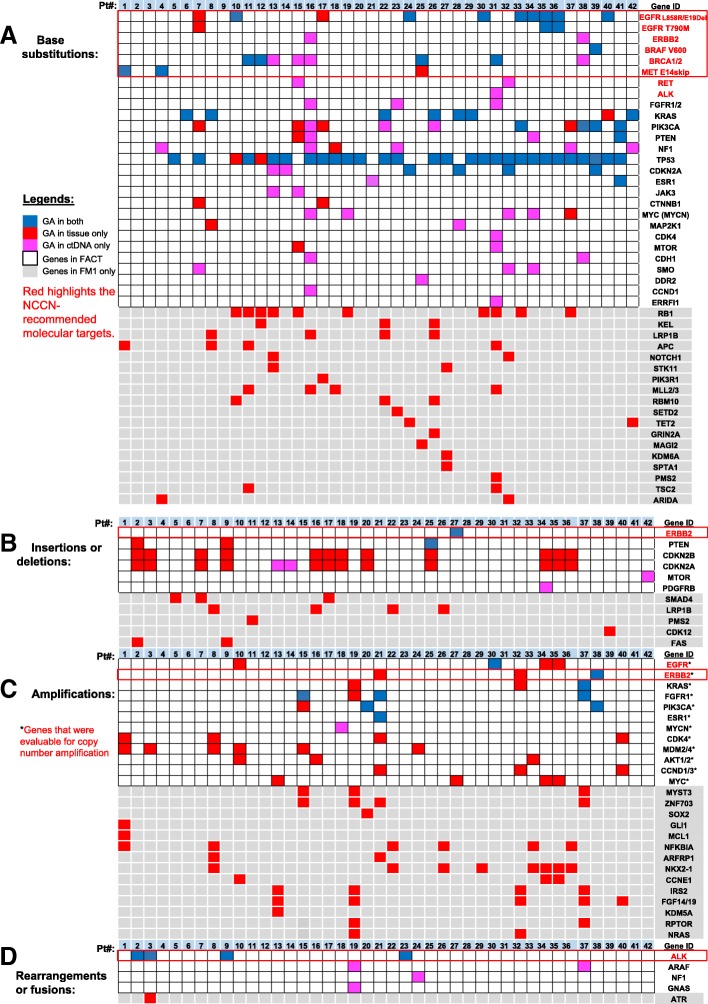
Results: FoundationACT detected GAs in 69 of 81 (85%) cases with MSAF > 0. Forty-two of 51 (82%) cases had ≥ 1 concordance GAs matched with FoundationOne, and 22 (52%) matched to the National Comprehensive Cancer Network (NCCN)-recommended molecular targets. FoundationACT also detected 8 unique molecular targets, which changed the therapy in 7 (88%) patients who did not have tumor rebiopsy or sufficient tumor DNA for genomic profiling assay. In all samples (N = 81), GAs were detected in plasma cfDNA from cancer patients with high MSAF quantity (P = 0.0006) or high tumor metabolic burden (P = 0.0006) regardless of cfDNA quantity (P = 0.2362).
Conclusion: This study supports the utility of using plasma-based genomic assays in cancer patients with high plasma MSAF level or high tumor metabolic burden.
Trial registration: ClinicalTrials.gov NCT02620527.
Keywords: Cell-free DNA (cfDNA); Circulating tumor DNA (ctDNA); Genomic alterations (GAs); Maximum somatic allele frequency (MSAF); Maximum standardized uptake value (SUVmax); Next-generation sequencing (NGS); Plasma; Positron emission tomography (PET) scan.
Conflict of interest statement
Ethics approval and consent to participate
The study was approved by the institutional review board (IRB) at the University of California, Davis (IRB ID: 937274).
Consent for publication
Not applicable
Competing interests
Jeffrey P. Gregg: Foundation Medicine (H), AstraZeneca (H), AstraZeneca (SAB), and BMS (C/A). Tianhong Li: NCI (RF), Pfizer (RF), Foundation Medicine (C/A), Takada (C/A), and Puma (C/A). Michael Molmen: Foundation Medicine (E, OI); Travis A. Clark: Foundation Medicine (E, OI); Dean Pavlick: Foundation Medicine (E, OI); Brady Forcier: Foundation Medicine (E, OI); Garret M. Frampton: Foundation Medicine (E, OI, IP); Matthew Cooke Foundation Medicine (E, OI); Siraj M. Ali Foundation Medicine (E, OI); Vincent A. Miller: Foundation Medicine (E, OI); Philip J. Stephens: Foundation Medicine (E, OI, IP).
(C/A) Consulting/advisory relationship; (RF) Research funding; (E) Employment; (ET) Expert testimony; (H) Honoraria received; (OI) Ownership interests; (IP) Intellectual property rights/ inventor/patent holder; (SAB) Scientific advisory board.
Publisher’s Note
Springer Nature remains neutral with regard to jurisdictional claims in published maps and institutional affiliations.
Figures


References
-
- Kalemkerian Gregory P., Narula Navneet, Kennedy Erin B., Biermann William A., Donington Jessica, Leighl Natasha B., Lew Madelyn, Pantelas James, Ramalingam Suresh S., Reck Martin, Saqi Anjali, Simoff Michael, Singh Navneet, Sundaram Baskaran. Molecular Testing Guideline for the Selection of Patients With Lung Cancer for Treatment With Targeted Tyrosine Kinase Inhibitors: American Society of Clinical Oncology Endorsement of the College of American Pathologists/International Association for the Study of Lung Cancer/Association for Molecular Pathology Clinical Practice Guideline Update. Journal of Clinical Oncology. 2018;36(9):911–919. doi: 10.1200/JCO.2017.76.7293. - DOI - PubMed
-
- Oncomine Dx Target Test FDA approval. 2017. https://www.accessdata.fda.gov/scripts/cdrh/cfdocs/cfpma/pma.cfm?id=P160045. Accessed 30 July 2018.
Publication types
MeSH terms
Substances
Associated data
Grants and funding
LinkOut - more resources
Full Text Sources
Other Literature Sources
Medical
