


Assessment of upper limb use in children with typical development and neurodevelopmental disorders by inertial sensors: a systematic review
- PMID: 30400992
- PMCID: PMC6219116
- DOI: 10.1186/s12984-018-0447-y
Assessment of upper limb use in children with typical development and neurodevelopmental disorders by inertial sensors: a systematic review
Abstract
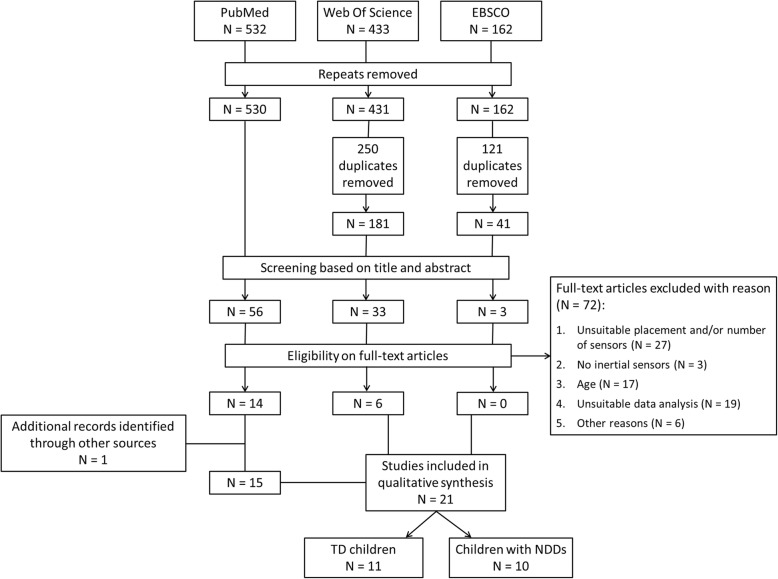
Understanding development of bimanual upper limb (UL) activities in both typical and atypical conditions in children is important for: i) tailoring rehabilitation programs, ii) monitoring progress, iii) determining outcomes and iv) evaluating effectiveness of treatment/rehabilitation. Recent technological advances, such as wearable sensors, offer possibilities to perform standard medical monitoring. Body-worn motion sensors, mainly accelerometers, have shown very promising results but, so far, these studies have mainly focused on adults. The main aim of this review was to report the evidence of UL activity of both typically developing (TD) children and children with neurodevelopmental disorders (NDDs) that are reliably reported and comparable, using a combination of multiple wearable inertial sensors, both in laboratory and natural settings. Articles were selected from three research databases (PubMed, Web of Science and EBSCO). Included studies reported data on children aged 0-20 years old simultaneously wearing at least two inertial sensors on upper extremities. The collected and reported data were relevant in order to describe the amount of physical activity performed by the two ULs separately. A total of 21 articles were selected: 11 including TD, and 10 regarding NDDs. For each article, a review of both clinical and technical data was performed. We considered inertial sensors used for following aims: (i) to establish activity intensity cut-points; (ii) to investigate validity and reliability of specified markers, placement and/or number of inertial sensors; (iii) to evaluate duration and intensity of natural UL movements, defined motor tasks and tremor; and (iv) to assess efficacy of certain rehabilitation protocols. Our conclusions were that inertial sensors are able to detect differences in use between both hands and that all reviewed studies support use of accelerometers as an objective outcome measure, appropriate in assessing UL activity in young children with NDDs and determining intervention effectiveness. Further research on responsiveness to interventions and consistency with use in real-world settings is needed. This information could be useful in planning UL rehabilitation strategies.
Keywords: Actigraphs; Asymmetry; Bimanual activity; Children; Hand dominance; Inertial sensor; Neurodevelopmental disorders; Typical development; Upper limb.
Conflict of interest statement
Ethics approval and consent to participate
Not applicable.
Consent for publication
Not applicable.
Competing interests
The authors declare that they have no competing interests.
Publisher’s Note
Springer Nature remains neutral with regard to jurisdictional claims in published maps and institutional affiliations.
Figures
References
-
- Duruöz MT, editor. Hand function: a practical guide to assessment. New York: Springer Science & Business Media; 2014.
-
- Cardwell M. Complete A-Z psychology hand book (3rd ed.) London: Hodder and Slottghoton; 2003.
Publication types
MeSH terms
LinkOut - more resources
Full Text Sources
Medical
