Review
. 2018 Dec;45(4):629-640.
doi: 10.1016/j.ogc.2018.07.005. Epub 2018 Oct 25.

Vasomotor Symptoms Across the Menopause Transition: Differences Among Women

Affiliations
Review

Vasomotor Symptoms Across the Menopause Transition: Differences Among Women

Nancy E Avis et al. Obstet Gynecol Clin North Am. 2018 Dec.

Abstract

Vasomotor symptoms (VMS) are the primary menopausal symptoms, occurring in up 80% of women and peaking around the final menstrual period. The average duration is 10 years, longer in women with an earlier onset. Compared with non-Hispanic white women, black and Hispanic women are more likely and Asian women are less likely to report VMS. Risk factors include greater body composition (in the early stage of menopausal transition), smoking, anxiety, depression, sensitivity to symptoms, premenstrual syndrome, lower education, and medical treatments, such as hysterectomy, oophorectomy, and breast cancer-related therapies. VMS patterns over time and within higher-risk subgroups are heterogeneous across women.

Keywords: Hot flashes; Menopause; Night sweats; Vasomotor symptoms.


Conflict of interest statement

There are no conflicts of interest to disclose.

Figures
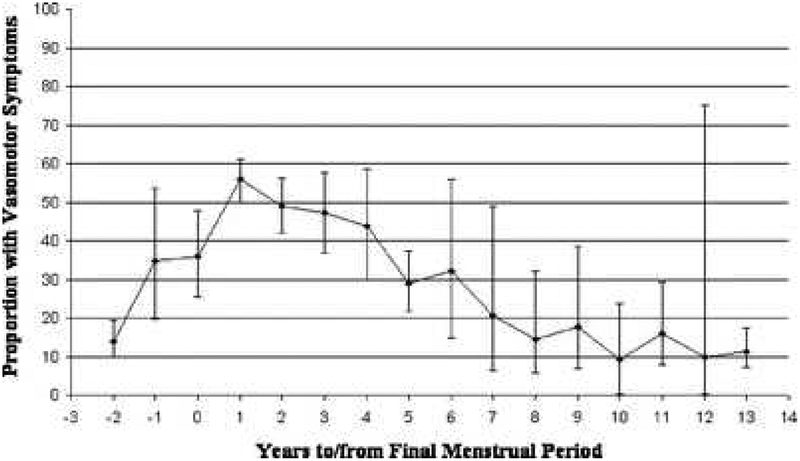
Figure 1:
Figure 1:
Pooled estimates from six studies of proportion of vasomotor symptoms by years to/from final menstrual period. One study was longitudinal, and five were cross-sectional. From Politi MC, Schleinitz MD, Col NF. Revisiting the duration of vasomotor symptoms of menopause: a meta-analysis. J Gen Intern Med 2008;23(9):1510; with permission.
Figure 2:
Figure 2:
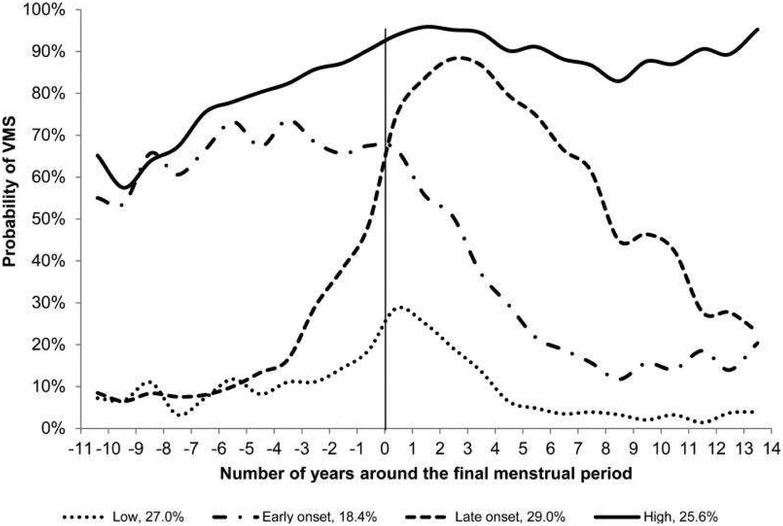
Trajectories of Vasomotor Symptoms over the Menopause Transition VMS indicates vasomotor symptoms. Probability of VMS represents the average observed probability of VMS at each time point within each trajectory subgroup. No factors were included in the model. From Tepper PG, Brooks MM, Randolph JF, et al. Characterizing the trajectories of vasomotor symptoms across the menopausal transition. Menopause 2016;23(10):1067–74; with permission.

References

    1. Avis NE, Ory M, Matthews KA, et al. Health-related quality of life in a multiethnic sample of middle-aged women: Study of Women’s Health Across the Nation (SWAN). Med Care 2003;41(11):1262–76. Doi: 10.1097/01.MLR.0000093479.39115.AF. - DOI - PubMed
    1. Avis NE, Colvin A, Bromberger JT, et al. Change in health-related quality of life over the menopausal transition in a multiethnic cohort of middle-aged women: Study of Women’s Health Across the Nation. Menopause 2009;16(5):860–9. Doi: 10.1097/gme.0b013e3181a3cdaf. - DOI - PMC - PubMed
    1. Blumel JE, Chedraui P, Baron G, et al. A large multinational study of vasomotor symptom prevalence, duration, and impact on quality of life in middle-aged women. Menopause 2011;18(7):778–85. Doi: 10.1097/gme.0b013e318207851d. - DOI - PubMed
    1. Williams RE, Levine KB, Kalilani L, et al. Menopause-specific questionnaire assessment in US population-based study shows negative impact on health-related quality of life. Maturitas 2009;62(2):153–9. Doi: 10.1016/j.maturitas.2008.12.006. - DOI - PubMed
    1. Woods NF, Mitchell ES. Symptoms during the perimenopause: prevalence, severity, trajectory, and significance in women’s lives. Am J Med 2005;118 Suppl 12B:14–24. Doi: 10.1016/j.amjmed.2005.09.031. - DOI - PubMed