


Genomic Surveillance of Enterococcus faecium Reveals Limited Sharing of Strains and Resistance Genes between Livestock and Humans in the United Kingdom
- PMID: 30401778
- PMCID: PMC6222123
- DOI: 10.1128/mBio.01780-18
Genomic Surveillance of Enterococcus faecium Reveals Limited Sharing of Strains and Resistance Genes between Livestock and Humans in the United Kingdom
Abstract
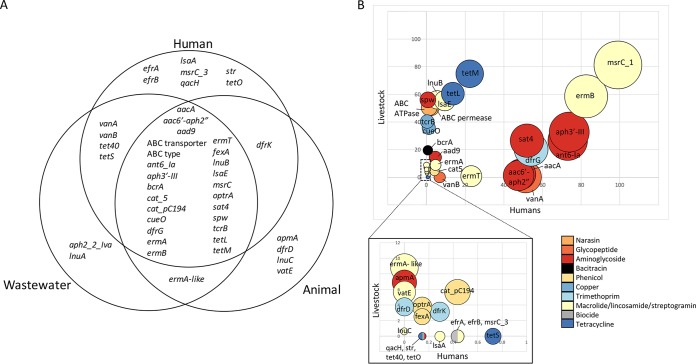
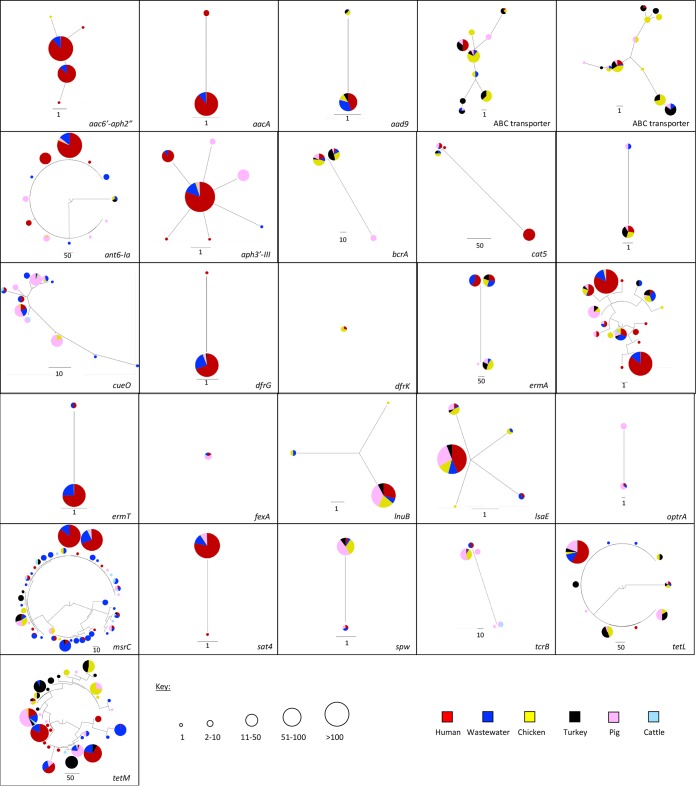
Vancomycin-resistant Enterococcus faecium (VREfm) is a major cause of nosocomial infection and is categorized as high priority by the World Health Organization global priority list of antibiotic-resistant bacteria. In the past, livestock have been proposed as a putative reservoir for drug-resistant E. faecium strains that infect humans, and isolates of the same lineage have been found in both reservoirs. We undertook cross-sectional surveys to isolate E. faecium (including VREfm) from livestock farms, retail meat, and wastewater treatment plants in the United Kingdom. More than 600 isolates from these sources were sequenced, and their relatedness and antibiotic resistance genes were compared with genomes of almost 800 E. faecium isolates from patients with bloodstream infection in the United Kingdom and Ireland. E. faecium was isolated from 28/29 farms; none of these isolates were VREfm, suggesting a decrease in VREfm prevalence since the last UK livestock survey in 2003. However, VREfm was isolated from 1% to 2% of retail meat products and was ubiquitous in wastewater treatment plants. Phylogenetic comparison demonstrated that the majority of human and livestock-related isolates were genetically distinct, although pig isolates from three farms were more genetically related to human isolates from 2001 to 2004 (minimum of 50 single-nucleotide polymorphisms [SNPs]). Analysis of accessory (variable) genes added further evidence for distinct niche adaptation. An analysis of acquired antibiotic resistance genes and their variants revealed limited sharing between humans and livestock. Our findings indicate that the majority of E. faecium strains infecting patients are largely distinct from those from livestock in this setting, with limited sharing of strains and resistance genes.IMPORTANCE The rise in rates of human infection caused by vancomycin-resistant Enterococcus faecium (VREfm) strains between 1988 to the 2000s in Europe was suggested to be associated with acquisition from livestock. As a result, the European Union banned the use of the glycopeptide drug avoparcin as a growth promoter in livestock feed. While some studies reported a decrease in VREfm in livestock, others reported no reduction. Here, we report the first livestock VREfm prevalence survey in the UK since 2003 and the first large-scale study using whole-genome sequencing to investigate the relationship between E. faecium strains in livestock and humans. We found a low prevalence of VREfm in retail meat and limited evidence for recent sharing of strains between livestock and humans with bloodstream infection. There was evidence for limited sharing of genes encoding antibiotic resistance between these reservoirs, a finding which requires further research.
Keywords: Enterococcus faecium; One Health; genome sequencing; livestock; vancomycin resistant; vancomycin-resistant.
Copyright © 2018 Gouliouris et al.
Figures
References
-
- Sievert DM, Ricks P, Edwards JR, Schneider A, Patel J, Srinivasan A, Kallen A, Limbago B, Fridkin S. 2013. Antimicrobial-resistant pathogens associated with healthcare-associated infections: summary of data reported to the National Healthcare Safety Network at the Centers for Disease Control and Prevention, 2009–2010. Infect Control Hosp Epidemiol 34:1–14. doi: 10.1086/668770. - DOI - PubMed
-
- Uttley AHC, Collins CH, Naidoo J, George RC. 1988. Vancomycin-resistant enterococci. Lancet 1:57–58. - PubMed
-
- Reacher MH, Shah A, Livermore DM, Wale MCJ, Graham C, Johnson AP, Heine H, Monnickendam MA, Barker KF, James D, George RC. 2000. Bacteraemia and antibiotic resistance of its pathogens reported in England and Wales between 1990 and 1998: trend analysis. Bmj 320:213–216. doi: 10.1136/bmj.320.7229.213. - DOI - PMC - PubMed
Publication types
MeSH terms
Substances
Grants and funding
LinkOut - more resources
Full Text Sources
Research Materials
Miscellaneous
