


Multilocus sequence typing of Candida albicans isolates from the oral cavities of patients undergoing haemodialysis
- PMID: 30401875
- PMCID: PMC6219599
- DOI: 10.1038/s41598-018-34565-7
Multilocus sequence typing of Candida albicans isolates from the oral cavities of patients undergoing haemodialysis
Abstract
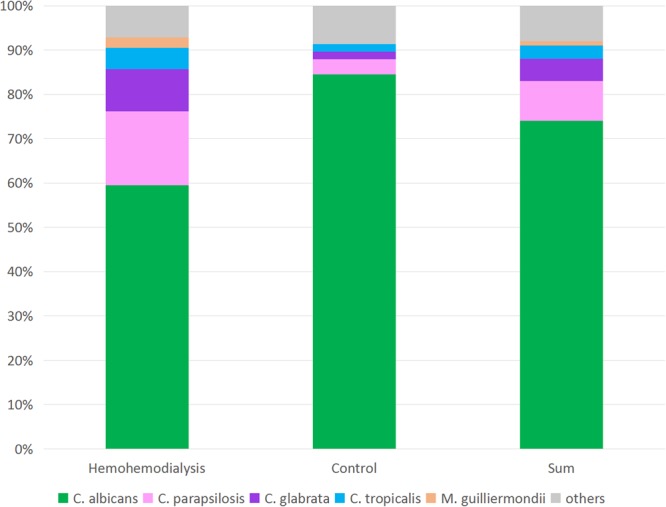
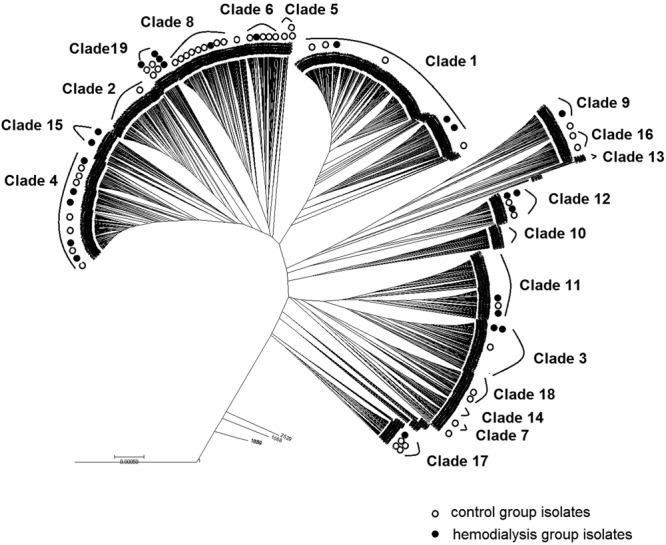
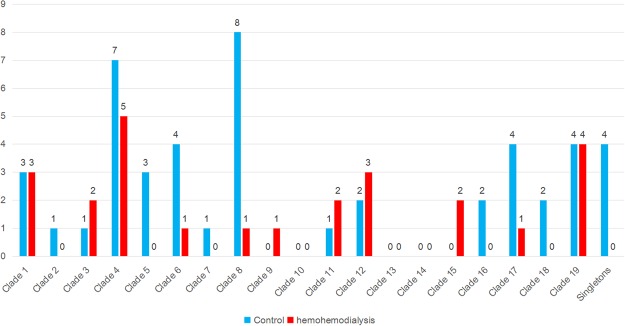
This study evaluates the prevalence, diversity, and genetic profiles of Candida albicans isolates recovered from the oral cavities of haemodialysis patients. Oral swab samples were obtained from haemodialysis patients (n = 126) and healthy control subjects (n = 233) and Candida species were characterised. There was no significant difference between the haemodialysis and control groups in the prevalence of yeast carriers (23.6% vs. 31.0%, respectively) or C. albicans carriers (19.8% vs. 21.0%, respectively). C. albicans was the most populous species in both cohorts, followed by C. parapsilosis. C. parapsilosis and C. glabrata were more prevalent in the haemodialysis group than in the control group (C. parapsilosis 5.6% vs. 0.9% and C. glabrata 3.2% vs. 0.4%, respectively; P < 0.05). C. albicans isolates were analysed by multilocus sequence typing and the results were used to construct a phylogenetic tree. Most haemodialysis isolates were placed into Clade 4 (20.0%) and Clade 19 (16.0%) and most control isolates into Clade 8 (17%) and Clade 4 (14.9%). Differences in the strain abundance in each clade were not statistically significant between the two groups. Moreover, there was no significant association between the health status or diagnosis and either the sequence types or clades.
Conflict of interest statement
The authors declare no competing interests.
Figures
Similar articles
-
Enrichment of multilocus sequence typing clade 1 with oral Candida albicans isolates in patients with untreated periodontitis.J Clin Microbiol. 2012 Oct;50(10):3335-44. doi: 10.1128/JCM.01532-12. Epub 2012 Aug 8. J Clin Microbiol. 2012. PMID: 22875886 Free PMC article.
-
Genotyping Candida albicans from Candida leukoplakia and non-Candida leukoplakia shows no enrichment of multilocus sequence typing clades but enrichment of ABC genotype C in Candida leukoplakia.PLoS One. 2013 Sep 18;8(9):e73738. doi: 10.1371/journal.pone.0073738. eCollection 2013. PLoS One. 2013. PMID: 24058485 Free PMC article.
-
Multilocus sequence typing for Candida albicans strains from the intestinal tract of patients with cirrhosis.Eur Rev Med Pharmacol Sci. 2018 Sep;22(18):6063-6071. doi: 10.26355/eurrev_201809_15944. Eur Rev Med Pharmacol Sci. 2018. PMID: 30280792
-
Oral mycology.Acta Odontol Scand. 1990 Feb;48(1):3-10. doi: 10.3109/00016359009012728. Acta Odontol Scand. 1990. PMID: 2181808 Review.
-
Multilocus sequence typing of Candida albicans: strategies, data exchange and applications.Infect Genet Evol. 2004 Sep;4(3):243-52. doi: 10.1016/j.meegid.2004.06.002. Infect Genet Evol. 2004. PMID: 15450203 Review.
Cited by
-
Molecular epidemiology of Candida albicans infections revealed dominant genotypes in waterfowls diagnosed with esophageal mycosis.Front Vet Sci. 2023 Jun 29;10:1215624. doi: 10.3389/fvets.2023.1215624. eCollection 2023. Front Vet Sci. 2023. PMID: 37456960 Free PMC article.
-
A Predominance of Clade 17 Candida albicans Isolated From Hemocultures in a Tertiary Care Hospital in Thailand.Front Microbiol. 2019 Jun 14;10:1194. doi: 10.3389/fmicb.2019.01194. eCollection 2019. Front Microbiol. 2019. PMID: 31258518 Free PMC article.
-
Prevalence, Molecular Identification, and Genotyping of Candida Species Recovered from Oral Cavity among Patients with Diabetes Mellitus from Tehran, Iran.Adv Biomed Res. 2022 Apr 29;11(1):29. doi: 10.4103/abr.abr_26_21. eCollection 2022. Adv Biomed Res. 2022. PMID: 35722454 Free PMC article.
-
Multilocus sequence typing of Candida albicans oral isolates reveals high genetic relatedness of mother-child dyads in early life.PLoS One. 2024 Jan 17;19(1):e0290938. doi: 10.1371/journal.pone.0290938. eCollection 2024. PLoS One. 2024. PMID: 38232064 Free PMC article.
-
Nakaseomyces glabratus (Candida glabrata) MLST Genotypes in Central Poland.Int J Mol Sci. 2025 May 6;26(9):4407. doi: 10.3390/ijms26094407. Int J Mol Sci. 2025. PMID: 40362646 Free PMC article.
References
Publication types
MeSH terms
LinkOut - more resources
Full Text Sources
Medical
