Review
. 2018 Oct 8:2018:2891957.
doi: 10.1155/2018/2891957. eCollection 2018.

The Mechanobiology of the Actin Cytoskeleton in Stem Cells during Differentiation and Interaction with Biomaterials

Affiliations
Review

The Mechanobiology of the Actin Cytoskeleton in Stem Cells during Differentiation and Interaction with Biomaterials

X Ambriz et al. Stem Cells Int. .

Abstract

An understanding of the cytoskeleton's importance in stem cells is essential for their manipulation and further clinical application. The cytoskeleton is crucial in stem cell biology and depends on physical and chemicals signals to define its structure. Additionally, cell culture conditions will be important in the proper maintenance of stemness, lineage commitment, and differentiation. This review focuses on the following areas: the role of the actin cytoskeleton of stem cells during differentiation, the significance of cellular morphology, signaling pathways involved in cytoskeletal rearrangement in stem cells, and the mechanobiology and mechanotransduction processes implicated in the interactions of stem cells with different surfaces of biomaterials, such as nanotopography, which is a physical cue influencing the differentiation of stem cells. Also, cancer stem cells are included since it is necessary to understand the role of their mechanical properties to develop new strategies to treat cancer. In this context, to study the stem cells requires integrated disciplines, including molecular and cellular biology, chemistry, physics, and immunology, as well as mechanobiology. Finally, since one of the purposes of studying stem cells is for their application in regenerative medicine, the deepest understanding is necessary in order to establish safety protocols and effective cell-based therapies.


Figures
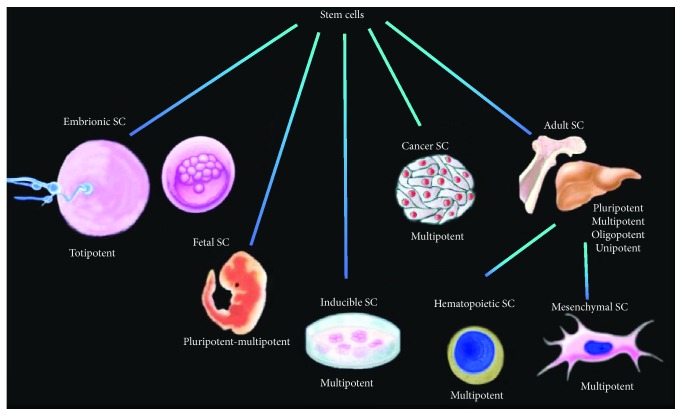
Figure 1
Figure 1
Kinds of stem cells and their differentiation potencies. Stem cells can be obtained from various tissues, with different potential properties (by Dr. Ambriz, 2018).
Figure 2
Figure 2
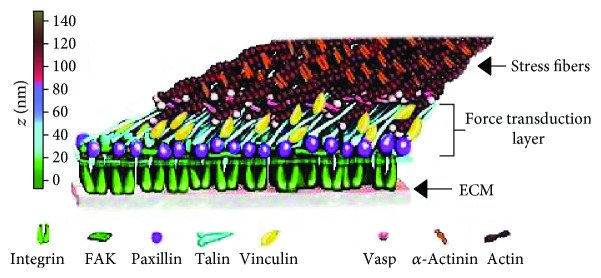
Molecular structure of contact adhesion. Different proteins are involved and are necessary for focal adhesion, like focal adhesion kinase (FAK), talin, vinculin, and paxilin, linking receptors with the cytoskeleton. Outside the membrane, adhesion receptors, like integrins and selectines link the membrane with the substrate (modified from P. Kanchanawong, copyright, 2010).
Figure 3
Figure 3
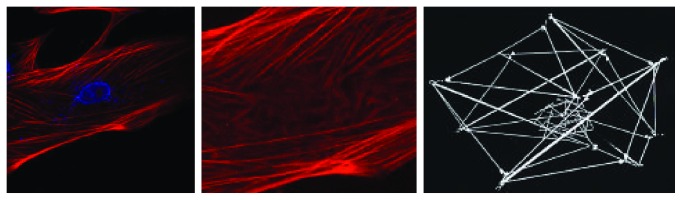
Actin networks of MSCs visualized by a confocal microscope. hMSCs transfected with β-actin-RFP (red) and stained with DAPI (blue) (by Dr. Ambriz, 2016). Actin networks resemble the same pattern from Ingber's model [47] in which tensed elastic strings and straws that are interconnected can predict the actomyosin complex behaviour. Actin filament orientation changes depending on its distance to the nucleus.
Figure 4
Figure 4
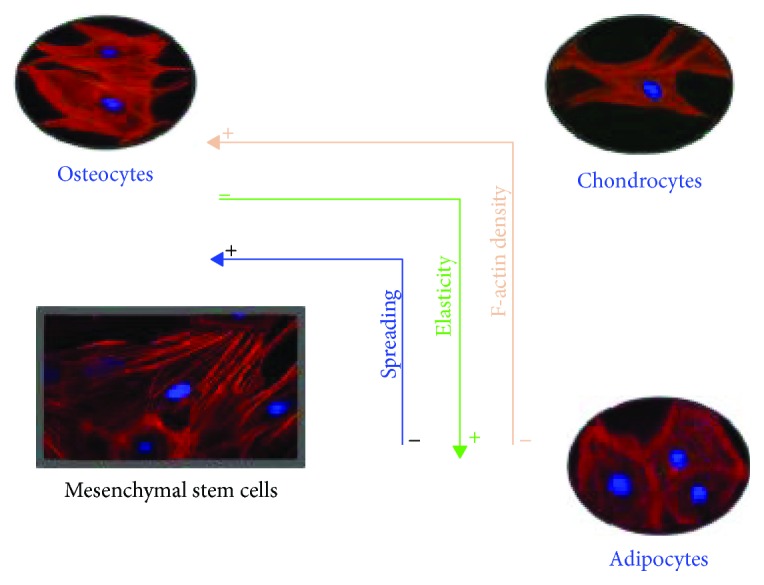
Actin cytoskeleton in stem cell differentiation. Cellular spreading (blue line), elasticity (green line), and F-actin density (orange line) are some of the properties that change during stem cell differentiation and can predict the cell's fate. Substrates with different mechanical characteristics influence the rearrangement of the F-actin cytoskeleton in the differentiation process modulating cellular spreading, elasticity, and F-actin. In the case of adipocytes, they have less F-actin and spreading but are more elastic compared to chondrocytes and osteocytes. On the other hand, osteocytes have the opposite context than adipocytes. They are less elastic but with higher F-actin and spreading. Chondrocytes display intermediate properties of adipocytes and osteocytes considering these three properties (by Dr. Ambriz, 2018).

References

    1. Thomson J. A., Itskovitz-Eldor J., Shapiro S. S., et al. Embryonic stem cell lines derived from human blastocysts. Science. 1998;282(5391):1145–1147. doi: 10.1126/science.282.5391.1145. - DOI - PubMed
    1. Ullah I., Subbarao R. B., Rho G. J. Human mesenchymal stem cells—current trends and future prospective. Bioscience Reports. 2015;35(2):1–18. doi: 10.1042/bsr20150025. - DOI - PMC - PubMed
    1. Takahashi K., Yamanaka S. Induction of pluripotent stem cells from mouse embryonic and adult fibroblast cultures by defined factors. Cell. 2006;126(4):663–676. doi: 10.1016/j.cell.2006.07.024. - DOI - PubMed
    1. Kim W.-T., Ryu C. J. Cancer stem cell surface markers on normal stem cells. BMB Reports. 2017;50(6):285–298. doi: 10.5483/BMBRep.2017.50.6.039. - DOI - PMC - PubMed
    1. Dominici M., Le Blanc K., Mueller I., et al. Minimal criteria for defining multipotent mesenchymal stromal cells. The International Society for Cellular Therapy position statement. Cytotherapy. 2006;8(4):315–317. doi: 10.1080/14653240600855905. - DOI - PubMed

LinkOut - more resources