Prevalence and Correlates of Benzodiazepine Use, Misuse, and Use Disorders Among Adults in the United States
- PMID: 30403446
- PMCID: PMC10309967
- DOI: 10.4088/JCP.18m12174
Prevalence and Correlates of Benzodiazepine Use, Misuse, and Use Disorders Among Adults in the United States
Abstract
Objective: Although benzodiazepine misuse and use disorders are associated with adverse health effects, it is unknown what proportion of benzodiazepine users misuse them or meet criteria for benzodiazepine use disorders. The goal of this study was to examine the prevalence and correlates of benzodiazepine use, misuse, and use disorders among US adults.
Methods: Data from 102,000 adults 18 years and older who participated in the 2015-2016 National Surveys on Drug Use and Health were used. IMS Health Total Patient Tracker data were also examined. Descriptive analyses and multinomial logistic regressions were applied.
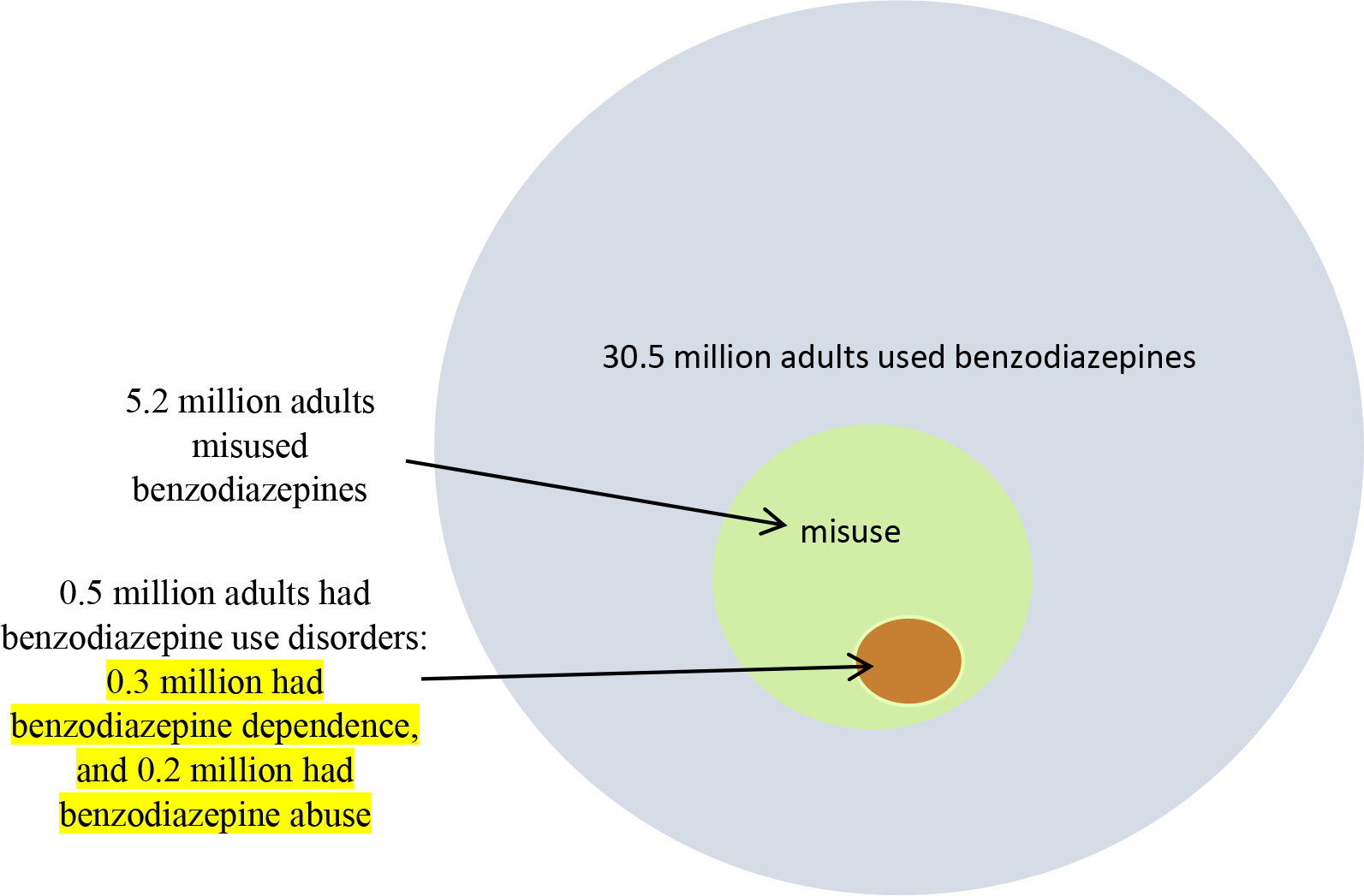
Results: Among US adults in 2015-2016, 12.5% (annual average, 95% CI, 12.19%-12.81%) used benzodiazepines, 2.1% (95% CI, 2.03%-2.25%) misused benzodiazepines at least once, and 0.2% (95% CI, 0.15%-0.22%) had benzodiazepine use disorders. Among benzodiazepine users, 17.1% (95% CI, 16.30%-17.93%) misused benzodiazepines, and 1.5% (95% CI, 1.26%-1.72%) had benzodiazepine use disorders. Benzodiazepine use was associated with emergency room visits, suicidal ideation, use of most substances, and mental disorders. Benzodiazepine misuse without use disorders was associated with younger age, male sex, being black, poor educational attainment, being uninsured and unemployed, being single, having family income below $50,000, and having suicidal ideation and other specific substance use problems. Correlates of benzodiazepine use disorders were similar, but most correlates were associated with benzodiazepine use disorders more strongly than with misuse without use disorders.
Conclusions: While benzodiazepine use is highly prevalent among US adults, benzodiazepine use disorders are relatively rare among benzodiazepine users. Our results help characterize benzodiazepine users and identify adults at risk for misuse and use disorders.
© Copyright 2018 Physicians Postgraduate Press, Inc.
Conflict of interest statement
Figures
References
-
- Olfson M, King M, Schoenbaum M. Benzodiazepine Use in the United States. Jama Psychiatry 2015. Feb;72(2):136–142. - PubMed
-
- Alessi-Severini S, Bolton JM, Enns MW, et al. Sustained use of benzodiazepine and escalation to high doses in a Canadian population. Psychiatric Services 2016;67(9):1012–1018. - PubMed
-
- Blanco C, Goodwin RD, Liebowitz MR, Schmidt AB, Lewis-Fernández R, Olfson M. Use of psychotropic medications for patients with office visits who receive a diagnosis of panic disorder. Medical Care 2004;42(2):1242–1246. - PubMed
-
- Martins S, Fenton M, Keyes K, Blanco C, Zhu H, Storr C. Mood and anxiety disorders and their association with non-medical prescription opioid use and prescription opioid-use disorder: longitudinal evidence from the National Epidemiologic Study on Alcohol and Related Conditions. Psychological Medicine 2012;42:1261–1272. - PMC - PubMed