


Accuracy of health administrative data to identify cases of reportable travel or migration-related infectious diseases in Ontario, Canada
- PMID: 30403758
- PMCID: PMC6221317
- DOI: 10.1371/journal.pone.0207030
Accuracy of health administrative data to identify cases of reportable travel or migration-related infectious diseases in Ontario, Canada
Abstract
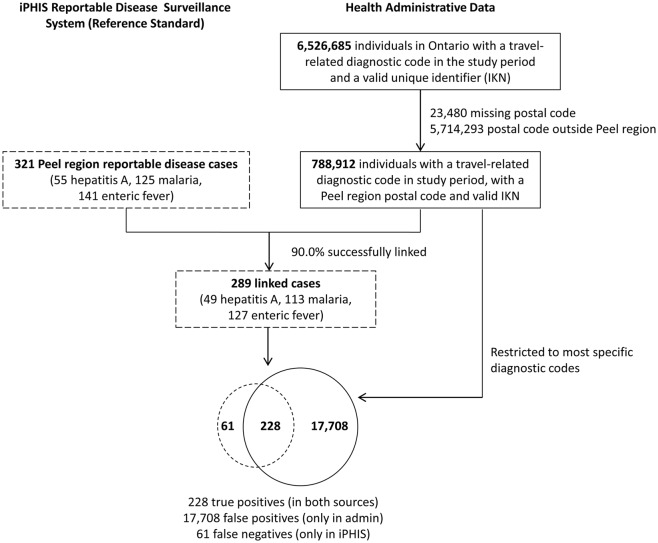
An ongoing challenge of estimating the burden of infectious diseases known to disproportionately affect migrants (e.g. malaria, enteric fever) is that many health information systems, including reportable disease surveillance systems, do not systematically collect data on migrant status and related factors. We explored whether health administrative data linked to immigration records offered a viable alternative for accurately identifying cases of hepatitis A, malaria and enteric fever in Ontario, Canada. Using linked health care databases generated by Ontario's universal health care program, we constructed a cohort of medically-attended individuals with presumed hepatitis A, malaria or enteric fever in Peel region using diagnostic codes. Immigrant status was ascertained using linked immigration data. The sensitivity and positive predictive value (PPV) of diagnostic codes was evaluated through probabilistic linkage of the cohort to Ontario's reportable disease surveillance system (iPHIS) as the reference standard. Linkage was successful in 90.0% (289/321) of iPHIS cases. While sensitivity was high for hepatitis A and enteric fever (85.8% and 83.7%) and moderate for malaria (69.0%), PPV was poor for all diseases (0.3-41.3%). The accuracy of diagnostic codes did not vary by immigrant status. A dated coding system for outpatient physician claims and exclusion of new immigrants not yet eligible for health care were key challenges to using health administrative data to identify cases. Despite this, we show that linkages of health administrative and immigration records with reportable disease surveillance data are feasible and have the potential to bridge important gaps in estimating burden using either data source independently. .
Conflict of interest statement
The authors have declared that no competing interests exist.
References
-
- Rechel B, Mladovsky P, Ingleby D, Mackenbach JP, McKee M. Migration and health in an increasingly diverse Europe. Lancet (London, England). 2013;381(9873):1235–45. - PubMed
-
- Committee to Advise on Tropical Medicine and Travel. Statement on international travellers who intend to visit friends and relatives. An advisory committee statement (ACS). Committee to Advise on Tropical Medicine and Travel (CATMAT) [Internet]. 2015 [cited 2017 Dec 14]:[46 p.]. https://www.canada.ca/content/dam/phac-aspc/migration/phac-aspc/tmp-pmv/....
-
- Horn M, Ratansi A, Varia M. Encouraging travellers to take preventive measures against travel-related communicable diseases: a rapid review of the literature, 2013 [cited 2017 Dec 12]. https://www.peelregion.ca/health/library/pdf/travellers-preventive-measu....
-
- Committee to Advise on Tropical Medicine and Travel. Statement on Hepatitis Vaccines for Travellers. CCDR. 2008;34(ACS-2). - PubMed
-
- Greenaway C, Schofield S, Henteleff A, Plourde P, Geduld J, Abdel-Motagally M, et al. Summary of the statement on international travellers and typhoid by the Committee to Advise on Tropical Medicine and Travel (CATMAT) CCDR. 2014;40(4).
Publication types
MeSH terms
Grants and funding
LinkOut - more resources
Full Text Sources
Medical
