. 2020 Jul 1;35(7):1195-1202.
doi: 10.1093/ndt/gfy333.

Impaired urinary concentration ability is a sensitive predictor of renal disease progression in Joubert syndrome

Affiliations

Impaired urinary concentration ability is a sensitive predictor of renal disease progression in Joubert syndrome

Sara Nuovo et al. Nephrol Dial Transplant. .

Abstract

Background: Joubert syndrome (JS) is an inherited ciliopathy characterized by a complex midbrain-hindbrain malformation and multiorgan involvement. Renal disease, mainly juvenile nephronophthisis (NPH), was reported in 25-30% patients although only ∼18% had a confirmed diagnosis of chronic kidney disease (CKD). NPH often remains asymptomatic for many years, resulting in delayed diagnosis. The aim of the study was to identify a biomarker able to quantify the risk of progressive CKD in young children with JS.

Methods: Renal features were investigated in 93 Italian patients, including biochemical tests, ultrasound and 1-deamino-8D-arginine vasopressin test in children with reduced basal urine osmolality. A subset of patients was followed-up over time.

Results: At last examination, 27 of 93 subjects (29%) presented with CKD, ranging from isolated urinary concentration defect (UCD) to end-stage renal disease. Both normal and pathological urine osmolality levels remained stable over time, even when obtained at very early ages. Follow-up data showed that the probability of developing CKD can be modelled as a function of the urine osmolality value, exceeding 75% for levels <600 mOsm/kg H2O, and significantly increased in patients with an early diagnosis of isolated UCD.

Conclusions: We conclude that the frequency of CKD in JS increases with age and is higher than previously reported. Urine osmolality represents an early sensitive quantitative biomarker of the risk of CKD progression.

Keywords: 1-deamino-8D-arginine vasopressin test; Joubert syndrome; early diagnosis; nephronophthisis; urine osmolality.


Figures

FIGURE 1
FIGURE 1
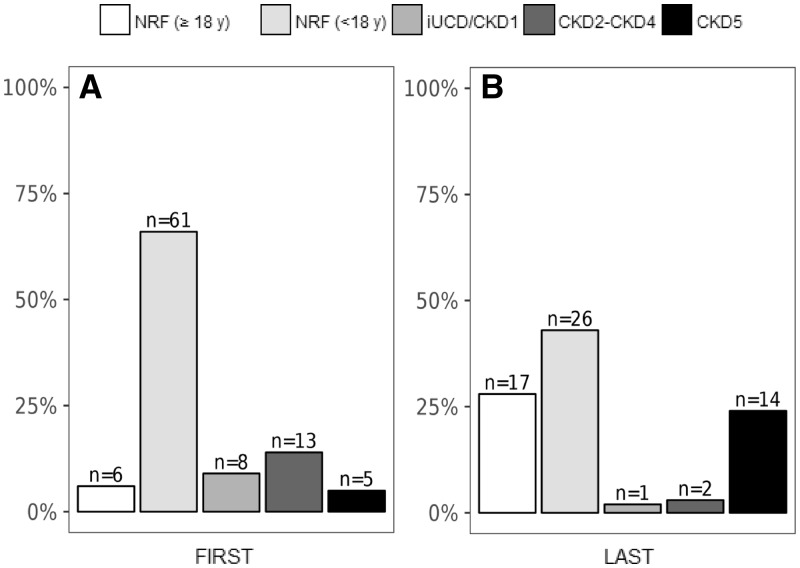
Assessment of renal function at first and last examination. Renal status of all 93 patients at first evaluation (A). Renal status of 60 patients with available follow-up data at last examination (B). NRF, normal renal function; iUCD/CKD1, iUCD with normal eGFR; CKD2–CKD4, CKD with mildly to severely decreased eGFR; CKD5, end-stage renal disease.
FIGURE 2
FIGURE 2
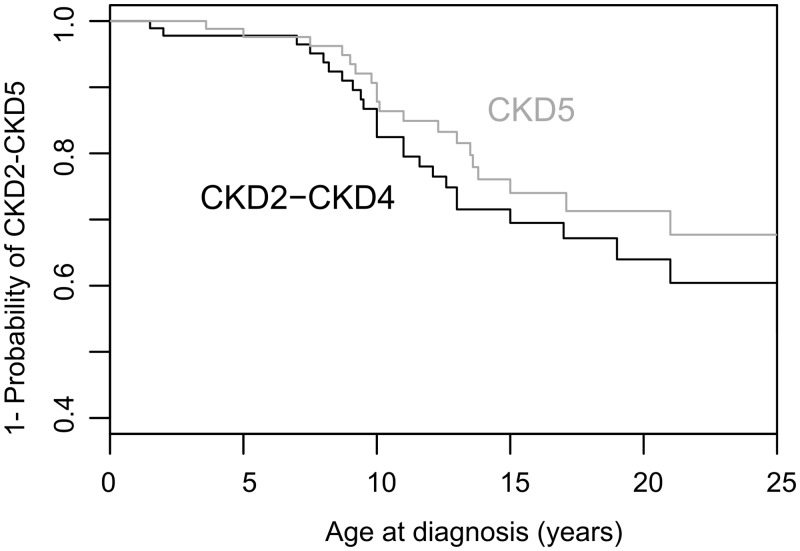
Survival analyses. Kaplan–Meyer curves representing the disease-free survival for CKD2–CKD4 and CKD5, respectively. The figure shows age at first diagnosis, which does not necessarily correspond to the actual age at onset. CKD2–CKD4, CKD with mildly to severely decreased eGFR; CKD5, end-stage renal disease.
FIGURE 3
FIGURE 3
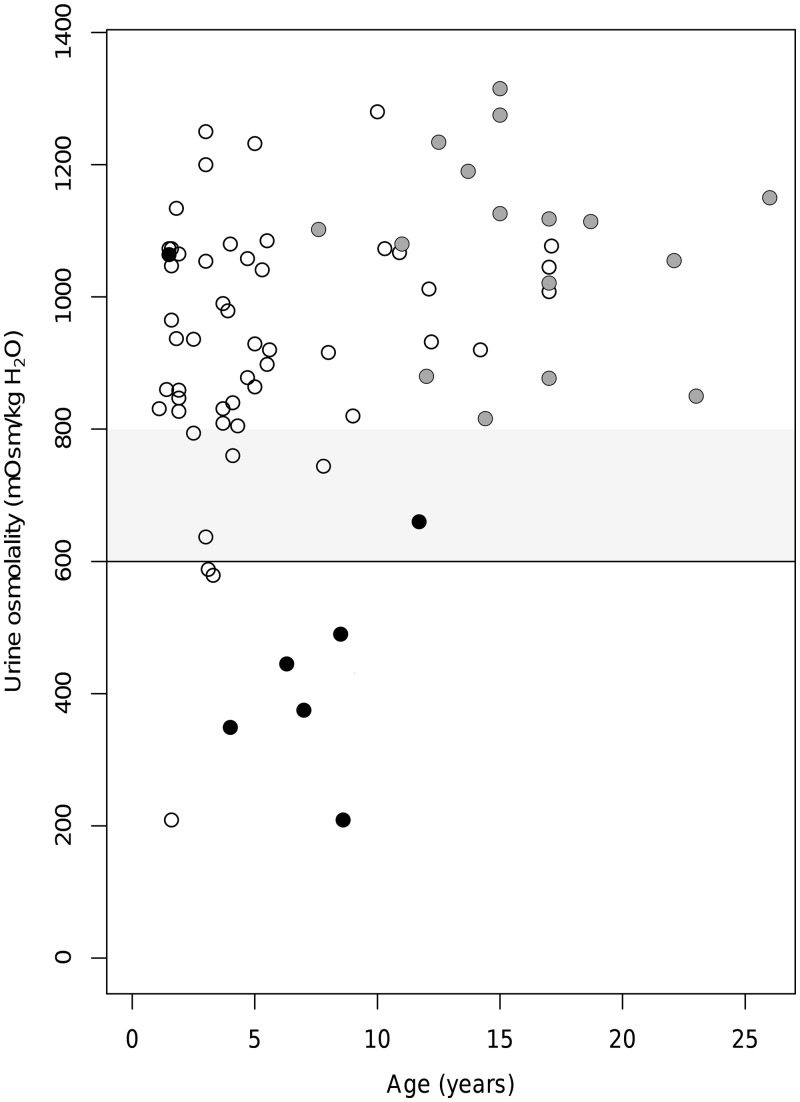
Assessment of urine osmolality and evolution of renal function. For each patient, urine osmolality at first examination was plotted against age. Normality values are set at or >600 mOsm/kg H2O (black line). The grey zone between 600 and 800 mOsm/kg H2O defines borderline values. Only subjects with normal eGFR at first examination were included. Grey circles represent patients with NRF who were ≥18 years at time of last examination. Black circles represent patients with normal, borderline or abnormal urinary osmolality at first examination who later developed overt renal insufficiency with abnormal eGFR (CKD2–CKD5). White circles represent patients with NRF who were still <18 years at time of last examination.
FIGURE 4
FIGURE 4
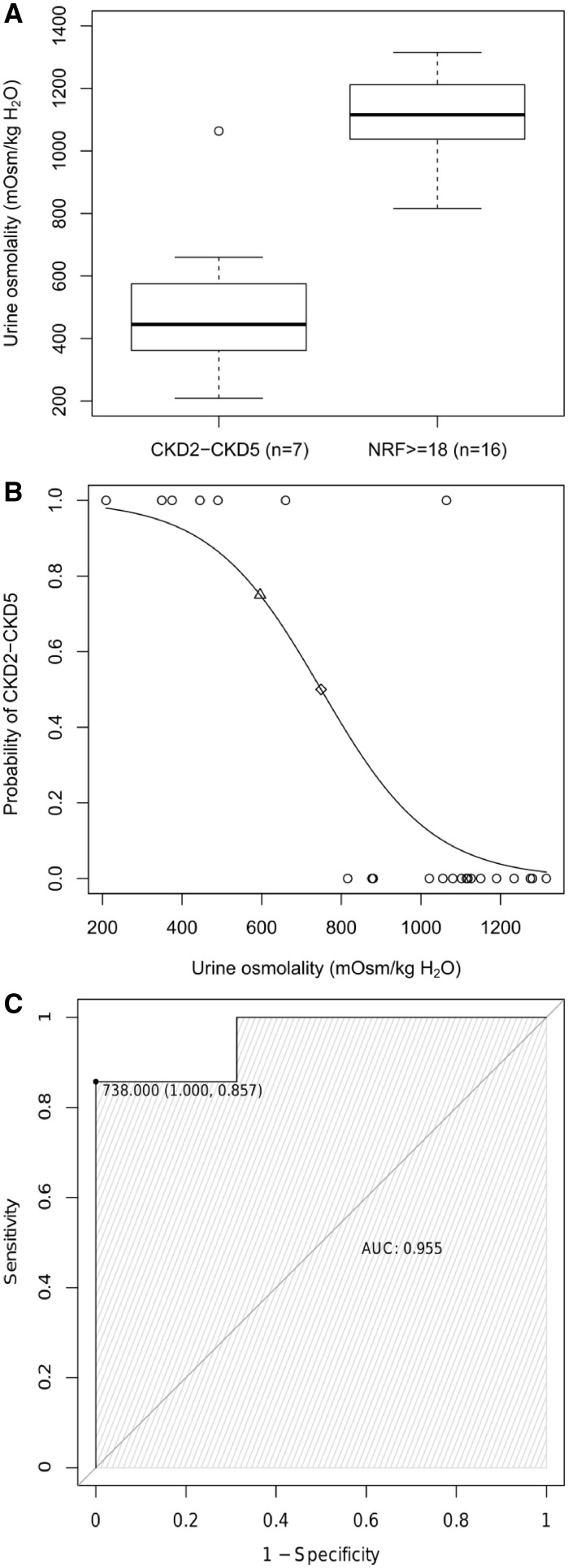
Predictive value of urinary osmolality. (A) Box and whisker plots of urine osmolality for patients with normal eGFR at first examination who at follow-up examination fell in the two following groups: NRF ≥ 18 (≥18 years with normal renal function); CKD2–CKD5. The central box represents the distance between the lower and the upper quartiles, the middle line is the median and the whiskers extend from the minimum to the maximum osmolality value, excluding outside and far out values, which are displayed as separate points. (B) Probability of developing adverse renal outcome (CKD2–CKD5) based on prediction from logistic regression model. Each circle represents a single patient. The risk is predicted to be >50% for urine osmolality values <749 mOsm/kg H2O (diamond) and >75% for urine osmolality values <596 mOsm/kg H2O (triangle). (C) ROC plot for urine osmolality comparing NRF ≥ 18 and CKD2–CKD5 groups. The area under is the curve is 0.96 (95% CI 0.86–1.00). The value of 738 mOsm/kg H2O is the best threshold for urine osmolality (defined as the value associated with minimum false-negative and false-positive rates). All figures refer to a subset of 23 patients with normal eGFR at the first examination, who either developed CKD2–CKD5 later or maintained normal NRF in adulthood.

References

    1. Romani M, Micalizzi A, Valente EM.. Joubert syndrome: congenital cerebellar ataxia with the molar tooth. Lancet Neurol 2013; 12: 894–905 - PMC - PubMed
    1. Mitchison HM, Valente EM.. Motile and non-motile cilia in human pathology: from function to phenotypes. J Pathol 2017; 241: 294–309 - PubMed
    1. Vilboux T, Malicdan MC, Roney JC. et al. CELSR2, encoding a planar cell polarity protein, is a putative gene in Joubert syndrome with cortical heterotopia, microophthalmia, and growth hormone deficiency. Am J Med Genet A 2017; 173: 661–666 - PMC - PubMed
    1. Stephen J, Vilboux T, Mian L. et al. Mutations in KIAA0753 cause Joubert syndrome associated with growth hormone deficiency. Hum Genet 2017; 136: 399–408 - PMC - PubMed
    1. Beck BB, Phillips JB, Bartram MP. et al. Mutation of POC1B in a severe syndromic retinal ciliopathy. Hum Mutat 2014; 35: 1153–1162 - PMC - PubMed

Publication types

MeSH terms

Supplementary concepts