


Effects of the Environmental Temperature on Aedes aegypti and Aedes albopictus Mosquitoes: A Review
- PMID: 30404142
- PMCID: PMC6316560
- DOI: 10.3390/insects9040158
Effects of the Environmental Temperature on Aedes aegypti and Aedes albopictus Mosquitoes: A Review
Abstract
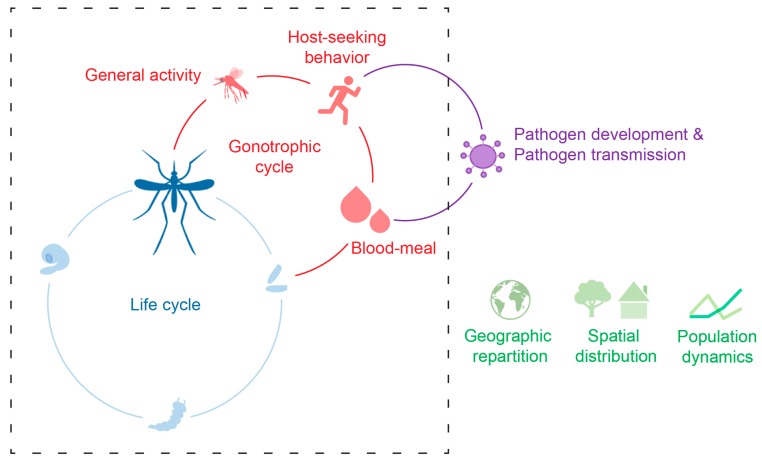
The temperature of the environment is one of the most important abiotic factors affecting the life of insects. As poikilotherms, their body temperature is not constant, and they rely on various strategies to minimize the risk of thermal stress. They have been thus able to colonize a large spectrum of habitats. Mosquitoes, such as Ae. aegypti and Ae. albopictus, vector many pathogens, including dengue, chikungunya, and Zika viruses. The spread of these diseases has become a major global health concern, and it is predicted that climate change will affect the mosquitoes' distribution, which will allow these insects to bring new pathogens to naïve populations. We synthesize here the current knowledge on the impact of temperature on the mosquito flight activity and host-seeking behavior (1); ecology and dispersion (2); as well as its potential effect on the pathogens themselves and how climate can affect the transmission of some of these pathogens (3).
Keywords: West Nile virus; Zika virus; blood-feeding; chikungunya virus; dengue virus complex; dispersion; gonotrophic cycle; pathogen transmission; thermotolerance; yellow fever virus.
Conflict of interest statement
The authors declare no conflict of interest.
Figures
References
-
- Denlinger D.L., Yocum G.D. Physiology of heat sensitivity. In: Hallman G.J., Denlinger D.L., editors. Temperature Sensitivity in Insects and Application in Integrated Pest Management. Westview Press; Boulder, CO, USA: Oxford, UK: 1998. pp. 7–53.
-
- Heinrich B. The Hot-Blooded Insects: Strategies and Mechanisms of Thermoregulation. Harvard University Press; Cambridge, MA, USA: 1993. p. 600.
-
- Huey R.B., Stevenson R.D. Integrating thermal physiology and ecology of ectotherms: A discussion of approaches. Am. Zool. 1979;19:357–366. doi: 10.1093/icb/19.1.357. - DOI
Publication types
LinkOut - more resources
Full Text Sources
Medical
Research Materials
