


Modeling of Protein Structural Flexibility and Large-Scale Dynamics: Coarse-Grained Simulations and Elastic Network Models
- PMID: 30404229
- PMCID: PMC6274762
- DOI: 10.3390/ijms19113496
Modeling of Protein Structural Flexibility and Large-Scale Dynamics: Coarse-Grained Simulations and Elastic Network Models
Abstract
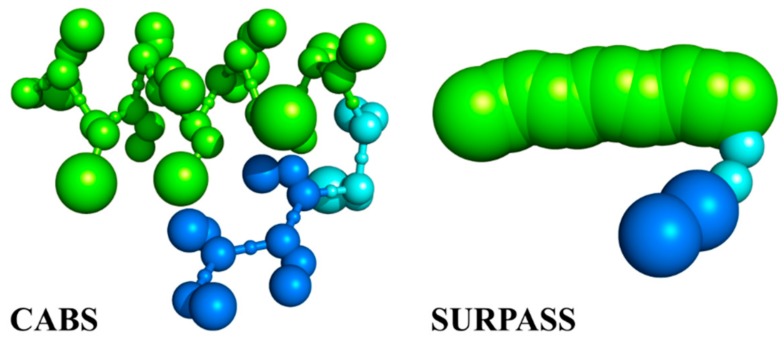
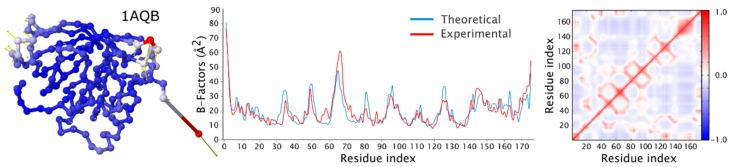
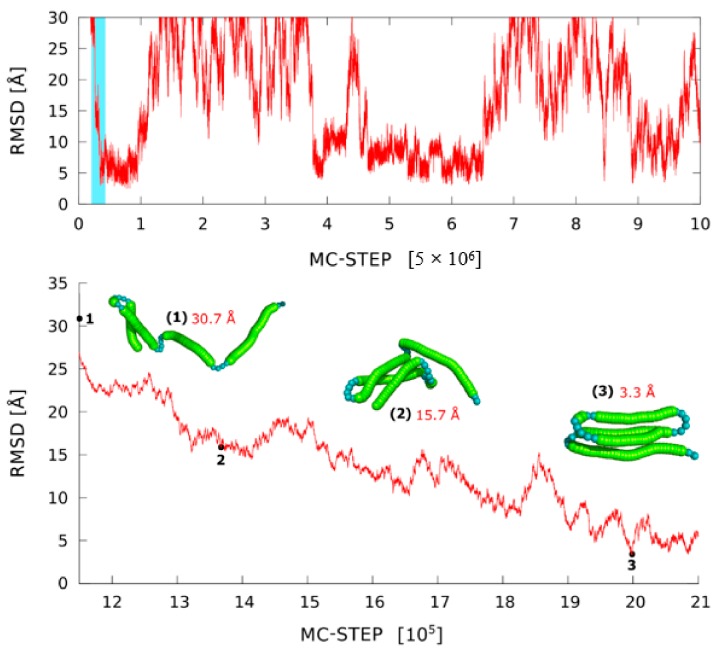
Fluctuations of protein three-dimensional structures and large-scale conformational transitions are crucial for the biological function of proteins and their complexes. Experimental studies of such phenomena remain very challenging and therefore molecular modeling can be a good alternative or a valuable supporting tool for the investigation of large molecular systems and long-time events. In this minireview, we present two alternative approaches to the coarse-grained (CG) modeling of dynamic properties of protein systems. We discuss two CG representations of polypeptide chains used for Monte Carlo dynamics simulations of protein local dynamics and conformational transitions, and highly simplified structure-based elastic network models of protein flexibility. In contrast to classical all-atom molecular dynamics, the modeling strategies discussed here allow the quite accurate modeling of much larger systems and longer-time dynamic phenomena. We briefly describe the main features of these models and outline some of their applications, including modeling of near-native structure fluctuations, sampling of large regions of the protein conformational space, or possible support for the structure prediction of large proteins and their complexes.
Keywords: Monte Carlo dynamics; coarse-grained simulation; elastic network model; large-scale dynamics; protein dynamics; structural flexibility.
Conflict of interest statement
The authors declare no conflict of interest.
Figures



Similar articles
-
Modeling Structural Dynamics of Biomolecular Complexes by Coarse-Grained Molecular Simulations.Acc Chem Res. 2015 Dec 15;48(12):3026-35. doi: 10.1021/acs.accounts.5b00338. Epub 2015 Nov 17. Acc Chem Res. 2015. PMID: 26575522 Review.
-
Coarse-Grained Protein Models and Their Applications.Chem Rev. 2016 Jul 27;116(14):7898-936. doi: 10.1021/acs.chemrev.6b00163. Epub 2016 Jun 22. Chem Rev. 2016. PMID: 27333362 Review.
-
SURPASS Low-Resolution Coarse-Grained Protein Modeling.J Chem Theory Comput. 2017 Nov 14;13(11):5766-5779. doi: 10.1021/acs.jctc.7b00642. Epub 2017 Oct 23. J Chem Theory Comput. 2017. PMID: 28992694
-
Protein-Protein Docking with Large-Scale Backbone Flexibility Using Coarse-Grained Monte-Carlo Simulations.Int J Mol Sci. 2021 Jul 8;22(14):7341. doi: 10.3390/ijms22147341. Int J Mol Sci. 2021. PMID: 34298961 Free PMC article.
-
Systematic methods for defining coarse-grained maps in large biomolecules.Adv Exp Med Biol. 2015;827:33-48. doi: 10.1007/978-94-017-9245-5_4. Adv Exp Med Biol. 2015. PMID: 25387958
Cited by
-
Allosteric Determinants of the SARS-CoV-2 Spike Protein Binding with Nanobodies: Examining Mechanisms of Mutational Escape and Sensitivity of the Omicron Variant.Int J Mol Sci. 2022 Feb 16;23(4):2172. doi: 10.3390/ijms23042172. Int J Mol Sci. 2022. PMID: 35216287 Free PMC article.
-
Establishing Computational Approaches Towards Identifying Malarial Allosteric Modulators: A Case Study of Plasmodium falciparum Hsp70s.Int J Mol Sci. 2019 Nov 8;20(22):5574. doi: 10.3390/ijms20225574. Int J Mol Sci. 2019. PMID: 31717270 Free PMC article.
-
Improvements and new functionalities of UNRES server for coarse-grained modeling of protein structure, dynamics, and interactions.Front Mol Biosci. 2022 Dec 14;9:1071428. doi: 10.3389/fmolb.2022.1071428. eCollection 2022. Front Mol Biosci. 2022. PMID: 36589235 Free PMC article.
-
Conformational flexibility of a free and TCR-bound pMHC-I protein investigated by long-term molecular dynamics simulations.BMC Immunol. 2022 Jul 29;23(Suppl 1):36. doi: 10.1186/s12865-022-00510-7. BMC Immunol. 2022. PMID: 35902791 Free PMC article.
-
Unveiling the Interplay between the TLR4/MD2 Complex and HSP70 in the Human Cardiovascular System: A Computational Approach.Int J Mol Sci. 2019 Jun 26;20(13):3121. doi: 10.3390/ijms20133121. Int J Mol Sci. 2019. PMID: 31247943 Free PMC article.
References
Publication types
MeSH terms
Substances
Grants and funding
LinkOut - more resources
Full Text Sources
