Review
. 2016 May 9;7(5):86.
doi: 10.3390/mi7050086.

Advances in Microfluidic Paper-Based Analytical Devices for Food and Water Analysis

Affiliations
Review

Advances in Microfluidic Paper-Based Analytical Devices for Food and Water Analysis

Lori Shayne Alamo Busa et al. Micromachines (Basel). .

Abstract

Food and water contamination cause safety and health concerns to both animals and humans. Conventional methods for monitoring food and water contamination are often laborious and require highly skilled technicians to perform the measurements, making the quest for developing simpler and cost-effective techniques for rapid monitoring incessant. Since the pioneering works of Whitesides' group from 2007, interest has been strong in the development and application of microfluidic paper-based analytical devices (μPADs) for food and water analysis, which allow easy, rapid and cost-effective point-of-need screening of the targets. This paper reviews recently reported μPADs that incorporate different detection methods such as colorimetric, electrochemical, fluorescence, chemiluminescence, and electrochemiluminescence techniques for food and water analysis.

Keywords: food analysis; point-of-need; water analysis; μPADs.


Conflict of interest statement

The authors declare no conflict of interest.

Figures
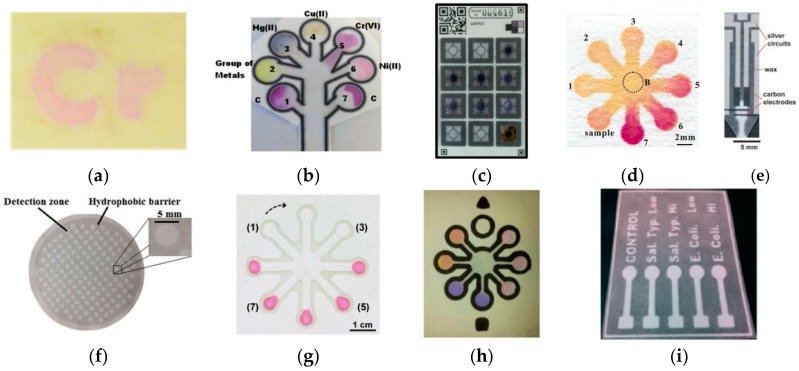
Figure 1
Figure 1
Examples of μPADs fabricated using different methods and paper substrates: (a) Wax patterning, WCP1. Reprinted with permission from reference [28]. Copyright 2015 American Chemical Society. (b) Wax printing, WP1. Reprinted with permission from reference [31]. Copyright 2011 American Chemical Society. (c) Wax printing, AP319. Reprinted with permission from reference [39]. Copyright 2015 American Chemical Society. (d) Alkylsilane self-assembling and UV/O3-patterning, WFP1. Reprinted with permission from reference [52]. Copyright 2013 American Chemical Society. (e) Wax printing with screen-printed electrodes, WCP1. Reprinted with permission from reference [38]. Copyright 2010 The Royal Society of Chemistry. (f) Polymer screen printing, WFP4. Reprinted with permission from reference [42]. Copyright 2016 The Royal Society of Chemistry. (g) Contact stamping, JPFP40. Reprinted with permission from reference [44]. Copyright 2015 The Royal Society of Chemistry. (h) Contact stamping, WFP1. Reprinted with permission from reference [45]. Copyright 2014 American Chemical Society. (i) Photolithography, CP. Reprinted with permission from reference [46]. Copyright 2013 The Royal Society of Chemistry. WFP1, Whatman No. 1 filter paper; WCP1, Whatman No. chromatography paper; WP1, Whatman No. 1 paper; AP310, Ahlstrom 319 paper; WFP4, Whatman No. 4 filter paper; JPFP40, JProLab JP 40 filter paper; CP, chromatography paper.
Figure 2
Figure 2
Detection methods for pathogens. (a) An image of a single-channel μPAD and (b) the smartphone application for Salmonella detection on a multi-channel μPAD. Reprinted with permission from reference [46]. Copyright 2013 The Royal Society of Chemistry. (c) Schematic layout of the PDMS/paper hybrid μPAD system and illustration of the one-step multiplexed FL detection principle on the μPAD during aptamer adsorption (Step 1) and liberation (Step 2) from the GO surface and the restoration of the FL for detection in the presence of the target pathogen. Reprinted with permission from reference [60]. Copyright 2013 The Royal Society of Chemistry.
Figure 3
Figure 3
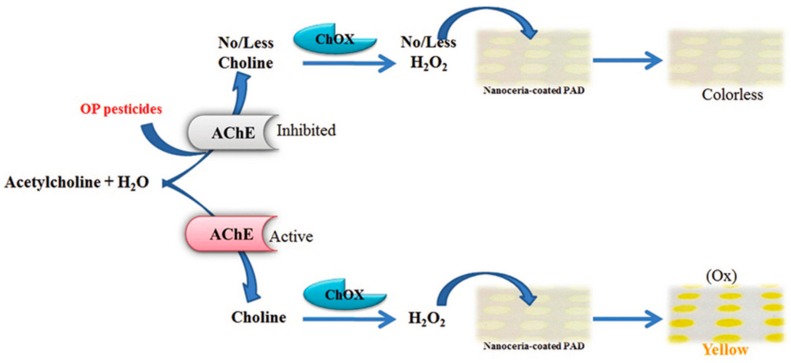
Colorimetric detection of pesticides based on the enzyme inhibition properties of the pesticide on nanoceria substrate. Reprinted with permission from reference [42]. Copyright 2016 The Royal Society of Chemistry.
Figure 4
Figure 4
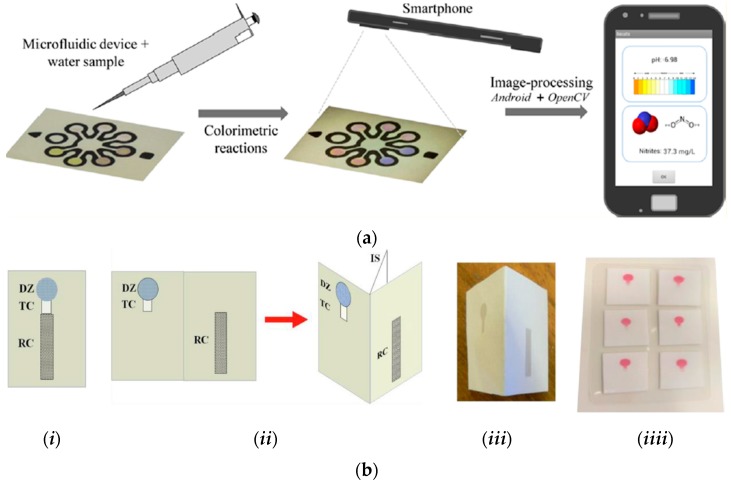
(a) Griess-color reaction assay-based detection methods for nitrite using a smartphone for image processing. Reprinted with permission from reference [45]. Copyright 2014 American Chemical Society. (b) Griess-color reaction assay-based detection methods for nitrite and nitrate using 2D (i) and 3D (ii–iv) μPADs. Reprinted with permission from reference [53]. Copyright 2014 American Chemical Society.
Figure 5
Figure 5
Detection methods for metals. (a) Electrochemical device for SWASV analysis of lead in water with screen-printed carbon working and counter electrodes and Ag/AgCl pseudo-reference electrode. Reprinted with permission from reference [47]. Copyright 2009 The Royal Society of Chemistry. (b) Multiplexed colorimetric detection of metals based on B-GAL and CPRG interaction in the presence of Hg2+, Cu2+, Cr6+ and Ni2+ mixture. Reprinted with permission from reference [31]. Copyright 2011 American Chemical Society.
Figure 6
Figure 6
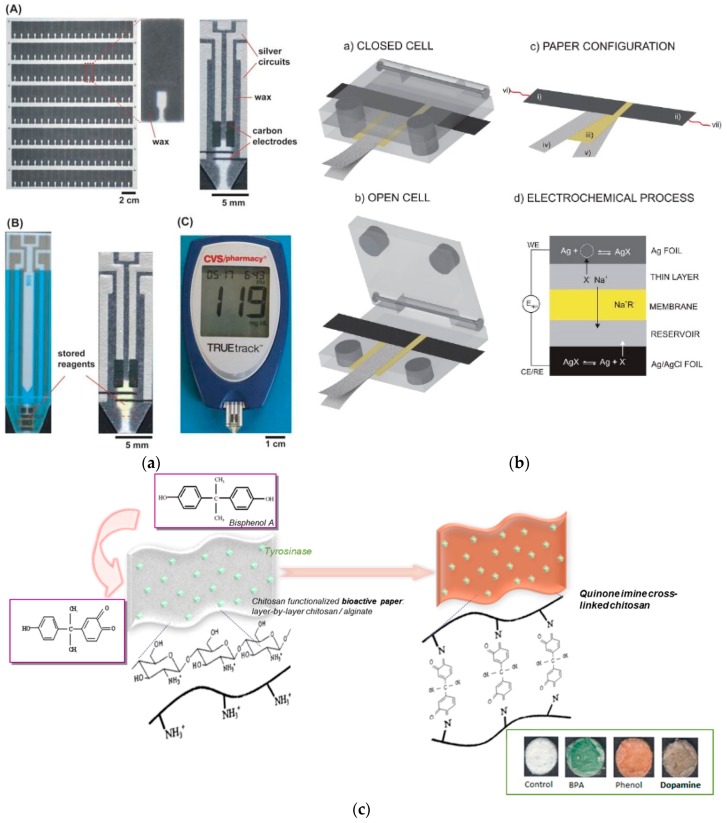
Detection methods for other food and water contaminants. (a) Components of the electrochemical detection system for ethanol using a glucometer as a readout device. Reprinted with permission from reference [38]. Copyright 2010 The Royal Society of Chemistry. (b) The configuration of the electrochemical cell for the analysis of halides utilizing silver components as electrodes on paper-assisted electrochemical detection. Reprinted with permission from reference [56]. Copyright 2015 American Chemical Society. (c) A representative paper-based colorimetric bioassay of BSA based on the enzymatically generated quinone from tyrosinase and chitosan interaction in the presence of the phenolic compound. Reprinted with permission from ref [59]. Copyright 2012 American Chemical Society.

References

    1. Hamburg M.A. Advancing regulatory science. Science. 2011;331:987. doi: 10.1126/science.1204432. - DOI - PubMed
    1. Escarpa A. Lights and shadows on food microfluidics. Lab Chip. 2014;14:3213–3224. doi: 10.1039/C4LC00172A. - DOI - PubMed
    1. Jéquier E., Constant F. Water as an essential nutrient: The physiological basis of hydration. Eur. J. Clin. Nutr. 2010;64:115–123. doi: 10.1038/ejcn.2009.111. - DOI - PubMed
    1. Sasaki Y.F., Kawaguchi S., Kamaya A., Ohshita M., Kabasawa K., Iwama K., Taniguchi K., Tsuda S. The comet assay with 8 mouse organs: Results with 39 currently used food additives. Mutat. Res. Toxicol. Environ. Mutagen. 2002;519:103–119. doi: 10.1016/S1383-5718(02)00128-6. - DOI - PubMed
    1. International Agency for Research in Cancer (IARC) IARC Monographs on the Evaluation of the Carcinogenic Risk of Chemicals to Humans: Some Food Additives, Feed Additives and Naturally Occurring Substances. Volume 31. World Health Organization; Lyon, France: 1983. 2-(2-Furyl)-3-(5-nitro-2-fyryl)acrylamide (AF-2) p. 41.

LinkOut - more resources