


Research prioritisation exercises related to the care of children and young people with life-limiting conditions, their parents and all those who care for them: A systematic scoping review
- PMID: 30404588
- PMCID: PMC6238162
- DOI: 10.1177/0269216318800172
Research prioritisation exercises related to the care of children and young people with life-limiting conditions, their parents and all those who care for them: A systematic scoping review
Abstract
Background: In planning high-quality research in any aspect of care for children and young people with life-limiting conditions, it is important to prioritise resources in the most appropriate areas.
Aim: To map research priorities identified from existing research prioritisation exercises relevant to infants, children and young people with life-limiting conditions, in order to inform future research.
Design: We undertook a systematic scoping review to identify existing research prioritisation exercises; the protocol is publicly available on the project website.
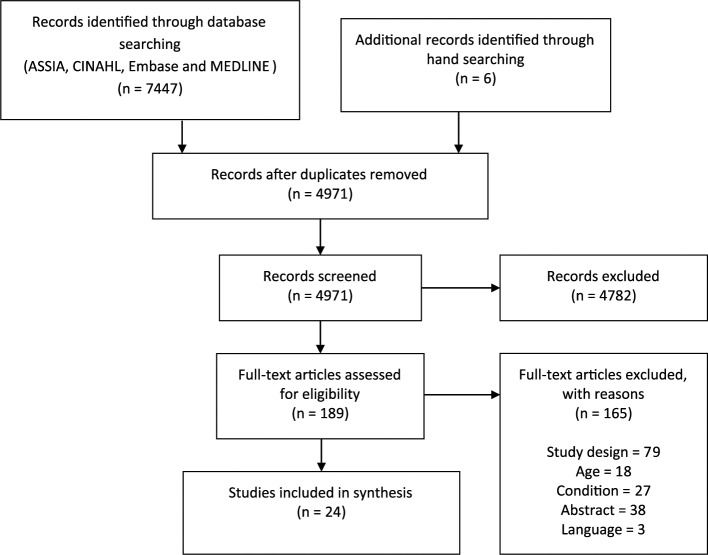
Data sources: The bibliographic databases ASSIA, CINAHL, MEDLINE/MEDLINE In Process and Embase were searched from 2000. Relevant reference lists and websites were hand searched. Included were any consultations aimed at identifying research for the benefit of neonates, infants, children and/or young people (birth to age 25 years) with life-limiting, life-threatening or life-shortening conditions; their family, parents, carers; and/or the professional staff caring for them.
Results: A total of 24 research prioritisation exercises met the inclusion criteria, from which 279 research questions or priority areas for health research were identified. The priorities were iteratively mapped onto an evolving framework, informed by World Health Organization classifications. This resulted in identification of 16 topic areas, 55 sub-topics and 12 sub-sub-topics.
Conclusion: There are numerous similar and overlapping research prioritisation exercises related to children and young people with life-limiting conditions. By mapping existing research priorities in the context in which they were set, we highlight areas to focus research efforts on. Further priority setting is not required at this time unless devoted to ascertaining families' perspectives.
Keywords: Delphi technique; adolescent; child; consensus; humans; infant; newborn; palliative care.
Conflict of interest statement
References
-
- Connor SR, Downing J, Marston J. Estimating the global need for palliative care for children: a cross-sectional analysis. J Pain Symptom Manag 2017; 53: 171–177. - PubMed
-
- Fraser LK, Miller M, Hain R, et al. Rising national prevalence of life-limiting conditions in children in England. Pediatrics 2012; 129: e923–e929. - PubMed
-
- Royal College of Paediatrics and Child Health. National paediatric diabetes audit. London: Royal College of Paediatrics and Child Health, 2014.
Publication types
MeSH terms
Grants and funding
LinkOut - more resources
Full Text Sources
Medical
Miscellaneous
