


Implementations of Virtual Reality for Anxiety-Related Disorders: Systematic Review
- PMID: 30404770
- PMCID: PMC6249506
- DOI: 10.2196/10965
Implementations of Virtual Reality for Anxiety-Related Disorders: Systematic Review
Abstract
Background: Although traditional forms of therapy for anxiety-related disorders (eg, cognitive behavioral therapy, CBT) have been effective, there have been long-standing issues with these therapies that largely center around the costs and risks associated with the components comprising the therapeutic process. To treat certain types of specific phobias, sessions may need to be held in public, therefore risking patient confidentiality and the occurrence of uncontrollable circumstances (eg, weather and bystander behavior) or additional expenses such as travel to reach a destination. To address these issues, past studies have implemented virtual reality (VR) technologies for virtual reality exposure therapy (VRET) to provide an immersive, interactive experience that can be conducted privately and inexpensively. The versatility of VR allows various environments and scenarios to be generated while giving therapists control over variables that would otherwise be impossible in a natural setting. Although the outcomes from these studies have been generally positive despite the limitations of legacy VR systems, it is necessary to review these studies to identify how modern VR systems can and should improve to treat disorders in which anxiety is a key symptom, including specific phobias, posttraumatic stress disorder and acute stress disorder, generalized anxiety disorder, and paranoid ideations.
Objective: The aim of this review was to establish the efficacy of VR-based treatment for anxiety-related disorders as well as to outline how modern VR systems need to address the shortcomings of legacy VR systems.
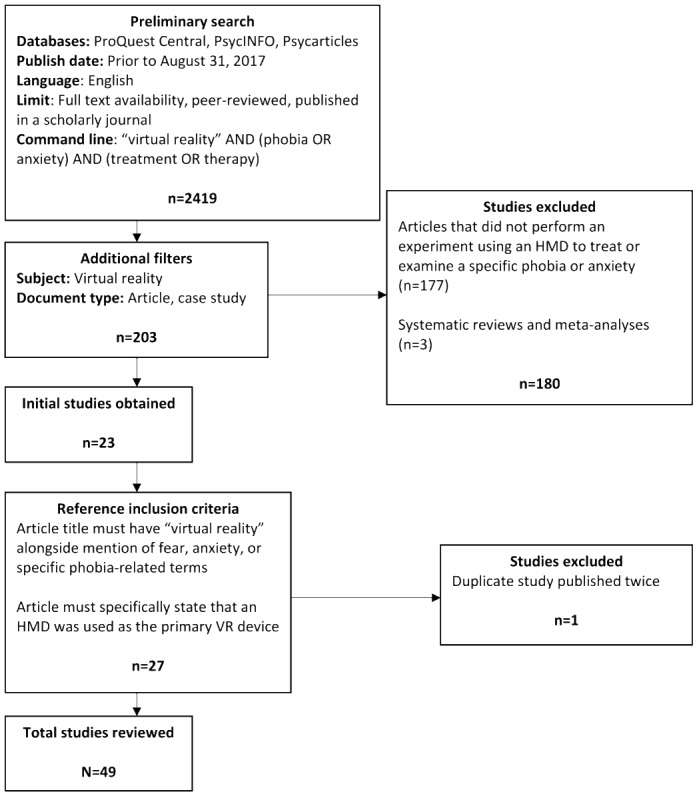
Methods: A systematic search was conducted for any VR-related, peer-reviewed articles focused on the treatment or assessment of anxiety-based disorders published before August 31, 2017, within the ProQuest Central, PsycINFO, and PsycARTICLES databases. References from these articles were also evaluated.
Results: A total of 49 studies met the inclusion criteria from an initial pool of 2419 studies. These studies were a mix of case studies focused solely on VRET, experimental studies comparing the efficacy of VRET with various forms of CBT (eg, in vivo exposure, imaginal exposure, and exposure group therapy), and studies evaluating the usefulness of VR technology as a diagnostic tool for paranoid ideations. The majority of studies reported positive findings in favor of VRET despite the VR technology's limitations.
Conclusions: Although past studies have demonstrated promising and emerging efficacy for the use of VR as a treatment and diagnostic tool for anxiety-related disorders, it is clear that VR technology as a whole needs to improve to provide a completely immersive and interactive experience that is capable of blurring the lines between the real and virtual world.
Keywords: anxiety disorders; phobic disorders; virtual reality; virtual reality exposure therapy.
©Theodore Oing, Julie Prescott. Originally published in JMIR Serious Games (http://games.jmir.org), 07.11.2018.
Conflict of interest statement
Conflicts of Interest: None declared.
Figures
References
-
- Mental Health Foundation . Fundamental Facts About Mental Health. London: Mental Health Foundation; 2016.
-
- López GC, Gómez AR, Figueroa RD, Baca XD. Virtual reality exposure for trauma and stress-related disorders for city violence crime victims. Int J Child Health Hum Dev. 2016;9(3):315–22. http://www.icdvrat.org/2014/papers/ICDVRAT2014_S03N2_Cardenas-Lopez_etal...
-
- Hoffman HG, Garcia-Palacios A, Carlin A, Furness TA, Botella-Arbona C. Interfaces that heal: coupling real and virtual objects to treat spider phobia. Int J Hum Comput Interact. 2003;16(2):283–300. doi: 10.1207/S15327590IJHC1602_08. - DOI
-
- Wrzesien M, Burkhardt JM, Alcañiz M, Botella C. How technology influences the therapeutic process: a comparative field evaluation of augmented reality and in vivo exposure therapy for phobia of small animals. IFIP TC 13 International Conference on Human-Computer Interaction; September 2011; Lisbon, Portugal. Springer; 2011. pp. 523–40. - DOI
Publication types
LinkOut - more resources
Full Text Sources
Medical
Miscellaneous
