Review
. 2018 Nov 7;9(11):580.
doi: 10.3390/mi9110580.

Recent Developments for Flexible Pressure Sensors: A Review

Affiliations
Review

Recent Developments for Flexible Pressure Sensors: A Review

Fenlan Xu et al. Micromachines (Basel). .

Abstract

Flexible pressure sensors are attracting great interest from researchers and are widely applied in various new electronic equipment because of their distinct characteristics with high flexibility, high sensitivity, and light weight; examples include electronic skin (E-skin) and wearable flexible sensing devices. This review summarizes the research progress of flexible pressure sensors, including three kinds of transduction mechanisms and their respective research developments, and applications in the fields of E-skin and wearable devices. Furthermore, the challenges and development trends of E-skin and wearable flexible sensors are also briefly discussed. Challenges of developing high extensibility, high sensitivity, and flexible multi-function equipment still exist at present. Exploring new sensing mechanisms, seeking new functional materials, and developing novel integration technology of flexible devices will be the key directions in the sensors field in future.

Keywords: e-skin; flexible pressure sensor; sensibility; transduction mechanism; wearable sensors.


Conflict of interest statement

The authors declare no conflict of interest. The funders had no role in the design of the study; in the collection, analyses, or interpretation of data; in the writing of the manuscript, or in the decision to publish the results.

Figures
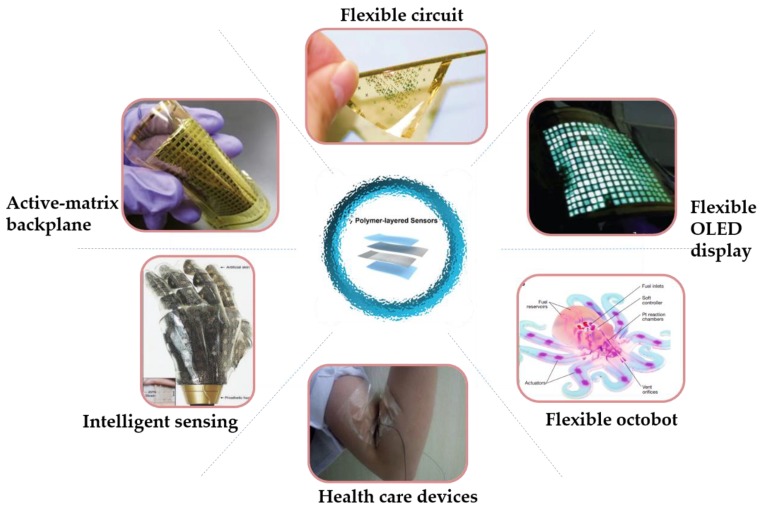
Figure 1
Figure 1
Characteristics and functions or applications of recently developed devices for flexible sensors. “Active-matrix backplane”, reproduced with permission [7]. Copyright 2010, Nature Materials. “Flexible circuit”, reproduced with permission [8]. Copyright 2010, Nature Materials. “Flexible display”, reproduced with permission [9]. Copyright 2013, Nature Materials. “Flexible octobot”, reproduced with permission [10]. Copyright 2016, Nature. “Human motion monitoring”, reproduced with permission [11]. Copyright 2017, ACS Applied Materials & Interfaces. “Intelligent sensing”, reproduced with permission [12]. Copyright 2014, Nature Communications. OLED—organic light-emitting diode.
Figure 2
Figure 2
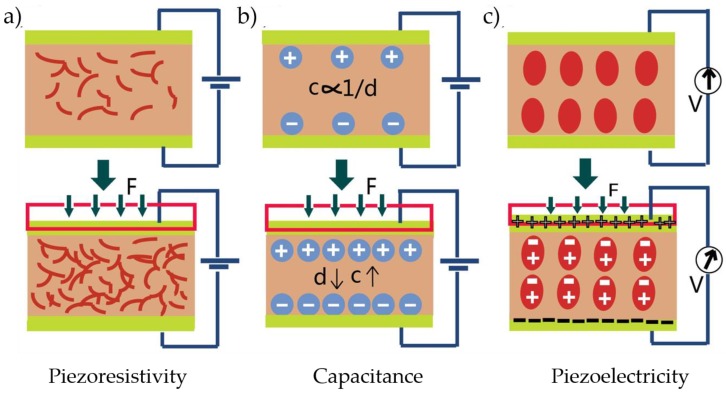
Schematic illustration of three common transduction mechanisms and representative devices: (a) piezoresistivity; (b) capacitance; and (c) piezoelectricity.
Figure 3
Figure 3
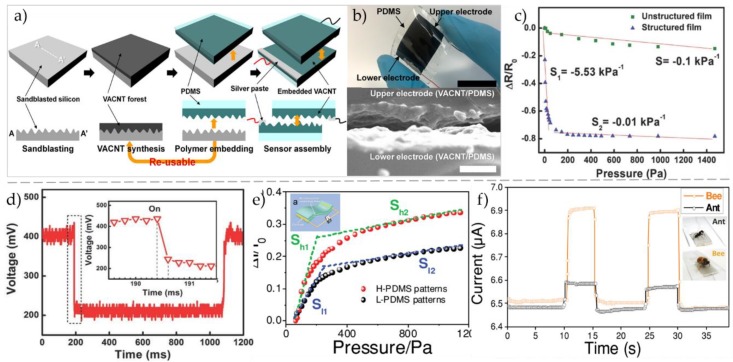
(a) Schematic illustration of the fabrication process of the flexible pressure sensor. (b) Digital image of the fabricated sensor and its cross-sectional scanning electron microscope (SEM) image. Reproduced with permission [24]. Copyright 2017, ACS Applied Materials & Interfaces. (c) Sensors sensitivities with microstructure and no structure. (d) Response time of sensors with microstructure. Reproduced with permission [33]. Copyright 2014, Small. (e) Sensitivities of pressure sensors constructed with different polydimethylsiloxane (PDMS) microstructures (Inset: schematic of a typical E-skin). (f) Real-time I–t curves of the E-skin constructed with PDMS for detection of a bee (40 mg) and an ant (10 mg), respectively. Reproduced with permission [34]. Copyright 2014, Advanced Materials. VANCT—vertically aligned carbon nanotube.
Figure 4
Figure 4
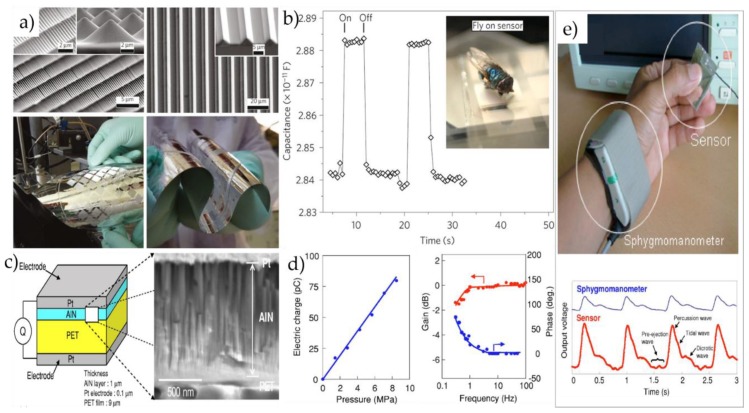
(a) (Top), SEM images of the microstructured polydimethylsiloxane (PDMS) films. Two-dimensional arrays of square pyramids (left) and pyramidal feature arrays (right). (Bottom), the pressure-sensitive structured PDMS films show the flexible and conformability. (b) The microstructured PDMS films are able to sense very small pressure. Reproduced with permission [26]. 2010, Copyright Nature Materials. (c) Multilayer structure of flexible pressure sensor, and schematic diagram and SEM image of sensor structure showing Pt electrodes, aluminum nitride (AlN), and polyethylene terephthalate (PET) films. (d) Relationship between pressure and electric charge of sensor. The frequency is 10 Hz. Dependence of gain and phase of sensor on frequency. The load and offset are 20 and 40 N, respectively. (e) Photograph of actual test setup to measure pulse wave forms with sensor and sphygmomanometer. Human pulse waves measured with sensor and sphygmomanometer. Reproduced with permission [43]. Copyright 2006, Journal of Applied Physics.
Figure 5
Figure 5
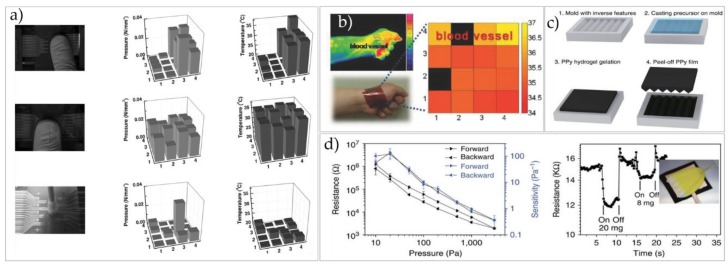
(a) The image of an electronic artificial skin. Reproduced with permission [49]. Copyright 2013, Journal of Micromechanics & Microengineering. (b) Sensor arrays based on P(VDF-TrFE) microstructure could be applicable for accurate detection of the human body temperature and heartbeat frequency. Reproduced with permission [50]. Copyright 2015, Scientific Reports. (c) Fabrication and resistive pressure response of micropatterned elastic microstructured conducting polymer (EMCP) films. (d) Resistance response and pressure sensitivity of the EMCP pressure. Reproduced with permission [51]. Copyright 2014, Nature Communication.
Figure 6
Figure 6
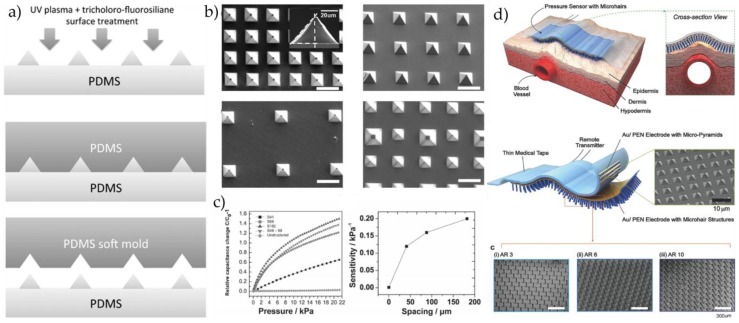
(a) Schematic process of the soft PDMS molds. (b) Scanning electron microscope (SEM) images of different spatial arrangements of pyramidal microstructured PDMS. Spacing of 41 µm, 88 µm, 182 µm, and interspersed design of two pyramidal structures with different base areas (scale bar: 100 µm). (c) Capacitance changes with increasing pressure for different spatial configurations of microstructured PDMS. Reproduced with permission [61]. Copyright 2015, Advanced Functional Materials. (d) High skin conforming and pulse-detectable pressure sensor using microhair structures. Reproduced with permission [62]. Copyright 2015, Advanced Materials.

References

    1. Cédric C., Maryline L., Vladan K. A Flexible Strain Sensor Based on a Conductive Polymer Composite forin situMeasurement of Parachute Canopy Deformation. Sensors. 2010;10:8291–8303. - PMC - PubMed
    1. Pang C., Lee C., Suh K.Y. Recent advances in flexible sensors for wearable and implantable devices. J. Appl. Polym. Sci. 2013;130:1429–1441. doi: 10.1002/app.39461. - DOI
    1. Hammock M.L., Chortos A., Tee C.K., Tok B.H., Bao Z. 25th Anniversary Article: The Evolution of Electronic Skin (E-Skin): A Brief History, Design Considerations, and Recent Progress. Adv. Mater. 2013;25:5997–6038. doi: 10.1002/adma.201302240. - DOI - PubMed
    1. Wang X.D., Zhang H.L., Yu R.M., Dong L., Peng D.F., Zhang A.H., Zhang Y., Liu H., Pan C.F., Wang Z.L. Dynamic Pressure Mapping of Personalized Handwriting by a Flexible Sensor Matrix Based on the Mechanoluminescence Process. Adv. Mater. 2015;27:2324–2331. doi: 10.1002/adma.201405826. - DOI - PubMed
    1. Chortos A., Bao Z.A. Skin-inspired electronic devices. Mater. Today. 2014;17:321–331. doi: 10.1016/j.mattod.2014.05.006. - DOI

LinkOut - more resources