. 2018 Nov 7;8(1):16502.
doi: 10.1038/s41598-018-34453-0.

Maternal High-Fat Diet Programs Offspring Liver Steatosis in a Sexually Dimorphic Manner in Association with Changes in Gut Microbial Ecology in Mice

Affiliations

Maternal High-Fat Diet Programs Offspring Liver Steatosis in a Sexually Dimorphic Manner in Association with Changes in Gut Microbial Ecology in Mice

Umesh D Wankhade et al. Sci Rep. .

Abstract

The contributions of maternal diet and obesity in shaping offspring microbiome remain unclear. Here we employed a mouse model of maternal diet-induced obesity via high-fat diet feeding (HFD, 45% fat calories) for 12 wk prior to conception on offspring gut microbial ecology. Male and female offspring were provided access to control or HFD from weaning until 17 wk of age. Maternal HFD-associated programming was sexually dimorphic, with male offspring from HFD dams showing hyper-responsive weight gain to postnatal HFD. Likewise, microbiome analysis of offspring cecal contents showed differences in α-diversity, β-diversity and higher Firmicutes in male compared to female mice. Weight gain in offspring was significantly associated with abundance of Lachnospiraceae and Clostridiaceae families and Adlercreutzia, Coprococcus and Lactococcus genera. Sex differences in metagenomic pathways relating to lipid metabolism, bile acid biosynthesis and immune response were also observed. HFD-fed male offspring from HFD dams also showed worse hepatic pathology, increased pro-inflammatory cytokines, altered expression of bile acid regulators (Cyp7a1, Cyp8b1 and Cyp39a1) and serum bile acid concentrations. These findings suggest that maternal HFD alters gut microbiota composition and weight gain of offspring in a sexually dimorphic manner, coincident with fatty liver and a pro-inflammatory state in male offspring.


Conflict of interest statement

The authors declare no competing interests.

Figures
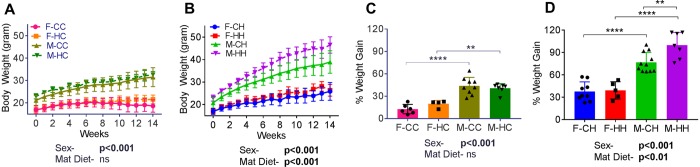
Figure 1
Figure 1
Body weights and weight gain in male and female offspring of control and HFD-fed dams. (A) Body weights of male and female offspring born to control (Con) and HFD-fed dams weaned onto Con (F-CC, F-HC, M-CC, and M-HC, n = 4–10) or (B) HFD (F-CH, F-HH, M-CH, and M-HH, n = 5–11) for 14-week following weaning. Overall weight gain at the end of the study in male and female offspring from Con and HFD-fed dams fed (C) control and (D) on high-fat diet. Data are expressed as means ± SD. Statistical differences between groups were determined using a 2-way ANOVA to examine the effects of maternal HFD and sex of the offspring, followed by Student-Newman-Keuls post hoc analyses. (*p < 0.05, **p < 0.01 ***p < 0.001, ****p < 0.0001).
Figure 2
Figure 2
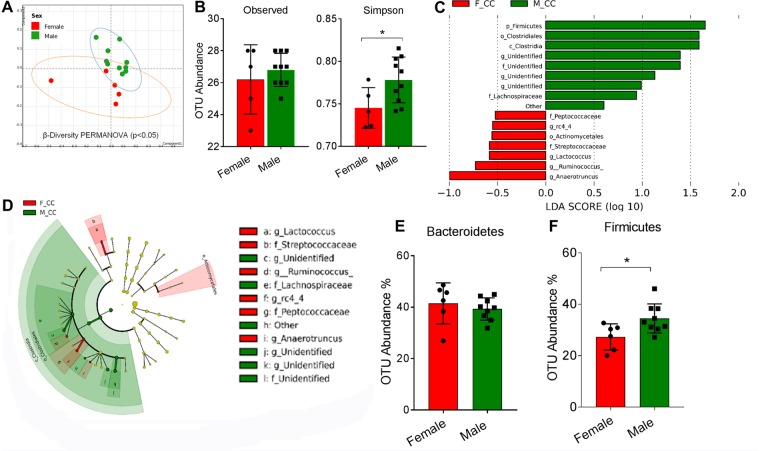
Sexually dimorphic nature of gut microbiome composition. (A) Non-metric multidimensional scaling (NMDS) ordination of the OTU dissimilarity matrix of β-diversity values. (B) Observed OTUs and Simpson indices representing α-diversity. (C) Linear discriminant analysis (LDA) coupled with effect size (LefSe) analysis showing the most differentially abundant taxonomical levels between female and male mice. (D) Cladogram illustrating different bacterial taxa in male and female mice. Colored nodes from the center to the periphery represent phylum (p), class (c), order (o), family (f), and genus (g) level differences detected between male (green) and female (red). (E,F) Overall % OTU abundance within Firmicutes and Bacteroidetes in male and female mice. Data are expressed as means ± SD. Statistical differences between male and female were determined using a Student’s t-test (*p < 0.05).
Figure 3
Figure 3
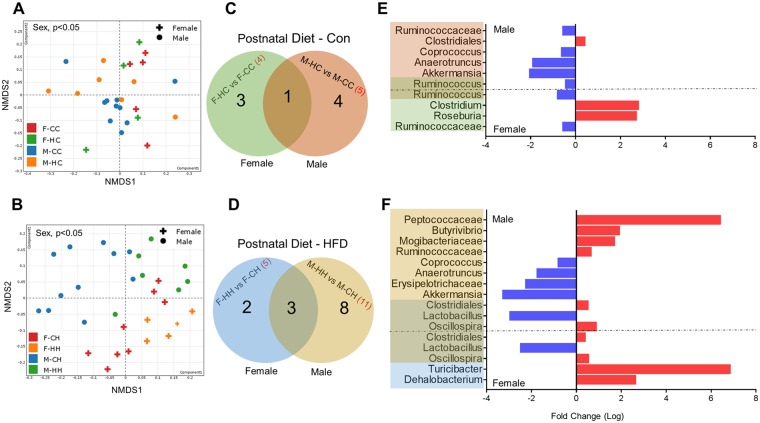
Effects of maternal HFD and offspring sex on bacterial diversity and abundance. Non-metric multidimensional scaling (NMDS) ordination of the OTU dissimilarity matrix (Bray-Curtis) of β-diversity values in offspring fed (A) control or (B) HFD. Venn diagrams representing the numbers of bacterial genera showing significant change (via DeSeq2) due to maternal HFD in offspring of either sex within (C) control or (D) HFD contexts postnatally. (E,F) Bar charts showing fold change of differentially expressed bacterial genera in male and female offspring. Note that male offspring exposed to HFD postnatally show greater reconfiguration of microbiota. Statistical differences between the groups were determined using inverse binomial tests using Deseq2 (p < 0.05).
Figure 4
Figure 4
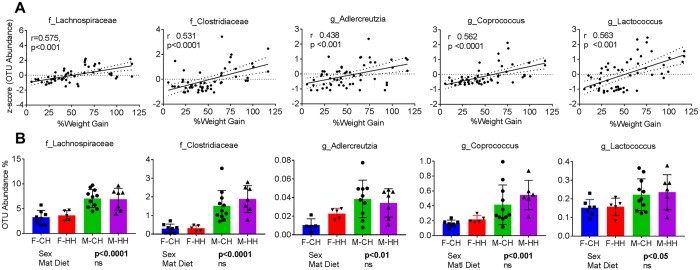
Bacterial taxa associated with offspring weight gain. (A) Pearson’s correlations of f_Lachnospiraceae, f_Clostridiaceae, g_Coprococcus, g_Adlercreutzia and f_Lactococcus with weight gain over the diet intervention period irrespective of sex of the offspring. Correlation co-efficients and p-values for linear regressions were calculated using Pearson’s correlation. (B) Microbial OTU abundance showing sexually dimorphic expression in male and female offspring when fed postnatal HFD. Data are expressed as means ± SD. Statistical differences between groups were determined using a 2-way ANOVA to examine the effects of maternal HFD and offspring sex.
Figure 5
Figure 5
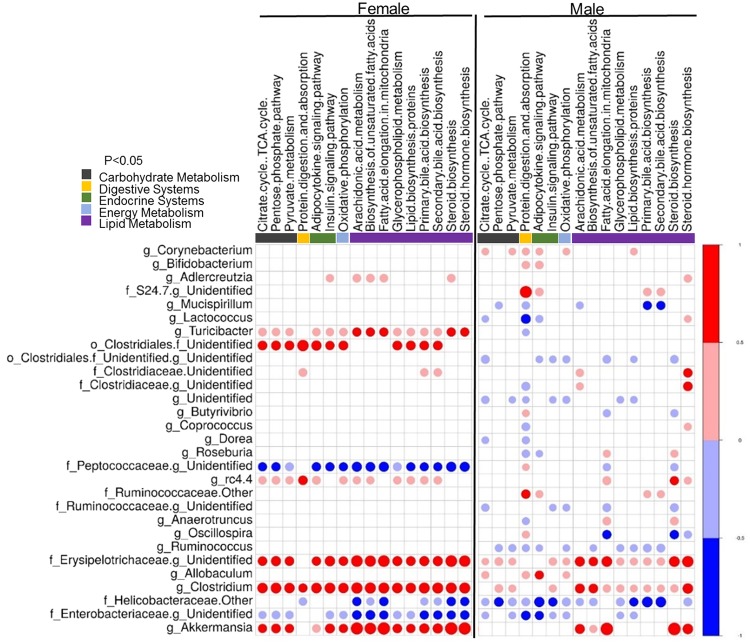
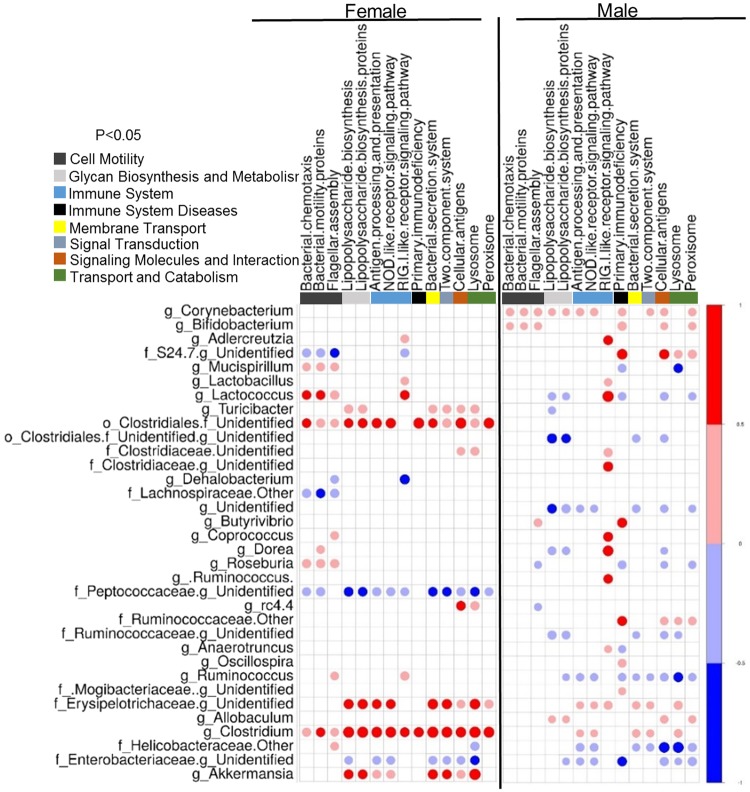
Maternal HFD and offspring sex significantly alter lipid metabolism and bile acid secretion synthesis pathways. Correlations between a PICRUSt-generated functional profiles and genus level bacterial abundance were calculated and plotted between HFD-fed male (M-HH) and female (F-HH) offspring from HFD-fed dams. Lipid metabolism and bile acid secretion synthesis pathways are indicated at the top of the graph. Left panel of the graph represents HH-female offspring while HH-male offspring are presented on the right panel. The shading intensity of the bubble, along with size, is indicative of the Kendall rank correlation coefficient between matrices. Red designates a positive association while blue designates a negative association. Only significant (p-value ≤ 0.05 by Kendall’s test; n = 5–7) correlations are visible in the plot.
Figure 6
Figure 6
Maternal HFD and offspring sex significantly alter immunological pathways. Correlations between a PICRUSt-generated functional profiles and genus level bacterial abundance were calculated and plotted between HFD-fed male (M-HH) and female (F-HH) offspring from HFD-fed dams. Immunological pathways designations are indicated at the top of the graph. Left panel of the graph represents HH-female offspring while HH-male offspring are presented on the right panel. The shading intensity of the bubble, along with size, is indicative of the Kendall rank correlation coefficient between matrices. Red designates a positive association while blue designates a negative association. Only significant (p ≤ 0.05 by Kendall’s test; n = 5–7) correlations are visible in the plot.
Figure 7
Figure 7
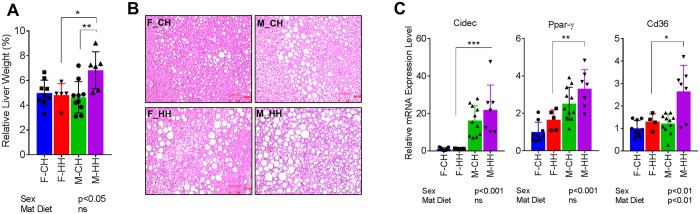
Exacerbated fatty liver phenotype in male offspring from HFD-fed dams. (A) Relative liver weights, (B) Photomicrographs of hematoxylin and eosin-stained liver sections, and (C) mRNA expression of lipogenic genes Cidec, Ppar-γ and CD36 in male and female offspring fed HFD postnatally. Data are expressed as means ± SD. Statistical differences were determined using a two-way ANOVA to examine the effects of maternal HFD and offspring sex, followed by Student-Newman-Keuls post hoc analyses. (*p < 0.05, **p < 0.01 ***p < 0.001).
Figure 8
Figure 8
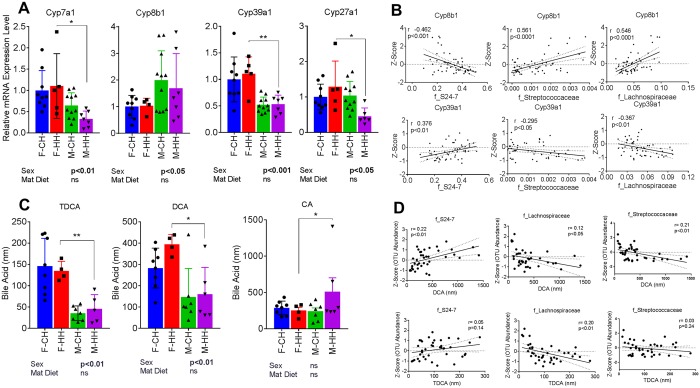
Sexual dimorphism in BA metabolites and regulatory enzymes and associations with microbial families. (A) mRNA expression of bile acid synthesis related genes Cyp7a1, Cyp8b1, Cyp39a1 and Cyp27a1 in livers of offspring. (B) Associations between Cyp8b1 and Cyp39a1 mRNA levels and bacterial families. (C) Serum concentrations of bile acids TDCA, DCA and CA in offspring. (D) Associations between DCA and TDCA concentrations and bacterial families. Data are expressed as means ± SD. Statistical differences in gene expression were determined using a two-way ANOVA to examine the effects of maternal HF and offspring sex, followed by Student-Newman-Keuls post hoc analyses. (*p < 0.05, **p < 0.01 ***p < 0.001).
Figure 9
Figure 9
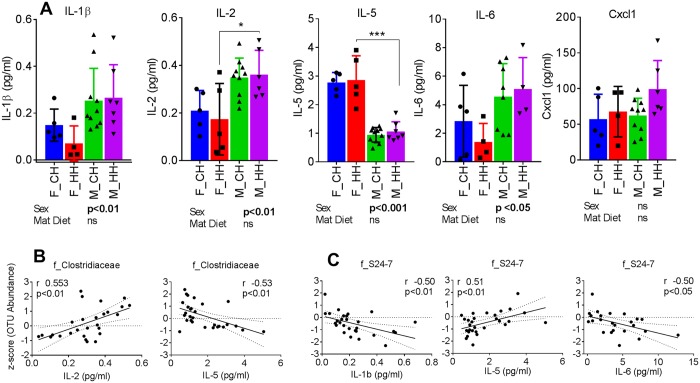
Sexual dimorphism in circulating cytokines and associations with microbial families. (A) Serum cytokine levels of IL-1β, IL-2, IL-5, IL-6 and Cxcl1, and Pearson correlations of cytokines with abundance of (B) f_Clostridiaceae and (C) f_S24-7. Data are expressed as means ± SD. Statistical differences in gene expression were determined using a 2-way ANOVA to examine the effects of maternal HF and offspring sex, followed by Student-Newman-Keuls post hoc analyses. (*p < 0.05, **p < 0.01 ***p < 0.001).

References

    1. Shankar K, et al. Maternal obesity at conception programs obesity in the offspring. American journal of physiology. Regulatory, integrative and comparative physiology. 2008;294:R528–538. doi: 10.1152/ajpregu.00316.2007. - DOI - PubMed
    1. Catalano PM, Shankar K. Obesity and pregnancy: mechanisms of short term and long term adverse consequences for mother and child. BMJ. 2017;356:j1. doi: 10.1136/bmj.j1. - DOI - PMC - PubMed
    1. McCurdy CE, et al. Maternal high-fat diet triggers lipotoxicity in the fetal livers of nonhuman primates. J.Clin.Invest. 2009;119:323–335. - PMC - PubMed
    1. Samuelsson AM, et al. Diet-induced obesity in female mice leads to offspring hyperphagia, adiposity, hypertension, and insulin resistance: a novel murine model of developmental programming. Hypertension. 2008;51:383–392. doi: 10.1161/HYPERTENSIONAHA.107.101477. - DOI - PubMed
    1. Myatt L, Thornburg KL. Effects of Prenatal Nutrition and the Role of the Placenta in Health and Disease. Methods in molecular biology. 2018;1735:19–46. doi: 10.1007/978-1-4939-7614-0_2. - DOI - PubMed

Publication types