


Propofol-sparing effect of different concentrations of dexmedetomidine : Comparison of gender differences
- PMID: 30406275
- PMCID: PMC6342900
- DOI: 10.1007/s00101-018-0506-6
Propofol-sparing effect of different concentrations of dexmedetomidine : Comparison of gender differences
Abstract
Background: The pharmacodynamics of propofol are closely linked to gender. Dexmedetomidine can decrease propofol needs during propofol anesthesia. The aim of this study was to compare the gender differences on the calculated effect site median effective concentration (EC50) of propofol for loss of consciousness (LOC) after pretreatment with different concentrations of dexmedetomidine.
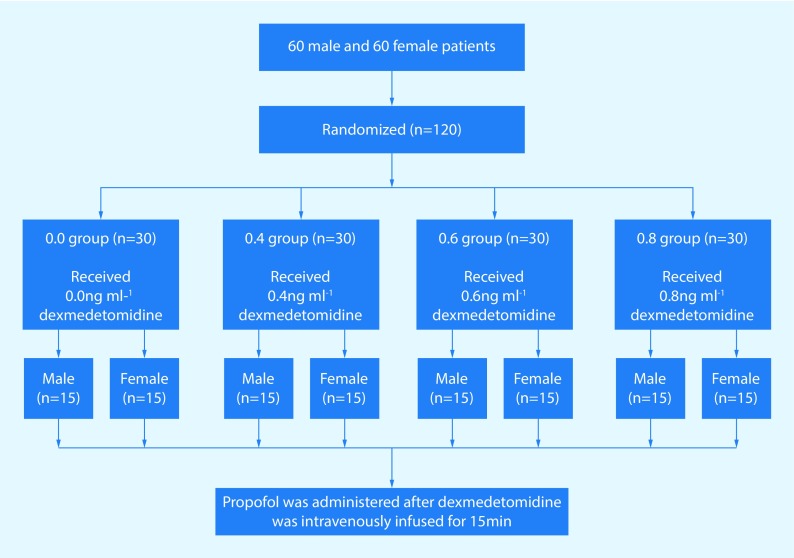
Methods: In this study 60 male and 60 female patients were randomly allocated to receive dexmedetomidine at target plasma concentrations of 0.0 ng/ml (0.0 group), 0.4 ng/ml (0.4 group), 0.6 ng/ml (0.6 group) and 0.8 ng/ml (0.8 group). Propofol was administered after dexmedetomidine had been intravenously infused for 15 min. The propofol infusion was targeted to provide an initial effect-site concentration of 1.0 μg/ml, followed by increments by 0.2 μg/ml when the effect-site concentration and target concentration of propofol were in equilibrium until LOC was established, where LOC was defined by the observer's assessment of alertness/sedation scale (OAA/S) score < 2.
Results: The calculated effect-site EC50 of propofol LOC was higher in males than in females in the 0.0, 0.4, 0.6, and 0.8 groups (2.43 vs. 2.17, 1.99 vs. 1.82, 1.72 vs. 1.56 and 1.50 vs. 1.32 μg/ml, respectively, all p < 0.05). The hypnotic interaction between dexmedetomidine and propofol could be described with an additive model of pharmacodynamic interaction.
Conclusion: Gender significantly influenced the calculated effect-site EC50 of propofol for LOC after pretreatment with different concentrations of intravenous dexmedetomidine. It was concluded that an additive interaction could describe the results seen. Thus, gender has to be considered when these drugs are co-administered.
Hintergrund: Die Pharmakodynamik von Propofol ist eng mit dem Patientengeschlecht verknüpft. Während einer Propofolanästhesie kann Dexmedetomidin den Propofolbedarf senken. Das Ziel dieser Studie war es, geschlechtsassoziierte Unterschiede der berechneten medianen effektiven Konzentration (EC50) von Propofol für einen Bewusstseinsverlust (LOC) nach Vorbehandlung mit verschiedenen Konzentrationen von Dexmedetomidin zu ermitteln
Methoden: Je 60 männliche und weibliche Patienten wurden randomisiert einer von 4 Gruppen mit veschiedenen Dexmedetomidinzielkonzentrationen zugeordnet: 0,0 ng/ml (0,0 Gruppe), 0,4 ng/ml (0,4 Gruppe), 0,6 ng/ml (0,6 Gruppe) und 0,8 ng/ml (0,8 Gruppe). Nach einer 15-minutigen intravenösen Dexmedetomidininfusion wurde Propofol verabreicht. Die Propofolinfusion zielte auf eine initiale Konzentration am Wirkungsort von 1,0 μg/ml ab, gefolgt von Erhöhungen um 0,2 μg/ml, wenn sich die Konzentration am Wirkungsort und die Zielkonzentration von Propofol im Gleichgewicht befanden, bis ein LOC bei einem OAA/S(Observer’s Assessment of Alertness/Sedation Scale)-Score > 2 erreicht wurde.
Ergebnisse: Die berechnete Propofol-EC50 am Wirkungsort für einen LOC war für Männern höher als für Frauen in den Gruppen 0,0, 0,4, 0,6 und 0,8 (2,43 vs. 2,17; 1,99 vs. 1,82; 1,72 vs. 1,56 und 1,50 vs. 1,32 μg/ml; alle p < 0,05). Die hypnotische Interaktion zwischen Dexmedetomidin und Propofol konnte mit einem additiven Modell einer pharmakodynamischen Interaktion beschrieben werden.
Schlussfolgerungen: Das Geschlecht beeinflusst die berechnete EC50 von Propofol für einen LOC am Wirkungsort nach der Vorbehandlung mit verschiedenen Konzentrationen von i.v. Dexmedetomidin signifikant. Ein additives Interaktionsmodell konnte die beobachteten Ergebnisse beschreiben. Daher muss bei der gemeinsamen Verabreichung dieser Medikamente das Geschlecht berücksichtigt werden.
Keywords: Bispectral index monitor; Comparative study; Loss of consciousness; Pharmacodynamics; Sedation.
Conflict of interest statement
M. Xiong, Z.-X. Zheng, Z.-R. Hu, J. He, U. Madubuko, D. Grech, X.-A. Zhang and B. Xu declare that they have no competing interests.
Figures
References
-
- Kunisawa T, Nagata O, Nagashima M, Mitamura S, Ueno M, Suzuki A, Takahata O, Iwasaki H. Dexmedetomidine suppresses the decrease in blood pressure during anesthetic induction and blunts the cardiovascular response to tracheal intubation. J Clin Anesth. 2009;21(3):194–199. doi: 10.1016/j.jclinane.2008.08.015. - DOI - PubMed
-
- Le Guen M, Liu N, Tounou F, Augé M, Tuil O, Chazot T, Dardelle D, Laloë PA, Bonnet F, Sessler D, Fischler M. Dexmedetomidine reduces propofol and remifentanil requirements during bispectral index-guided closed-loop anesthesia: a double-blind, placebo-controlled trial. Anesth Analg. 2014;118(5):946–955. doi: 10.1213/ANE.0000000000000185. - DOI - PubMed
Publication types
MeSH terms
Substances
LinkOut - more resources
Full Text Sources
