


Nutritional status and related factors of schoolchildren in Çorum, Turkey
- PMID: 30406743
- PMCID: PMC10260469
- DOI: 10.1017/S1368980018002938
Nutritional status and related factors of schoolchildren in Çorum, Turkey
Abstract
Objective: We aimed to determine nutritional status and related factors among schoolchildren in Çorum, Central Anatolia, Turkey.
Design: Schoolchildren's height and weight were measured to calculate BMI and BMI Z-scores. Height, weight and BMI Z-scores were analysed and nutritional status classified according to the WHO.
Setting: Central Anatolia, Turkey.ParticipantsSchoolchildren aged 5-17 years (n 1684) participated in study.
Results: Of children, 4·2% were stunted, 6·9% thin, 13·8% overweight and 6·6% were obese. Proportions of stunting, thinness and overweight/obesity were significantly higher in children aged >10 years (78·6, 75·0 and 64·9%, respectively) than in those aged ≤10 years (21·4, 25·0 and 35·1%, respectively; all P <0·001). Median (range) birth weight and breast-feeding duration in children with stunting (2750 (1400-3600)g; 10 (0-36) months) were significantly lower and shorter, respectively, than those of normal height (3200 (750-5500)g; 15 (0-72) months) and tall children (3500 (2500-4900)g; 18 (0-36) months; P <0·001, <0·001, 0·011 and 0·016, respectively). The same relationship was observed in thin children (3000 (1000-4500)g; 12 (0-36) months) compared with normal-weight (3200 (750-5500)g; 15 (0-72) months) and overweight/obese children (3300 (1200-5500)g; 16 (0-48) months; P=0·026, <0·001, 0·045 and 0·011, respectively).
Conclusions: Overweight and obesity are health problems that must be addressed in schoolchildren. Adolescents also have a risk of double malnutrition. Promoting normal birth weight and encouraging long duration of breast-feeding are important to support normal growth in children.
Keywords: Adolescent; Breast-feeding; Child; Malnutrition; Obesity.
Figures
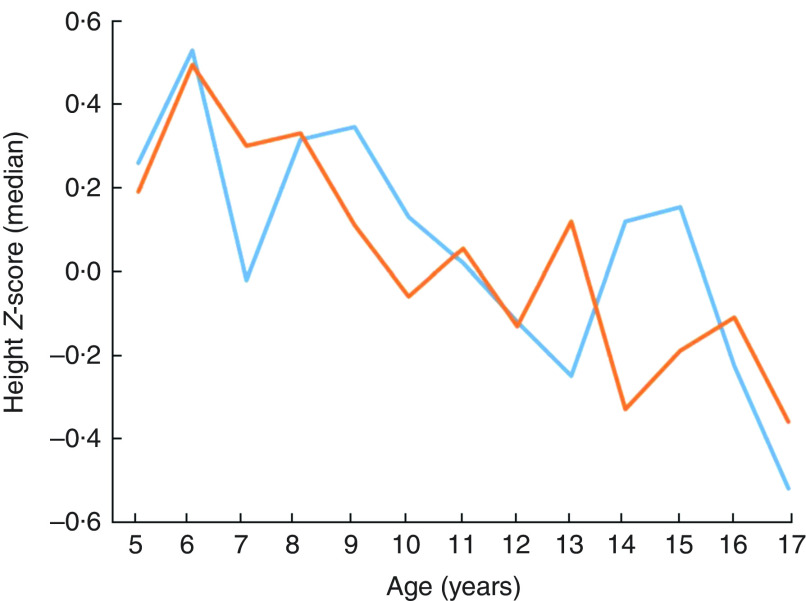
 , girls;
 , boys) among the schoolchildren aged 5–17 years (n 1684) from Çorum, Central Anatolia, Turkey, January–May 2017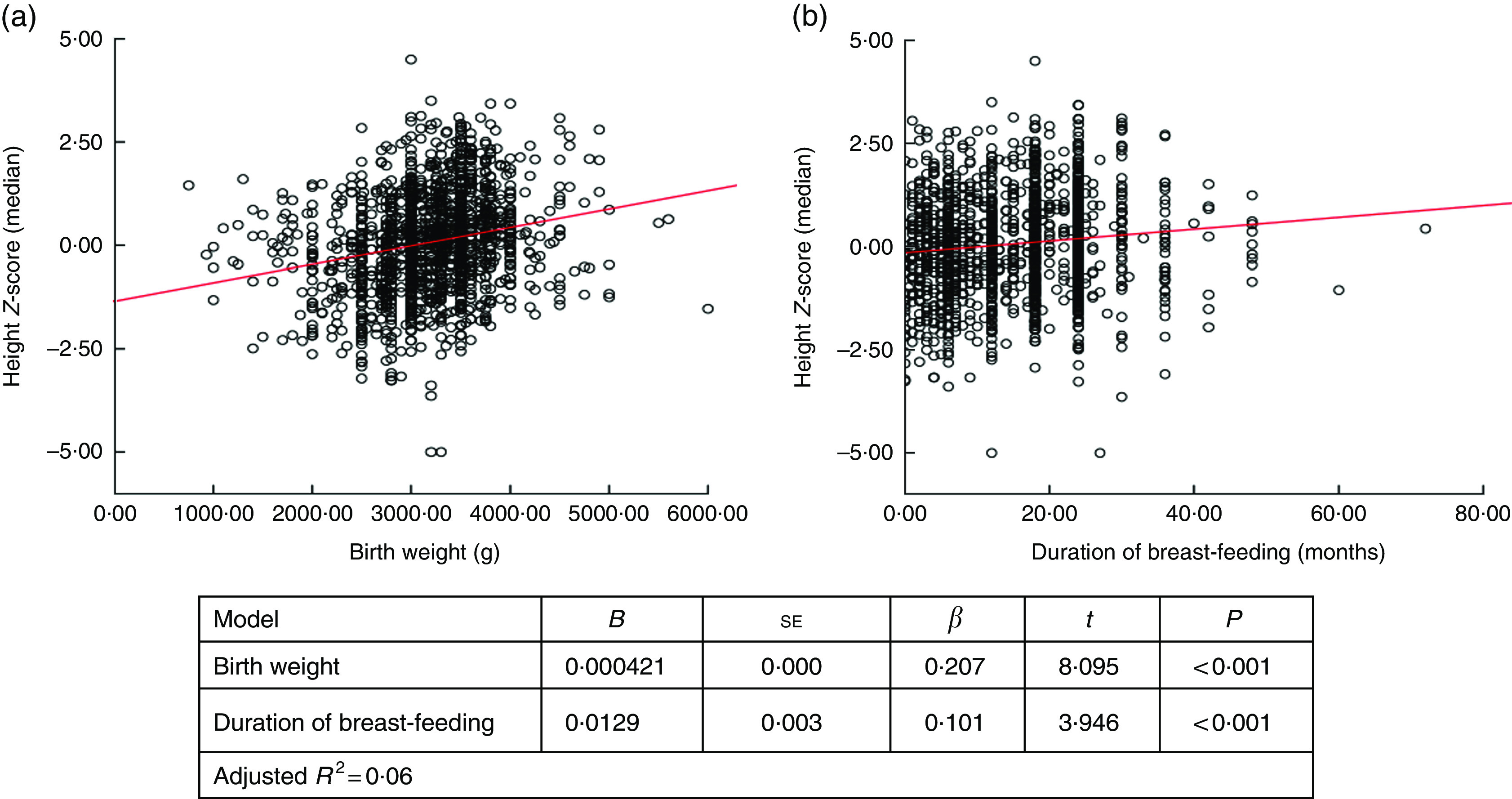
 , observation;
 , linear regression line) between (a) height Z-score and birth weight and (b) height Z-score and duration of breast-feeding among the schoolchildren aged 5–17 years (n 1684) from Çorum, Central Anatolia, Turkey, January–May 2017
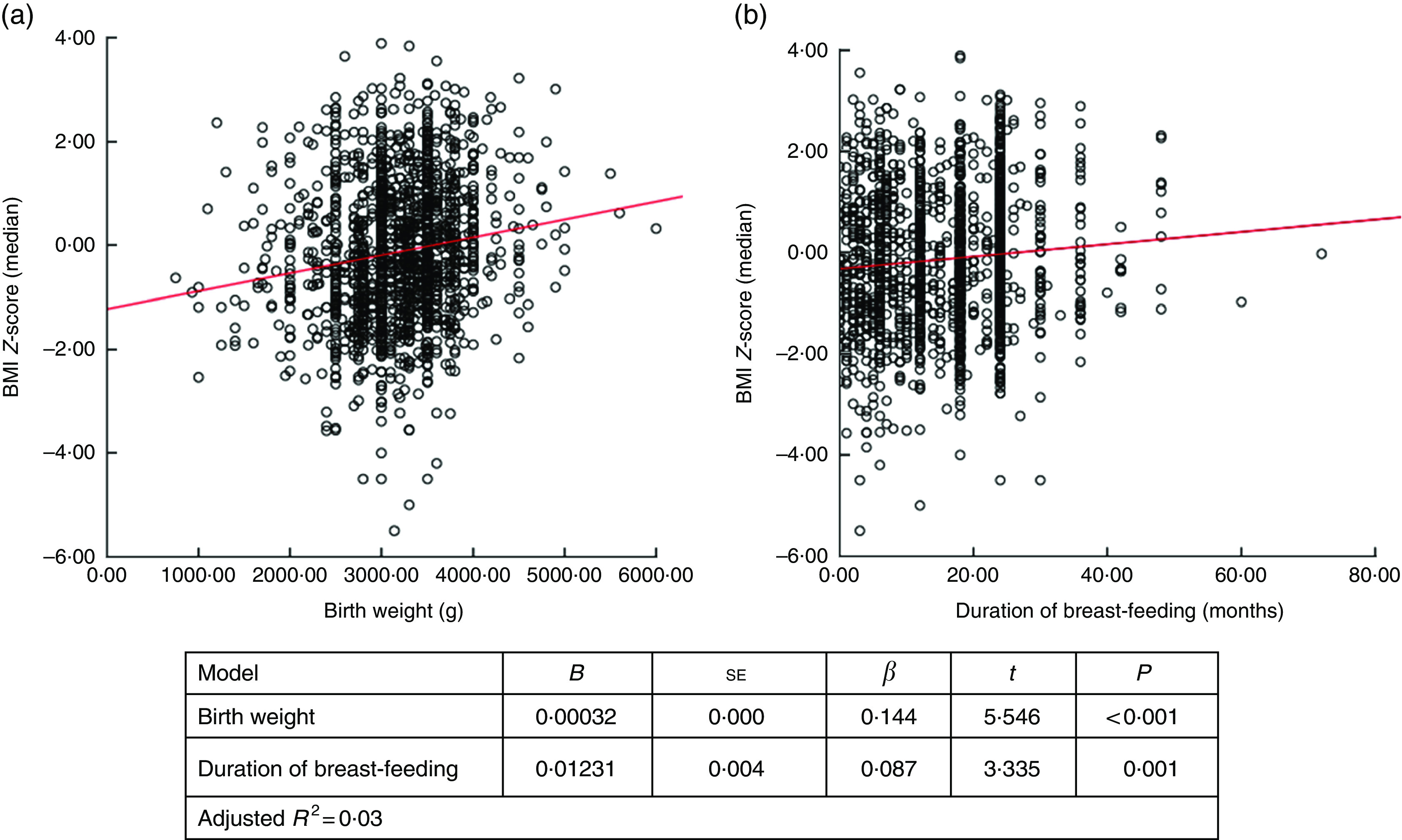 , observation;
, linear regression line) between (a) BMI Z-score and birth weight and (b) BMI Z-score and duration of breast-feeding among the schoolchildren aged 5–17 years (n 1684) from Çorum, Central Anatolia, Turkey, January–May 2017
, observation;
, linear regression line) between (a) BMI Z-score and birth weight and (b) BMI Z-score and duration of breast-feeding among the schoolchildren aged 5–17 years (n 1684) from Çorum, Central Anatolia, Turkey, January–May 2017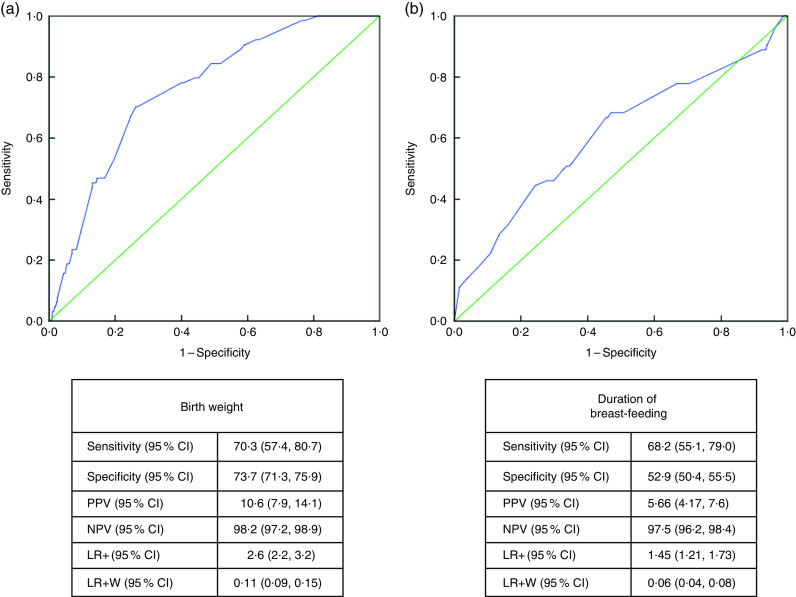 , data;
 , line of no discrimination) for estimation of height Z-score group according to (a) birth weight and (b) duration of breast-feeding among the schoolchildren aged 5–17 years (n 1684) from Çorum, Central Anatolia, Turkey, January–May 2017. (a) AUC=0·759 (95% CI 0·706, 0·813), P<0·001; (b) AUC=0·611 (95% CI 0·532, 0·690), P<0·003 (AUC, area under the curve; PPV, positive predictive value; NPV, negative predictive value; LR+, likelihood ratio; LR+W, likelihood ratio weighted)
References
-
- Mehta NM, Corkins MR, Lyman B et al. (2013) Defining pediatric malnutrition: a paradigm shift toward etiology-related definitions. JPEN J Parenter Enteral Nutr 37, 460–481. - PubMed
-
- World Health Organization (2017) Fact sheets | Malnutrition. http://www.who.int/mediacentre/factsheets/malnutrition/en/ (accessed February 2018).
-
- Best C, Neufingerl N, van Geel L et al. (2010) The nutritional status of school-aged children: why should we care? Food Nutr Bull 31, 400–417. - PubMed
MeSH terms
LinkOut - more resources
Full Text Sources
Medical
Miscellaneous
