


Perioperative alcohol cessation intervention for postoperative complications
- PMID: 30408162
- PMCID: PMC6517044
- DOI: 10.1002/14651858.CD008343.pub3
Perioperative alcohol cessation intervention for postoperative complications
Abstract
Background: Risky consumption of alcohol is a global problem. More than 3.3 million deaths annually are associated with risky use of alcohol, and global alcohol consumption continues to increase. People who have high alcohol consumption often require planned and emergency surgical procedures.Risky drinking is associated with increased postoperative complications such as infections, cardiopulmonary complications, and bleeding episodes. Alcohol causes disorders of the liver, pancreas, and nervous system. Stopping consumption of alcohol can normalize these organ systems to some degree and may reduce the occurrence of complications after surgery.This review was first published in 2012 and was updated in 2018.
Objectives: To assess the effects of perioperative alcohol cessation interventions on rates of postoperative complications and alcohol consumption.
Search methods: We searched the following databases up until 21 September 2018: Cochrane Central Register of Controlled Trials (CENTRAL), in the Cochrane Library; MEDLINE; Embase; CINAHL via EBSCOhost; and two trials registers. We scanned the reference lists and citations of included trials and any identified relevant systematic reviews for further references to additional trials. When necessary, we contacted trial authors to ask for additional information.
Selection criteria: We included all randomized controlled trials (RCTs) that evaluated the effects of perioperative alcohol cessation interventions on postoperative complications and alcohol consumption. We included participants with risky consumption of alcohol who were undergoing all types of elective or acute surgical procedures under general or regional anaesthesia or sedation, who were offered a perioperative alcohol cessation intervention or no intervention.We defined 'risky drinking' as alcohol consumption equivalent to more than 3 alcoholic units (AU)/d or 21 AU/week (with 1 AU containing 12 grams of ethanol) with or without symptoms of alcohol abuse or dependency. This corresponds to the amount of alcohol associated with increased postoperative complication rates in most clinical studies.
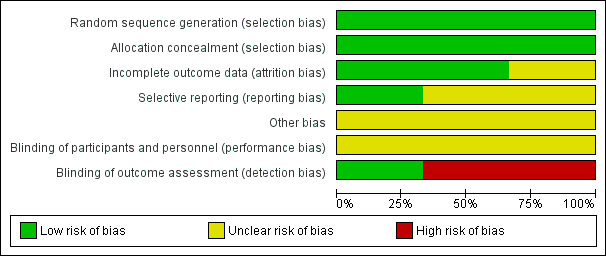
Data collection and analysis: We used guidance provided in the Cochrane Handbook for Systematic Reviews of Interventions. We presented main outcomes as dichotomous variables in a meta-analysis. When data were available, we conducted subgroup and sensitivity analyses to explore the risk of bias. Primary outcome measures were postoperative complications and in-hospital and 30-day mortality. Secondary outcomes were successful quitting at the end of the programme, postoperative alcohol use, and length of hospital stay. We assessed the quality of evidence using the GRADE approach.
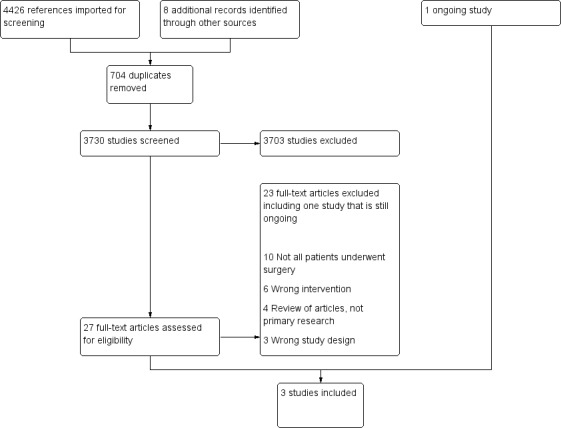
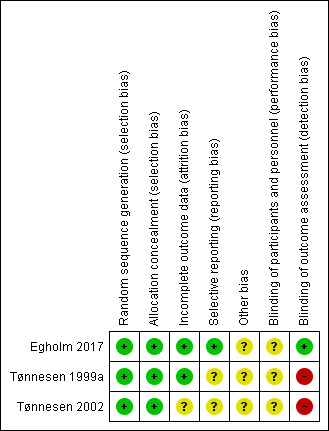
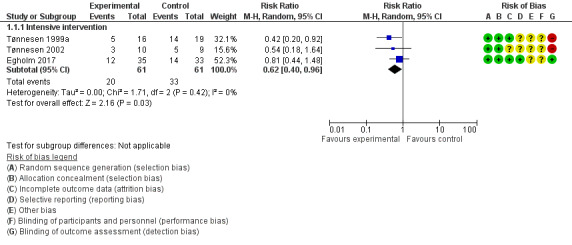
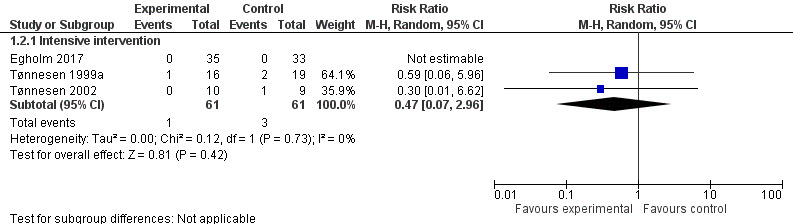
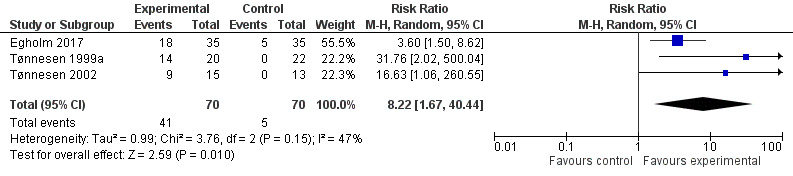
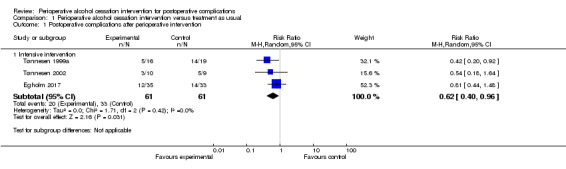
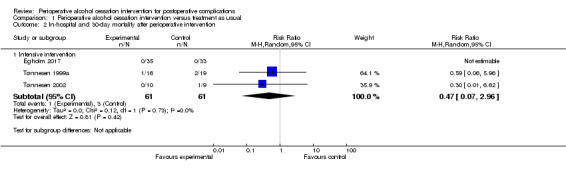
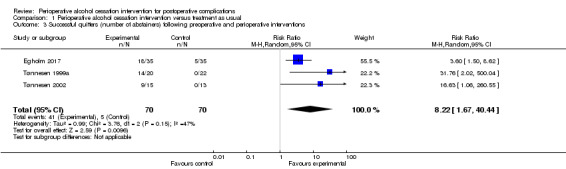
Main results: We included in this updated review one new study (70 participants), resulting in a total of three RCTs (140 participants who drank 3 to 40 AU/d). All three studies were of moderate to good quality. All studies evaluated the effects of intensive alcohol cessation interventions, including pharmacological strategies for alcohol withdrawal symptoms, patient education, and relapse prophylaxis. We identified one ongoing study.Overall, 53 of the 122 participants from three studies who underwent surgery developed any type of postoperative complication that required treatment. Of 61 participants in the intervention groups, 20 had complications, compared with 33 of 61 participants in the control groups (risk ratio (RR) 0.62, 95% confidence interval (CI) 0.40 to 0.96). Results show differences between the three clinical studies regarding outcome measurement and intensity of the interventions. However, all alcohol cessation programmes were intensive and included pharmacological therapy. The overall quality of evidence for this outcome is moderate.In-hospital and 30-day postoperative mortality rates were low in the three studies. Researchers reported one death among 61 participants in the intervention groups, and three deaths among 61 participants in the control groups (RR 0.47, 95% CI 0.07 to 2.96). The quality of evidence for this outcome is low.Investigators describe more successful quitters at the end of the intervention programme than among controls. Forty-one out of 70 participants in the intervention groups successfully quit drinking compared with only five out of 70 participants in the control groups (RR 8.22, 95% CI 1.67 to 40.44). The quality of evidence for this outcome is moderate.All three studies reported postoperative alcohol consumption (grams of alcohol/week) at the end of the programme as median and range values; therefore it was not possible to estimate the mean and the standard deviation (SD). We performed no meta-analysis. All three studies reported length of stay, and none of these studies described a significant difference in length of stay. Data were insufficient for review authors to perform a meta-analysis. No studies reported on the prevalence of participants without risky drinking in the longer term.
Authors' conclusions: This systematic review assessed the efficacy of perioperative alcohol cessation interventions for postoperative complications and alcohol consumption. All three studies showed a significant reduction in the number of participants who quit drinking alcohol during the intervention period. Intensive alcohol cessation interventions offered for four to eight weeks to participants undergoing all types of surgical procedures to achieve complete alcohol cessation before surgery probably reduced the number of postoperative complications. Data were insufficient for review authors to assess their effects on postoperative mortality. No studies reported an effect on length of stay, and no studies addressed the prevalence of risky drinking in the longer term.Included studies were few and reported small sample sizes; therefore one should be careful about drawing firm conclusions based on these study results. All three studies were conducted in Denmark, and most participants were men. The included participants may represent a selective group, as they could have been more motivated and/or more interested in participating in clinical research or otherwise different, and effects may have been overestimated for both intervention and control groups in these studies. Trial results indicate that these studies are difficult to perform, that strong research competencies are necessary for future studies, and that further evaluation of perioperative alcohol cessation interventions in high-quality randomized controlled trials is needed. Once published and assessed, the one 'ongoing' study identified may alter the conclusions of this review.
Conflict of interest statement
Hanne Tønnesen has authored all three of the studies included in this review (Egholm 2017; Tønnesen 1999a; Tønnesen 2002).
Julie Weber Melchior Egholm, Johanna Adami, and Bolette Pedersen have authored one of the included studies (Egholm 2017).
Hanne Tønnesen is also the primary investigator for the ongoing study (NCT02188446).
Therefore, to avoid any potential bias, Carsten B Juhl extracted data and checked the interpretation against study reports and any available study registration details or protocols as an independent review author.
Figures
Update of
-
Preoperative alcohol cessation prior to elective surgery.Cochrane Database Syst Rev. 2012 Jul 11;(7):CD008343. doi: 10.1002/14651858.CD008343.pub2. Cochrane Database Syst Rev. 2012. Update in: Cochrane Database Syst Rev. 2018 Nov 08;11:CD008343. doi: 10.1002/14651858.CD008343.pub3. PMID: 22786514 Updated.
References
References to studies included in this review
Egholm 2017 {unpublished data only}
-
- Egholm JWM, Pedersen B, Oppedal K, Rasmussen M, Adami J, Lauritzen JB, et al. Scand‐Ankle: effect of patient education for alcohol cessation intervention on acute fracture surgery ‐ a randomized controlled trial. Unpublished RCT ‐ Data on file (as supplied 1 June 2017).
Tønnesen 1999a {published data only (unpublished sought but not used)}
Tønnesen 2002 {unpublished data only}
-
- Tønnesen H. Intensive intervention among alcohol patients prior to elective hip replacement‐complications, life‐quality, surgical outcome. Report ‐ Unpublished data 31.07.2002.
References to studies excluded from this review
Antti‐Poika 1988 {published data only}
-
- Antti‐Poika I, Karaharju E, Roine R, Salaspuro M. Intervention of heavy drinking ‐ a prospective and controlled study of 438 consecutive injured male patients. Alcohol and Alcoholism 1998;23(2):115‐21. [PUBMED: 3390235] - PubMed
Avram 2009 {published data only}
-
- Avram O, Grecu I, Macovei R, Marinesco O, Grintescu I. Benefits of implementations of a protocol for preoperative chronic alcohol abusers identification and alcohol withdrawal syndrome prevention. Romanian Journal of Anaesthesia and Intensive Care 2009;16:121‐7.
Batioglu‐Karaaltin 2017 {published data only}
-
- Batioglu‐Karaaltin A, Binbay Z, Yigit Ö, Dönmez Z, Yollu U. Can temperament and character features of patients predict alcohol use after laryngectomy?. Clinical Otolaryngolgy 2017;42:373‐80. [PUBMED: 27717234 ] - PubMed
Bejou 2000 {published data only}
-
- Bejou B, Benamouzig R. Effect of preoperative abstinence on poor postoperative outcome in alcohol misusers: randomized controlled trial [Effect de l'abstinence sur le prognostic post‐opératorie des consommateus excessifs d'alcool]. Gastroenterérologie Clinique Et Biologique 2000;24(3):377‐8. [PUBMED: 10866517] - PubMed
Chiang 1995 {published data only}
-
- Chiang PP. Perioperative management of the alcohol dependent patient. American Family Physician 1995;52(8):2267‐73. [PUBMED: 7484720] - PubMed
Forsberg 2000 {published data only}
-
- Forsberg L, Ekman S, Halldin J, Ronnberg S. Brief intervention for risk consumption of alcohol at an emergency surgical ward. Addictive Behaviors 2000;25(3):471‐5. [PUBMED: 10890304] - PubMed
Gentilello 1999 {published data only}
Heather 1996 {published data only}
-
- Heather N, Rollnick S, Bell A, Richmond R. Effects of brief counselling among male heavy drinkers identified on general hospital wards. Drugs and Alcohol Review 1996;15(1):29‐38. [PUBMED: 16203349] - PubMed
Holloway 2007 {published data only}
-
- Holloway AS, Watson HE, Arthur AJ, Starr G, McFadyen AK, McIntosh J. The effect of brief interventions on alcohol consumption among heavy drinkers in a general hospital setting. Addiction 2007;102(11):1762‐70. [PUBMED: 17784901] - PubMed
Kaka 2017 {published data only}
-
- Kaka AS, Zhao S, Ozer E, Agrawal A, Kang S, Rocco J, et al. Comparison of clinical outcomes following head and neck surgery among patients who contract to abstain from alcohol vs patients who abuse alcohol. JAMA Otolaryngology‐Head & Neck Surgery 2017;143(12):1181‐6. [PUBMED: 28447103 ] - PMC - PubMed
Schermer 2006 {published data only}
-
- Schermer CR, Moyers TB, Miller WR, Bloomfield LA. Traumacentre brief interventions for alcohol disorders decrease subsequent driving under the influence arrests. Journal of Trauma 2006;60(1):29‐34. [PUBMED: 16456433] - PubMed
Schoenfeld 2007 {published data only}
-
- Schoenfeld H, Heymann C, Lau A, Krocker D, Neuner B, Schink T, et al. The effect of stress‐reducing, low‐dose ethanol infusion on frequency of bleeding complications in long‐term alcoholic patients undergoing major surgery. American Surgeon 2007;73(2):192‐8. [PUBMED: 17305301] - PubMed
Shepard 2016 {published data only}
Shetty 2011 {published data only}
Shourie 2006 {published and unpublished data}
-
- Shourie S, Conigrave KM, Proude EM, Ward JE, Wutzke SE, Haber PS. The effectiveness of a tailored intervention for excessive alcohol consumption prior to elective surgery. Alcohol and Alcoholism 2006;41(6):643‐9. [PUBMED: 16905552] - PubMed
Smith 2003 {published data only}
-
- Smith AJ, Hodgson J, Bridgeman K, Shepherd JP. A randomized controlled trial of brief intervention after alcohol‐related facial injury. Addiction 2003;98(1):43‐52. [PUBMED: 12492754] - PubMed
Sommers 2006 {published data only}
-
- Sommers MS, Dyehouse JM, Howe SR, Fleming M, Fargo JD, Schafer JC. Effectiveness of brief interventions after alcohol‐related vehicular injury: a randomized controlled trial. Journal of Trauma 2006;61(3):523‐31. [PUBMED: 16966982] - PubMed
Soria 1981 {published data only}
-
- Soria P, Richard P. Tiapride and alcoholism in surgical practice [Tiapride et ethylisme en milieu chirurgical]. Annales De Chirurgie 1981;35(6):425‐8. [PUBMED: 7259038] - PubMed
Spies 1995 {published data only}
-
- Spies CD, Dubisz N, Funk W, Blum S, Müller C, Rommelspacher H, et al. Prophylaxis of alcohol withdrawal syndrome in alcohol‐dependent patients admitted to the intensive care unit after tumour resection. British Journal of Anaesthesia 1995;75(734):9. [PUBMED: 8672322] - PubMed
Spies 1996 {published data only}
-
- Spies CD, Nordmann, A, Brummer G, Marks C, Conrad C, Berger G, et al. Intensive care unit stay is prolonged in chronic alcoholic men following tumor resection of the upper digestive tract. Acta Anaesthesiologica Scandinavica 1996;40(6):649‐56. [PUBMED: 8836256] - PubMed
Spies 2006 {published data only}
-
- Spies C, Eggers V, Szabo G, Lau A, Dossow V, Schoenfeld H, et al. Intervention at the level of the neuroendocrine‐immune axis and postoperative pneumonia rate in long‐term alcoholics. American Journal of Respiratory and Critical Care Medicine 2006;174:408‐14. [DOI: 10.1164/rccm.200506-907OC; PUBMED: 16728716 ] - DOI - PubMed
Vagts 2002 {published data only}
-
- Vagts VDA, Noldge‐Schomburg GFE. Anesthesiological considerations in alcoholic patients. Anaesthesiologie und Reanimation 2002;27(6):160‐7. - PubMed
Watson 1999 {published data only}
-
- Watson HE. Problem drinkers in acute care settings: validation of an assessment instrument. International Journal of Nursing Studies 1999;36(5):415‐23. [PUBMED: 10519686] - PubMed
References to ongoing studies
NCT02188446 {published data only}
-
- NCT02188446. Intensive smoking and alcohol cessation intervention in bladder cancer surgery patients (STOP‐OP). clinicaltrials.gov/ct2/show/NCT02188446 (date first received 11 July 2014).
Additional references
Amato 2010
ASA 2014
-
- American Society of Anesthesiologists. ASA physical status classification system. https://www.asahq.org/resources/clinical‐information/asa‐physical‐status... 2014.
Babor 2001
-
- Babor T, Higgins‐Biddle JC, Saunders JB, Maristela MG. AUDIT. Alcohol use disorders identification test. Guidelines for use in primary care. AUDIT. Alcohol Use Disorders Identification Test. Guidelines for Use in Primary Care. Geneva, Switzerland: World Health Organization, 2001.
Breuer 2003
-
- Breuer JP, Neumann T, Heinz A, Kox WJ, Spies C. The alcoholic patient in the daily routine. Wiener Klinische Wochenschrift 2003;115(17‐18):618‐33. [PUBMED: 14603733] - PubMed
Clavien 2009
-
- Clavien PA, Barkun J, Oliveira ML, Vauthey JN, Dindo D, Schulick RD, et al. The Clavien‐Dindo classification of surgical complications: five‐year experience. Annals of Surgery 2009;250(2):187‐96. - PubMed
Danish Health Authority 2017
-
- Danish Health Authority. Alcohol and surgery ‐ prevent complications when undertaken surgery [Alkohol og operationer ‐ forebyg komplikationer når du skal opereres]. https://www.sst.dk/da/udgivelser/2012/alkohol‐og‐operationer‐forebyg‐kom... (accessed August 2017).
DSM‐4 1994
-
- American Psychiatric Association. Diagnostic and Statistical Manual of Mental Disorders (DSM‐4). https://www.psychiatry.org/psychiatrists/practice/dsm 1994 (accessed August 2018).
DSM‐5 2013
-
- American Psychiatric Association. Diagnostic and Statistical Manual of Mental Disorders (DSM‐5). https://www.psychiatry.org/psychiatrists/practice/dsm 2013 (accessed August 2018).
Eliasen 2013
-
- Eliasen M, Grønkjær M, Skov‐Ettrup LS, Mikkelsen SS, Becker U, Tolstrup JS, et al. Preoperative alcohol consumption and postoperative complications. A systematic review and meta‐analysis. Annals of Surgery 2013;258(6):930‐42. [PUBMED: 23732268 ] - PubMed
Ewing 1984
-
- Ewing JA. Detecting alcoholism. The CAGE questionnaire. JAMA 1984;12(14):1905‐7. [PMID 6471323] - PubMed
Fiore 2008
GBD 2015
-
- GBD 2015 Mortality and Causes of Death Collaborators. Global, regional, and national life expectancy, all‐cause mortality, and cause‐specific mortality for 249 causes of death, 1980‐2015: a systematic analysis for Global Burden of Disease Study 2015. Lancet 2016;388:1459‐54. [PUBMED: 27733281 ] - PMC - PubMed
GRADEpro [Computer program]
-
- McMaster University (developed by Evidence Prime). GRADEpro GDT. Version accessed 6 August 2017. Hamilton (ON): McMaster University (developed by Evidence Prime), 2015.
Guyatt 2008
Guyatt 2011
Higgins 2002
-
- Higgins JP, Thompson SG. Quantifying heterogeneity in a meta‐analysis. Statistics in Medicine 2002;21(11):1539‐58. [PUBMED: 12111919] - PubMed
Higgins 2011
-
- Higgins JP, Green S, editor(s). Cochrane Handbook for Systematic Reviews of Interventions Version 5.1.0 (updated March 2011). The Cochrane Collaboration, 2011. Available from handbook.cochrane.org.
Jørgensen 2011
Kaner 2007
Kip 2008
-
- Kip MJ, Neumann T, Jugel C, Kleinwaechter R, Weiss‐Gerlach E, Guill MM, et al. New strategies to detect alcohol use disorders in the preoperative assessment clinic of a German university hospital. Anesthesiology 2008;109(2):169‐70. [PUBMED: 18648225] - PubMed
McQueen 2009
Minozzi 2010
Mundt 2003
-
- Mundt K, Jensen M, Kann A, Nielsen AS, Grønbæk M, Tønnesen H. Alkohol ‐ Forebyggelse på Sygehus, Fakta, Metoder og Anbefalinger [Alcohol ‐ Prevention in Hospitals, Facts, Methods and Recommendations]. 1st Edition. Vol. 1, Copenhagen: Klinisk Enhed for Sygdomsforebyggelse, 2003. [ISBN: 87‐91098‐02‐5]
Nolan 2017
Rasmussen 2016
-
- Rasmussen M, Tønnesen H. The smoking cessation database. Clincal Health Promotion 2016;6(2):36‐41.
Rasmussen 2017
Review Manager 2014 [Computer program]
-
- Nordic Cochrane Centre, The Cochrane Collaboration. Review Manager 5 (RevMan 5). Version 5.3. Copenhagen: Nordic Cochrane Centre, The Cochrane Collaboration, 2014.
Rotevatn 2017
-
- Rotevatn TA, Bøggild H, Olesen CR, Torp‐Pedersen C, Mortensen RN, Jensen PF, et al. Alcohol consumption and the risk of postoperative mortality and morbidity after primary hip or knee arthroplasty ‐ a register‐based cohort study. PLOS One 2017;12(3):e0173083. [https://doi.org/10.1371/journal.pone.0173083 Access November 2017; PUBMED: 28306737 ] - PMC - PubMed
Rubinsky 2013
-
- Rubinsky AD, Bishop MJ, Maynard C, Henderson WG, Hawn MT, Harris AH, et al. Postoperative risks associated with alcohol screening depend on documented drinking at the time of surgery. Drug and Alcohol Dependence 2013;132(3):521‐7. [DOI: 10.1016/j.drugalcdep.2013.03.022; PUBMED: 23683792] - DOI - PubMed
Rösner 2010a
Rösner 2010b
Selzer 1971
-
- Selzer ML. The Michigan Alcoholism Screening Test: the quest for a new diagnostic instrument. American Journal of Psychiatry 1971;127(12):1653‐8. - PubMed
Shabanzadeh 2014
Shabanzadeh 2015
SOF 2017
-
- Swedish Orthopaedic Association. www.ortopedi.se (accessed August 2017).
Spies 2001
-
- Spies C, Tønnesen H, Andreasson S, Helander A, Conigrave K. Perioperative morbidity and mortality in chronic alcoholic patients. Alcoholism, Clinical and Experimental Research 2001;25(5):164‐70. [PUBMED: 11391067] - PubMed
Spies 2004
-
- Spies CD, Dossow V, Eggers V, Jetschmann G, El‐Hilali R, Egert J, et al. Altered cell‐mediated immunity and increased postoperative infection rate in long‐term alcoholic patients. Anesthesiology 2004;100(5):1088‐100. [PUBMED: 15114205] - PubMed
The ICD‐10 Classification, 1993
-
- The ICD‐10 Classification of Mental and Behavioural Disorders: Diagnostic Criteria for Research. Geneva, Switzerland: World Health Organization, 1993.
Thomsen 2014
Tønnesen 1992a
-
- Tønnesen H, Kaiser AH, Nielsen BB, Pedersen AE. Reversibility of alcohol‐induced immune depression. British Journal of Addiction 1992;87(7):1025‐8. [PUBMED: 1643394] - PubMed
Tønnesen 1992b
-
- Tønnesen H, Petersen KR, Højgaard L, Stokholm KH, Nielsen HJ, Knigge U, et al. Postoperative morbidity among symptom‐free alcohol misusers. Lancet 1992;340(8815):334‐7. [PUBMED: 1353805] - PubMed
Tønnesen 1992c
-
- Tønnesen H. Influence of alcohol on several physiological functions and its reversibility: a surgical view. Acta Psychiatrica Scandinavica Supplementum 1992;369:67‐71. [PUBMED: 1471555] - PubMed
Tønnesen 1999
-
- Tonnesen H, Kehlet H. Preoperative alcoholism and postoperative morbidity. British Journal of Surgery 1999;86(7):869‐74. [PUBMED: 10417555] - PubMed
Tønnesen 2003
-
- Tønnesen H. Alcohol abuse and postoperative morbidity. Danish Medical Bulletin 2003;50(2):139‐60. [PUBMED: 12812138] - PubMed
Tønnesen 2008
-
- Tønnesen H, Roswall N, Odgaard MD, Pedersen KM, Larsen KL, Mathiassen B, et al. Basic registration of risk factors in medical records. Malnutrition, overweight, physical inactivity, smoking and alcohol [Basale journaloplysninger om risikofaktorer]. Ugeskrift for Laeger 2008;170(20):1747‐52. [PUBMED: 18489891] - PubMed
Tønnesen 2009
-
- Tønnesen H, Nielsen PR, Lauritzen JB, Møller AM. Smoking and alcohol intervention before surgery: evidence for best practice. British Journal of Anaesthesia 2009;102(3):297‐306. [PUBMED: 19218371 ] - PubMed
Tønnesen 2015
-
- Tønnesen H, Egholm JW, Oppedal K, Lauritzen JB, Madsen B, Pedersen B. Patient education for alcohol cessation intervention at the time of acute fracture surgery: study protocol for a randomised clinical multi‐centre trial on a gold standard programme (Scand‐Ankle). BMC Surgery 2015;15(52):1‐9. [DOI 10.1186/s12893‐015‐0035‐z; PUBMED: 25925742 ] - PMC - PubMed
Vagts 2003
-
- Vagts DA, Iber T, Nöldge‐Schomburg GF. Alcohol ‐ a perioperative problem of anaesthesia and intensive care medicine [Alkohol als perioperatives Problem in Anästhesiologie und Intensivmedizin]. Anästhesiologie, Intensivmedizin, Notfallmedizin, Schmerztherapie 2003;38(12):747‐61. [DOI: 10.1055/s-2003-45400; PUBMED: 14666437] - DOI - PubMed
WHO 2010
-
- World Health Organization. Global strategy to reduce the harmful use of alcohol. Geneva, Switzerland: WHO, 2010. http://www.who.int/substance_abuse/publications/global_strategy_reduce_h... (accessed August 2017).
WHO 2014
-
- World Health Organization. Global status report on alcohol and health. Geneva, Switzerland: WHO, 2014. http://www.who.int/substance_abuse/publications/global_alcohol_report/en/ (accessed August 2017).
Wåhlin 2014
-
- Wåhlin S, Tønnesen H. Time for "alcohol‐free operations". Two standard drinks a day doubles the risk of postoperative complications [Dags för »alkoholfri operation« Två standardglas per dag fördubblar risken för postoperativa komplikationer]. Läkartidningen 2014;111(44‐45):1966‐9. [PUBMED: 25349999] - PubMed
References to other published versions of this review
Oppedal 2010
Publication types
MeSH terms
LinkOut - more resources
Full Text Sources
Other Literature Sources
Medical
