


Intradonor reproducibility and changes in hemolytic variables during red blood cell storage: results of recall phase of the REDS-III RBC-Omics study
- PMID: 30408207
- PMCID: PMC7007704
- DOI: 10.1111/trf.14987
Intradonor reproducibility and changes in hemolytic variables during red blood cell storage: results of recall phase of the REDS-III RBC-Omics study
Abstract
Background: Genetic determinants may underlie the susceptibility of red blood cells (RBCs) to hemolyze in vivo and during routine storage. This study characterized the reproducibility and dynamics of in vitro hemolysis variables from a subset of the 13,403 blood donors enrolled in the RBC-Omics study.
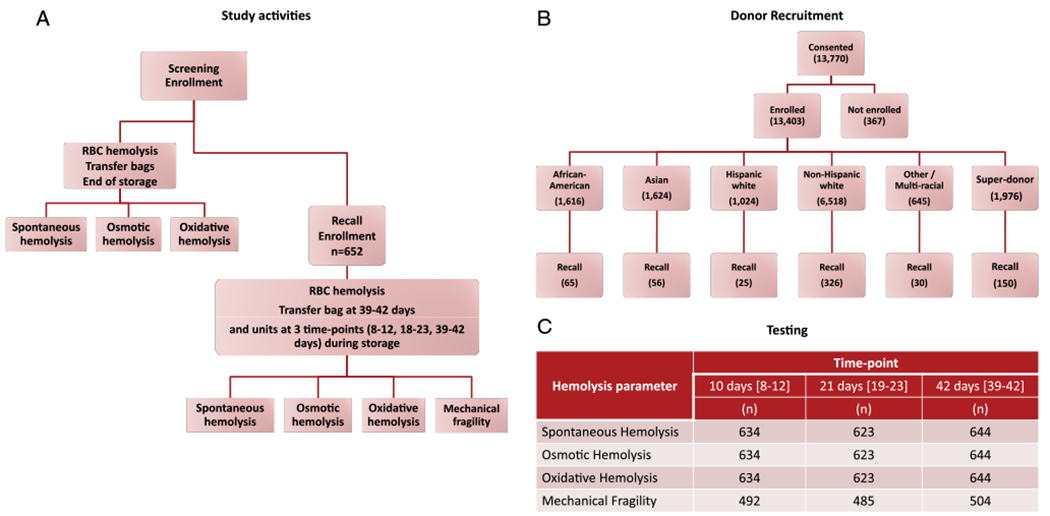
Study design and methods: RBC-Omics donors with either low or high hemolysis results on 4°C-stored leukoreduced (LR)-RBC samples from enrollment donations stored for 39 to 42 days were recalled 2 to 12 months later to donate LR-RBCs. Samples of stored LR-RBCs from the unit and from transfer bags were evaluated for spontaneous and stress-induced hemolysis at selected storage time points. Intradonor reproducibility of hemolysis variables was evaluated in transfer bags over two donations. Hemolysis data at serial storage time points were generated on LR-RBCs from parent bags and analyzed by site, sex, race/ethnicity, and donation frequency.
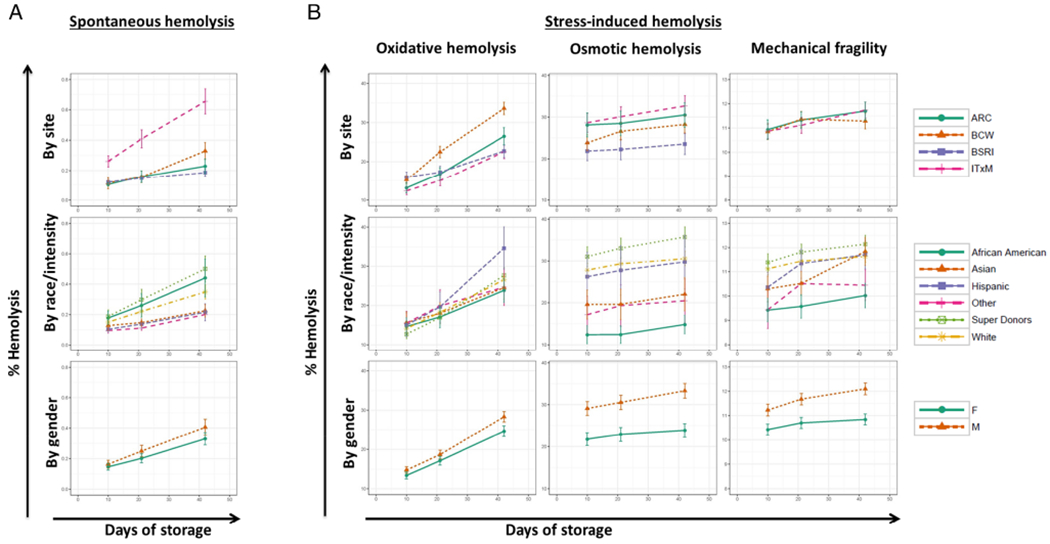
Results: A total of 664 donors were successfully recalled. Analysis of intradonor reproducibility revealed that osmotic and oxidative hemolysis demonstrated good and moderate reproducibility (Pearson's r = 0.85 and r = 0.53, respectively), while spontaneous hemolysis reproducibility was poor (r = 0.40). Longitudinal hemolysis in parent bags showed large increases over time in spontaneous (508.6%) and oxidative hemolysis (399.8%) and smaller increases in osmotic (9.4%) and mechanical fragility (3.4%; all p < 0.0001).
Conclusion: Spontaneous hemolysis is poorly reproducible in donors over time and may depend on site processing methods, while oxidative and osmotic hemolysis were reproducible in donors and hence could reflect consistent heritable phenotypes attributable to genetic traits. Spontaneous and oxidative hemolysis increased over time of storage, whereas osmotic and mechanical hemolysis remained relatively stable.
© 2018 The Authors. Transfusion published by Wiley Periodicals, Inc. on behalf of AABB.
Conflict of interest statement
CONFLICT OF INTEREST
AEM receives research grant funding from Novo Nordisk. The remaining authors have disclosed no relevant conflicts of interest.
Figures


Comment in
-
Translating red cell "omics" into new perspectives in transfusion medicine: mining the gems in the data mountains.Transfusion. 2019 Jan;59(1):2-5. doi: 10.1111/trf.15066. Transfusion. 2019. PMID: 30615814 No abstract available.
-
Intradonor reproducibility and changes in hemolytic variables during RBC storage: a common mistake in reproducibility analysis.Transfusion. 2019 Aug;59(8):2749-2750. doi: 10.1111/trf.15400. Transfusion. 2019. PMID: 31374149 No abstract available.
-
In response.Transfusion. 2019 Aug;59(8):2750-2751. doi: 10.1111/trf.15418. Transfusion. 2019. PMID: 31374152 No abstract available.
References
-
- Bordbar A, McCloskey D, Zielinski DC, et al. Personalized whole-cell kinetic models of metabolism for discovery in genomics and pharmacodynamics. Cell Syst 2015;1:283–92. - PubMed
-
- Hess JR. Biomedical excellence for safer transfusion scientific problems in the regulation of red blood cell products. Transfusion 2012;52:1827–35. - PubMed
-
- Tzounakas VL, Georgatzakou HT, Kriebardis AG, et al. Donor variation effect on red blood cell storage lesion: a multivariable, yet consistent, story. Transfusion 2016;56:1274–86. - PubMed
-
- Tzounakas VL, Kriebardis AG, Papassideri IS, et al. Donor-variation effect on red blood cell storage lesion: a close relationship emerges. Proteomics Clin Appl 2016;10:791–804. - PubMed
Publication types
MeSH terms
Grants and funding
LinkOut - more resources
Full Text Sources
Medical
