


Ethanol→Nicotine & Nicotine→Ethanol drug-sequence discriminations: Conditional stimulus control with two interoceptive drug elements in rats
- PMID: 30408489
- PMCID: PMC6500766
- DOI: 10.1016/j.alcohol.2018.10.012
Ethanol→Nicotine & Nicotine→Ethanol drug-sequence discriminations: Conditional stimulus control with two interoceptive drug elements in rats
Abstract
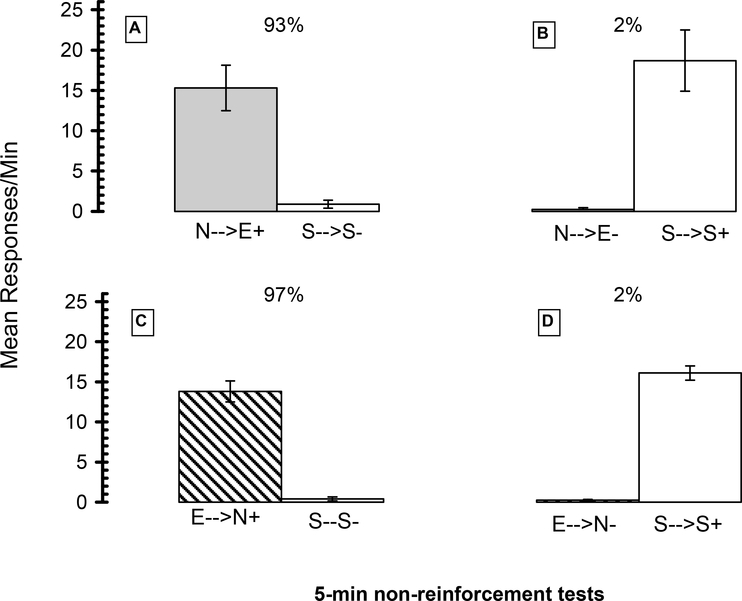
Self-administration of ethanol (E) and nicotine (N) occurs frequently in tandem orders (i.e., N→E vs. E→N) and thereby produces differing interoceptive profiles of subjective effects in humans. If the interoceptive stimulus characteristics of N→E differ from E→N, it is possible that such differences contribute to their co-dependence. The rationale for the present investigation was to determine whether ethanol, when preceded or followed by nicotine, produces different discriminative stimulus effects in rats. In two experiments, using a one-manipulandum operant drug discrimination procedure, rats were trained to discriminate temporal sequential administrations of ethanol (1.0 g/kg) that was followed or preceded by nicotine (0.3 mg/kg). Sessions alternated between food-reinforcement sessions on a variable interval 30-sec schedule (i.e., SD) and non-reinforcement sessions (i.e., SΔ). In Experiment 1, administrations of ethanol were followed or preceded by a 10-min interval of nicotine. Training sessions took place 10 min following the second drug injection. Four groups of rats were trained to discriminate only one sequence from sequential administrations of saline, and each drug sequence was counterbalanced across groups for their roles as SD or SΔ. There was robust stimulus control. N→E and E→N functioned equally well as SD or SΔ. Experiment 2 used two groups of rats. For one group, the E→N sequence functioned as the SD and the N→E sequence functioned as the SΔ. The drug sequences were counterbalanced for the other group. Brief non-reinforcement tests revealed significantly greater responding during the SD sequence compared to the SΔ sequence for both groups. These results suggest that different drug sequences of ethanol followed or preceded by nicotine established reliable discriminative stimulus control over operant responding, potentially because of characteristic differences in the overlapping pharmacokinetic profiles of the NE compound. The results are discussed in terms of: 1) conditional stimulus control among two interoceptive drug states; and 2) the clinical modulation of human alcohol consumption and tobacco smoking.
Keywords: Conditional drug discrimination; Drug sequence; Ethanol; Nicotine; Rats.
Copyright © 2018 Elsevier Inc. All rights reserved.
Conflict of interest statement
Conflict of Interest
The author has no conflict of interest, financial of otherwise.
Figures



References
-
- Barret SP, Tichauer M, Leyton M, & Pihl RO (2006). Nicotine increases alcohol selfadministration in non-dependent male smokers. Drug and Alcohol Dependence, 81, 197–204. - PubMed
-
- Barry HB III, Koepfer E, & Lutch J (1965). Learning to discriminate between alcohol and nondrug condition. Psychological Reports, 16, 1072.
-
- Barry HB III, and Krimmer EC (1976). Discriminable stimuli produced by alcohol and other CNS depressants. Psychopharmacology Communications, 2, 323–326. - PubMed
-
- Becker HC, & Baros AM (2006). Effect of duration and pattern of chronic ethanol exposure on tolerance to the discriminative stimulus effects of ethanol in C57BL/6J mice. Journal of Pharmacology & Experimental Therapeutics, 319(2), 871–878. - PubMed
-
- Bevins RA, Wilkinson JL, Palmatier MI, Siebert HL, & Wiltgen SM (2006). Characterization of nicotine’s ability to serve as a negative feature in a Pavlovian appetitive conditioning task in rats. Psychopharmacology, 184, 470–481. - PubMed
Publication types
MeSH terms
Substances
Grants and funding
LinkOut - more resources
Full Text Sources
Research Materials
Miscellaneous
