


Five-year follow-up of a cluster-randomized controlled trial of a client-centred activities of daily living intervention for people with stroke
- PMID: 30409049
- PMCID: PMC6348459
- DOI: 10.1177/0269215518809791
Five-year follow-up of a cluster-randomized controlled trial of a client-centred activities of daily living intervention for people with stroke
Abstract
Objective:: To compare five-year outcomes and changes over time of a client-centred activities of daily living (ADL) intervention versus usual ADL interventions for people with stroke and their significant others.
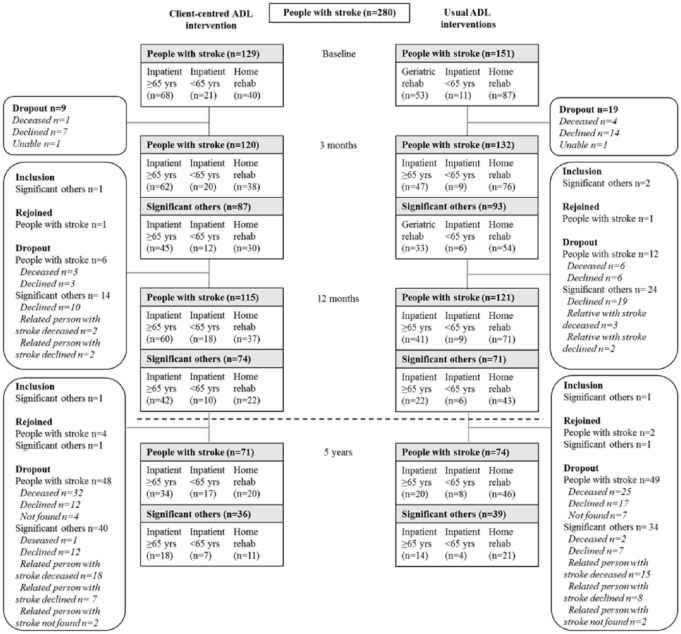
Design:: Five-year follow-up of a cluster-randomized controlled trial where a client-centred ADL intervention ( n = 129) or usual ADL interventions ( n = 151) were delivered to people with stroke.
Setting:: Multicentre study including 16 inpatient or home-based rehabilitation units.
Participants:: People with stroke and significant others.
Intervention:: The client-centred ADL intervention aimed at enabling agency in daily activities and participation in everyday life and at reducing caregiver burden.
Main measures:: For people with stroke, perceived participation (Stroke Impact Scale), independence in ADL, life satisfaction, and use of formal/informal care were measured. For significant others, caregiver burden, life satisfaction, and mood (Hospital Anxiety and Depression Scale) were assessed.
Results:: Five years post-intervention, data were collected from 145 people with stroke (intervention group: n = 71/control group: n = 74) and 75 significant others (intervention group: n = 36/control group: n = 39). For those with stroke, the Participation domain of the Stroke Impact Scale showed no group differences at year five (68.9 vs 75.4, P = 0.062) or in changes over time. At year five, the control group had better outcomes regarding Other help/supervision. Significant others in the control group were more likely to show signs of depression at year five (odds ratio = 22.3; P < 0.001).
Conclusion:: The client-centred ADL intervention appears to render similar long-term effects as usual ADL interventions for people with stroke, but for significant others signs of depression might be reduced.
Keywords: Stroke rehabilitation; caregivers; evaluation studies; follow-up studies; longitudinal studies; occupational therapy; rehabilitation.
Conflict of interest statement
Figures
References
-
- Achten D, Visser-Meily JMA, Post MWM, et al. Life satisfaction of couples 3 years after stroke. Disabil Rehabil 2012; 34(17): 1468–1472. - PubMed
-
- Bergstrom A, Guidetti S, Tham K, et al. Association between satisfaction and participation in everyday occupations after stroke. Scand J Occup Ther 2017; 24(5): 339–348. - PubMed
-
- Ytterberg C, Dyback M, Bergstrom A, et al. Perceived impact of stroke six years after onset, and changes in impact between one and six years. J Rehabil Med 2017; 49(8): 637–643. - PubMed
-
- Abzhandadze T, Forsberg-Wärleby G, Holmegaard L, et al. Life satisfaction in spouses of stroke survivors and control subjects: a 7-year follow-up of participants in the Sahlgrenska Academy study on ischaemic stroke. J Rehabil Med 2017; 49(7): 550–557. - PubMed
Publication types
MeSH terms
LinkOut - more resources
Full Text Sources
Medical
