


Identifying heart failure using EMR-based algorithms
- PMID: 30409334
- PMCID: PMC6233734
- DOI: 10.1016/j.ijmedinf.2018.09.016
Identifying heart failure using EMR-based algorithms
Abstract
Background: Heart failure (HF) is a major clinical and public health problem, the management of which will benefit from large-scale pragmatic research that leverages electronic medical records (EMR). Requisite to using EMRs for HF research is the development of reliable algorithms to identify HF patients. We aimed to develop and validate computable phenotype algorithms to identify patients with HF using standardized data elements defined by the Patient Centered Outcomes Research Network (PCORnet) Common Data Model (CDM).
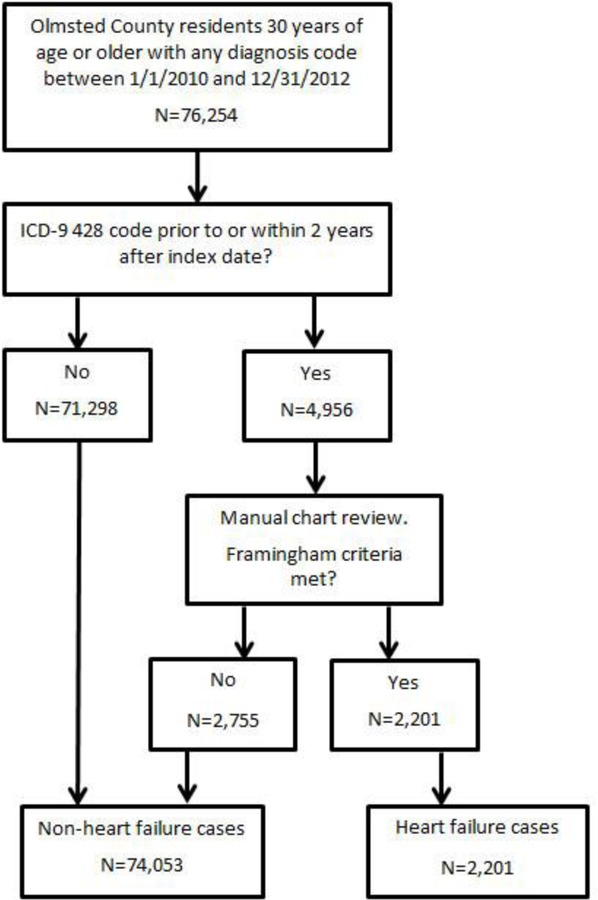
Methods: We built HF computable phenotypes utilizing the data domains of HF diagnosis codes, prescribed HF-related medications and N-terminal B-type natriuretic peptide (NT-proBNP). Algorithms were validated in a cohort (n = 76,254) drawn from Olmsted County, MN between 2010-2012 a sample of whose records were manually reviewed to confirm HF according to Framingham criteria.
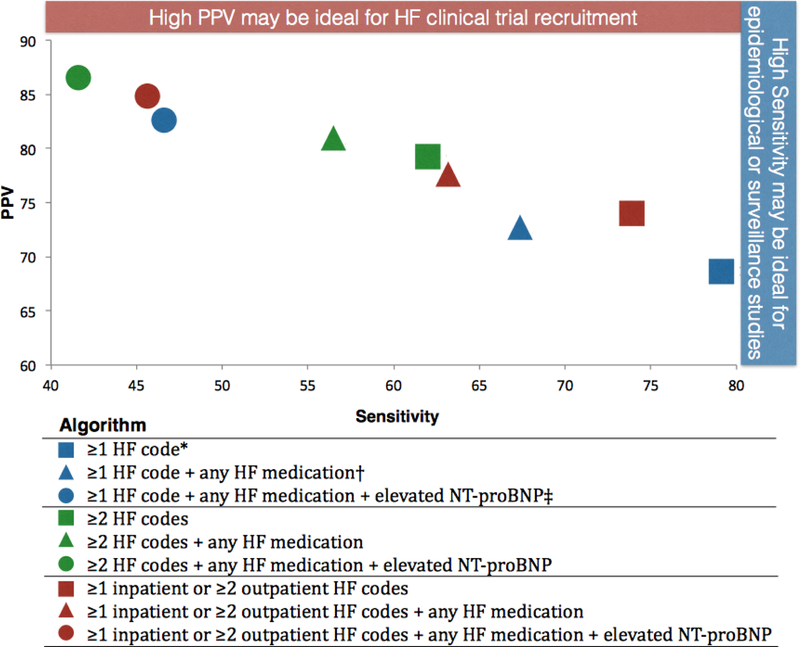
Results: The different algorithms we tested provided different tradeoffs between sensitivity and positive predictive value (PPV). The highest sensitivity (78.7%) algorithm utilized one HF diagnosis code and had the lowest PPV (68.5%). The addition of more algorithm components, such as additional HF diagnosis codes, HF medications or elevated NT-proBNP, improved the PPV while reducing sensitivity. When added to a diagnostic code, the addition of NT-proBNP (>450 pg/mL) had a similar impact compared to additional HF medication criteria, increasing PPV by ∼3-4% and decreasing sensitivity by ∼7-10%.
Conclusions: Algorithms derived from PCORnet CDM elements can be used to identify patients with HF without manual adjudication with reasonable sensitivity and PPV. Algorithm choice should be driven by the goal of the research.
Keywords: Cohort studies; Electronic health records; Heart failure; Learning health system; Outcomes assessment.
Copyright © 2018 Elsevier B.V. All rights reserved.
Conflict of interest statement
Conflict of Interest:
Relevant industry disclosures are as follows: Jeff Olgin—Research Grant, Zoll Medical Corporation.
Figures
References
Publication types
MeSH terms
Substances
Grants and funding
LinkOut - more resources
Full Text Sources
Medical
Research Materials
Miscellaneous
