


Mechanisms of resistance to BRAF and MEK inhibitors and clinical update of US Food and Drug Administration-approved targeted therapy in advanced melanoma
- PMID: 30410366
- PMCID: PMC6200076
- DOI: 10.2147/OTT.S182721
Mechanisms of resistance to BRAF and MEK inhibitors and clinical update of US Food and Drug Administration-approved targeted therapy in advanced melanoma
Abstract
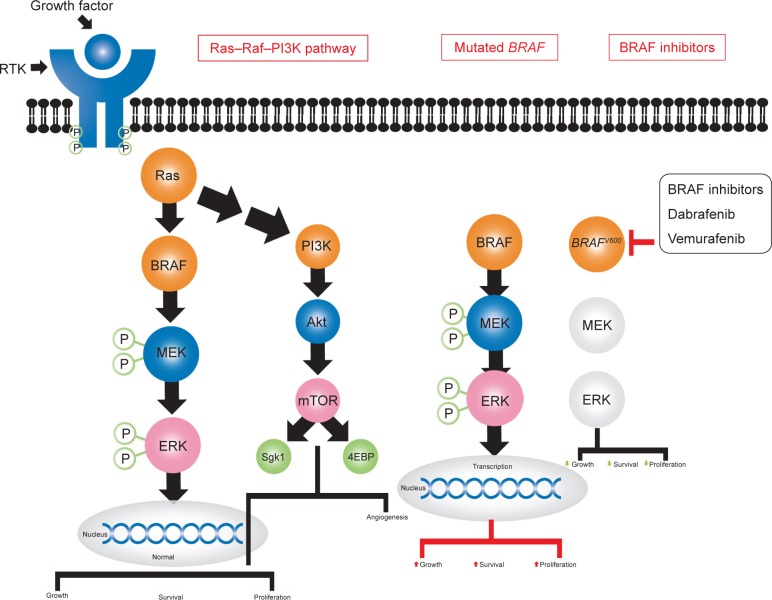
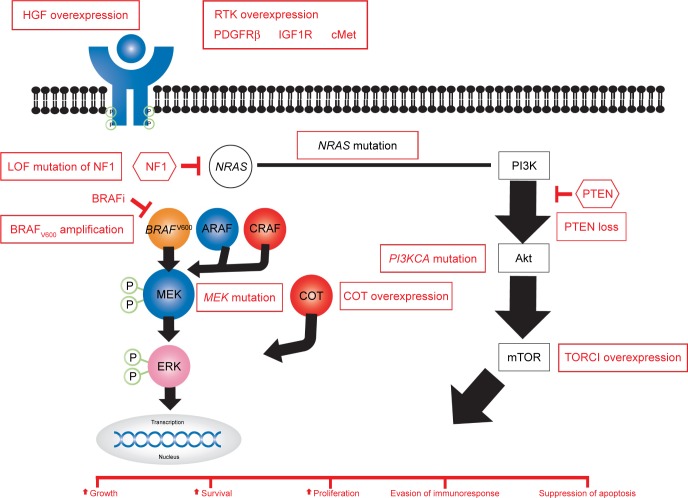
Approximately 50% of melanomas harbor an activating BRAF mutation. Combined BRAF and MEK inhibitors such as dabrafenib and trametinib, vemurafenib and cobimetinib, and encorafenib and binimetinib are US Food and Drug Administration (FDA)-approved to treat patients with BRAF V600-mutated advanced melanoma. Both genetic and epigenetic alterations play a major role in resistance to BRAF inhibitors by reactivation of the MAPK and/or the PI3K-Akt pathways. The role of BRAF inhibitors in modulating the immunomicroenvironment and perhaps enhancing the efficacy of checkpoint inhibitors is gaining interest. This article provides a comprehensive review of mechanisms of resistance to BRAF and MEK inhibitors in melanoma and summarizes landmark trials that led to the FDA approval of BRAF and MEK inhibitors in metastatic melanoma.
Keywords: BRAF inhibitor; MEK inhibitor; malignant melanoma; resistance; targeted therapy.
Conflict of interest statement
Disclosure The authors report no conflicts of interest in this work.
Figures
References
-
- Davies H, Bignell GR, Cox C, et al. Mutations of the BRAF gene in human cancer. Nature. 2002;417(6892):949–954. - PubMed
-
- Weinstein IB, Joe AK. Mechanisms of disease: oncogene addiction – a rationale for molecular targeting in cancer therapy. Nat Clin Pract Oncol. 2006;3(8):448–457. - PubMed
-
- Kefford R, Arkenau H, Brown MP, et al. Phase I/II study of GSK2118436, a selective inhibitor of oncogenic mutant BRAF kinase, in patients with metastatic melanoma and other solid tumors. J Clin Oncol. 2010;28(15 Suppl):8503.
-
- Robert C, Karaszewska B, Schachter J, et al. Improved overall survival in melanoma with combined dabrafenib and trametinib. N Engl J Med. 2015;372(1):30–39. - PubMed
Publication types
LinkOut - more resources
Full Text Sources
Other Literature Sources
Research Materials
