Review
. 2018 Oct 19:7:F1000 Faculty Rev-1664.
doi: 10.12688/f1000research.14385.1. eCollection 2018.

What is the hologenome concept of evolution?

Affiliations
Review

What is the hologenome concept of evolution?

J Jeffrey Morris. F1000Res. .

Abstract

All multicellular organisms are colonized by microbes, but a gestalt study of the composition of microbiome communities and their influence on the ecology and evolution of their macroscopic hosts has only recently become possible. One approach to thinking about the topic is to view the host-microbiome ecosystem as a "holobiont". Because natural selection acts on an organism's realized phenotype, and the phenotype of a holobiont is the result of the integrated activities of both the host and all of its microbiome inhabitants, it is reasonable to think that evolution can act at the level of the holobiont and cause changes in the "hologenome", or the collective genomic content of all the individual bionts within the holobiont. This relatively simple assertion has nevertheless been controversial within the microbiome community. Here, I provide a review of recent work on the hologenome concept of evolution. I attempt to provide a clear definition of the concept and its implications and to clarify common points of disagreement.

Keywords: holobiont; hologenome; microbiome; symbiosis.


Conflict of interest statement

No competing interests were disclosed.No competing interests were disclosed.No competing interests were disclosed.

Figures
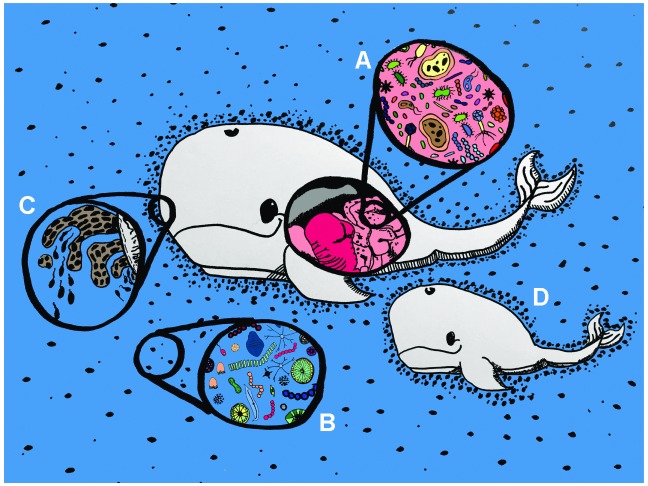
Figure 1.
Figure 1.. Challenges in defining the holobiont.
Some of the discomfort over the hologenome concept stems from the difficulty in defining what a holobiont is. This mother and baby whale highlight some of the issues. ( A) According to the most common definition of “holobiont”, the microbes and viruses living inside the whale’s body clearly qualify as members of the whale holobiont. ( B) Likewise, at a sufficient distance from the whale’s body, the planktonic microbial population is clearly not part of the whale holobiont. ( C) However, many organisms spend part of their lives in contact with the whale and part of their lives elsewhere, as demonstrated by these skin microbes alternating between biofilm and planktonic life stages. The theoretical basis for understanding the evolutionary trajectories of these part-time symbionts remains in its infancy. ( D) The hologenome concept posits that many social animals inherit their microbiome from their kin because the environment they share becomes enriched with bacteria specific to their lineage (shown here as denser clouds of microbial dots near the whales). However, this presents interesting challenges to the hologenome concept since microbial symbiont lineages are shared more or less promiscuously between individual hosts and also spend time in the environment between hosts. In the case of these aquatic animals, the portion of the symbiont community currently living planktonically is even capable of communicating with those living on or in the whale via diffusible chemical cues (for example, quorum-sensing autoinducers). These factors blur the boundaries between holobionts and present difficulties for understanding evolution at the holobiont level by using traditional individual-based models. Artwork by Sarah J. Adkins.

References

    1. Yong E: I Contain Multitudes.(Ecco, New York)2017.
    1. Rosenberg E, Kellogg C, Rohwer F: Coral Microbiology. Oceanog. 2007;20(2):146–54. 10.5670/oceanog.2007.60 - DOI
    1. Gutschick VP: Evolved Strategies in Nitrogen Acquisition by Plants. Am Nat. 1981;118(5):607–37. 10.1086/283858 - DOI
    1. Ruby EG: Lessons from a cooperative, bacterial-animal association: The Vibrio fischeri-Euprymna scolopes light organ symbiosis. Annu Rev Microbiol. 1996;50:591–624. 10.1146/annurev.micro.50.1.591 - DOI - PubMed
    1. Margaret JMN: Consequences of Evolving with Bacterial Symbionts: Insights from the Squid-Vibrio Associations. Annu Rev Ecol Syst. 1999;30:235–56. 10.1146/annurev.ecolsys.30.1.235 - DOI

Publication types

LinkOut - more resources