


Care of infants with gastroschisis in low-resource settings
- PMID: 30413264
- PMCID: PMC7116007
- DOI: 10.1053/j.sempedsurg.2018.08.004
Care of infants with gastroschisis in low-resource settings
Abstract
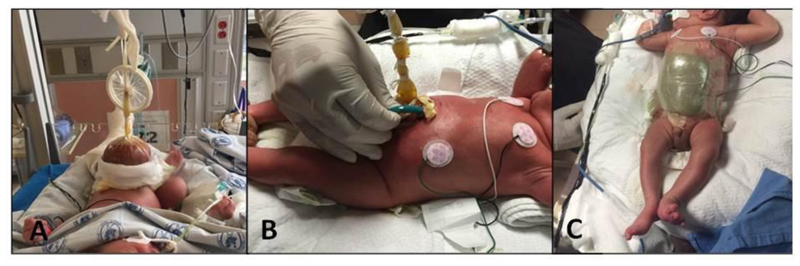
There is great global disparity in the outcome of infants born with gastroschisis. Mortality approaches 100% in many low income countries. Barriers to better outcomes include lack of antenatal diagnosis, deficient pre-hospital care, ineffective neonatal resuscitation and venous access, limited intensive care facilities, poor access to the operating theatre and safe neonatal anesthesia, and lack of neonatal parenteral nutrition. However, lessons can be learned from the evolution in management of gastroschisis in high-income countries, generic efforts to improve neonatal survival in low- and middle-income countries as well as specific gastroschisis management initiatives in low-resource settings. Micro and meso-level interventions include educational outreach programs, and pre and in hospital management protocols that focus on resuscitation and include the delay or avoidance of early neonatal anesthesia by using a preformed silo or equivalent. Furthermore, multidisciplinary team training, nurse empowerment, and the intentional involvement of mothers in monitoring and care provision may contribute to improving survival. Macro level interventions include the incorporation of ultrasound into World Health Organisation antenatal care guidelines to improve antenatal detection and the establishment of the infrastructure to enable parenteral nutrition provision for neonates in low- and middle-income countries. On a global level, gastroschisis has been suggested as a bellwether condition for evaluating access to and outcomes of neonatal surgical care provision.
Keywords: Bellwether; Gastroschisis; Low and middle-income countries; Low-resource settings.
Crown Copyright © 2018. Published by Elsevier Inc. All rights reserved.
Figures
References
-
- Feldkamp ML, Botto LD. Developing a research and public health agenda for gastroschisis: how do we bridge the gap between what is known and what is not? Am J Med Genet C Semin Med Genet. 2008;148C(3):155–61. - PubMed
-
- Ford K, Poenaru D, Moulot O, et al. Gastroschisis: Bellwether for neonatal surgery capacity in low resource settings? J Pediatr Surg. 2016;51(8):1262–7. - PubMed
-
- Wesonga AS, Fitzgerald TN, Kabuye R, et al. Gastroschisis in Uganda: Opportunities for improved survival. J Pediatr Surg. 2016;51(11):1772–7. - PubMed
-
- Apfeld JC, Wren SM, Macheka N, et al. Infant, maternal, and geographic factors influencing gastroschisis related mortality in Zimbabwe. Surgery. 2015;158(6):1475–80. - PubMed
Publication types
MeSH terms
Grants and funding
LinkOut - more resources
Full Text Sources
