


Testing a Web-Based Interactive Comic Tool to Decrease Obesity Risk Among Minority Preadolescents: Protocol for a Pilot Randomized Control Trial
- PMID: 30413399
- PMCID: PMC6251980
- DOI: 10.2196/10682
Testing a Web-Based Interactive Comic Tool to Decrease Obesity Risk Among Minority Preadolescents: Protocol for a Pilot Randomized Control Trial
Abstract
Background: Childhood obesity is a public health crisis, particularly in low-income, minority populations in the United States. Innovative and technology-enhanced interventions may be an engaging approach to reach at-risk youth and their parents to improve dietary behaviors and feeding practices. However, such tools are limited, especially ones that are theory-based; co-developed with user-centered approaches; tailored to low-income, minority preadolescents; and include parent-focused content.
Objective: The objectives of this study include assessing the feasibility and acceptability and exploring the potential impact of the Intervention INC (Interactive Nutrition Comics for urban, minority preadolescents) Web-based tool, which is focused on decreasing childhood obesity risk in black/African American and Latino children aged 9 to 12 years.
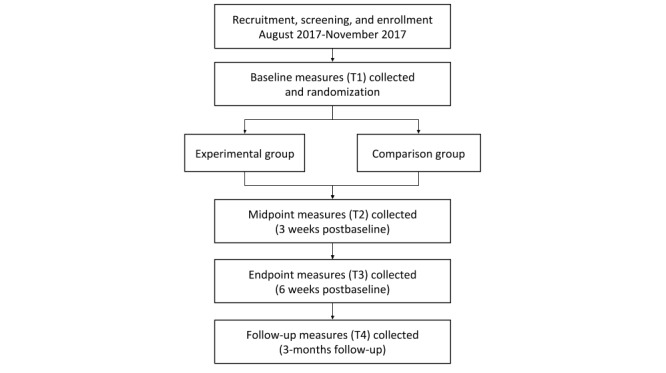
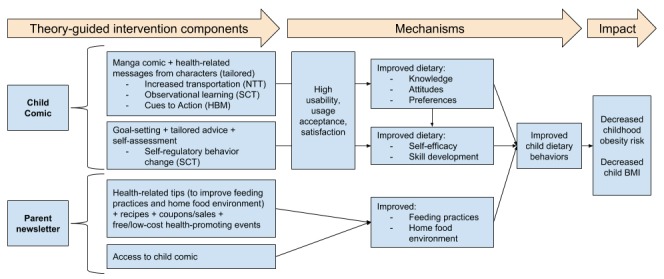
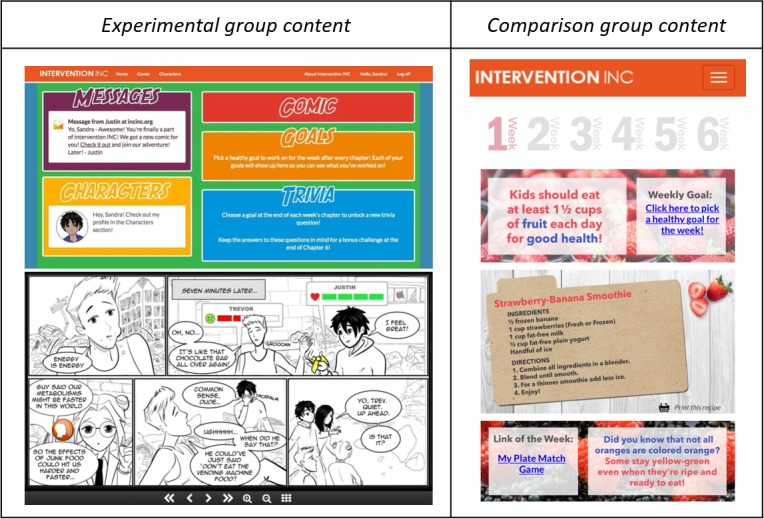
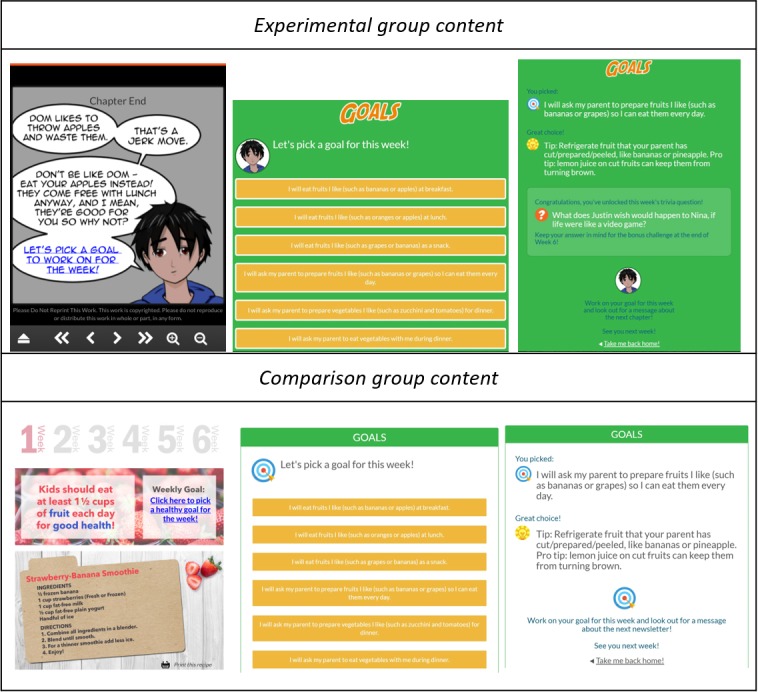
Methods: Intervention INC is underpinned by the narrative transportation theory, social cognitive theory, and health belief model, and it was co-developed by children and parents from the intended population. The child component consists of a 6-chapter interactive nutrition comic optimized for use on tablet devices, a goal-setting and self-assessment feature, and weekly text/email messages and reminders. The parental component consists of 6 Web-based newsletters, access to the child comic, and weekly text/email messages and reminders. The tool was evaluated using a pilot, single-blind, 2-group randomized controlled study design. Child-parent dyads were randomized to either the experimental or comparison group and assigned to a targeted behavior (increase fruit/vegetable or water intake) based on initial screening questions. Data were collected at 4 time points: baseline (T1), intervention midpoint (T2), intervention endpoint (T3), and 3 months postintervention (T4). Primary measures comprise usage, usability, and feasibility of the Web-based tool. Secondary measures comprise dietary knowledge, preferences, and intake and anthropometric measures (for child) and feeding practices and home food environment (for parent).
Results: Study enrollment was completed in November 2017. A total of 89 child-parent dyads were randomized to either the experimental (n=44) or comparison (n=45) group. Data analysis is currently being conducted.
Conclusions: This study aims to implement and assess an innovative approach to deliver health messages and resources to at-risk minority preadolescents and their parents. If found to be acceptable, engaging, feasible, and a potential approach to improve dietary behaviors, a full-fledged randomized controlled trial will be conducted to assess its efficacy and potential impact.
Trial registration: ClinicalTrials.gov NCT03165474; https://clinicaltrials.gov/ct2/show/NCT03165474 (Archived by WebCite at http://www.webcitation.org/73122IjgP).
International registered report identifier (irrid): RR1-10.2196/10682.
Keywords: child; diet; mHealth; minority; parents; pediatric obesity; vulnerable populations.
©May May Leung, Katrina F Mateo, Sandra Verdaguer, Katarzyna Wyka. Originally published in JMIR Research Protocols (http://www.researchprotocols.org), 09.11.2018.
Conflict of interest statement
Conflicts of Interest: None declared.
Figures

References
-
- Ogden CL, Carroll MD, Fakhouri TH, Hales CM, Fryar CD, Li X, Freedman DS. Prevalence of obesity among youths by household income and education level of head of household - United States 2011-2014. MMWR Morb Mortal Wkly Rep. 2018 Feb 16;67(6):186–89. doi: 10.15585/mmwr.mm6706a3. doi: 10.15585/mmwr.mm6706a3. - DOI - PMC - PubMed
-
- Danaei G, Ding EL, Mozaffarian D, Taylor B, Rehm J, Murray CJ, Ezzati M. The preventable causes of death in the United States: comparative risk assessment of dietary, lifestyle, and metabolic risk factors. PLoS Med. 2009 Apr 28;6(4):e1000058. doi: 10.1371/journal.pmed.1000058. http://dx.plos.org/10.1371/journal.pmed.1000058 - DOI - PMC - PubMed
Associated data
LinkOut - more resources
Full Text Sources
Medical
