Review
. 2019 Jan;120(1):16-25.
doi: 10.1038/s41416-018-0333-1. Epub 2018 Nov 9.

Immunosuppression mediated by myeloid-derived suppressor cells (MDSCs) during tumour progression

Affiliations
Review

Immunosuppression mediated by myeloid-derived suppressor cells (MDSCs) during tumour progression

Christopher Groth et al. Br J Cancer. 2019 Jan.

Abstract

Under steady-state conditions, bone marrow-derived immature myeloid cells (IMC) differentiate into granulocytes, macrophages and dendritic cells (DCs). This differentiation is impaired under chronic inflammatory conditions, which are typical for tumour progression, leading to the accumulation of IMCs. These cells are capable of inducing strong immunosuppressive effects through the expression of various cytokines and immune regulatory molecules, inhibition of lymphocyte homing, stimulation of other immunosuppressive cells, depletion of metabolites critical for T cell functions, expression of ectoenzymes regulating adenosine metabolism, and the production of reactive species. IMCs are therefore designated as myeloid-derived suppressor cells (MDSCs), and have been shown to accumulate in tumour-bearing mice and cancer patients. MDSCs are considered to be a strong contributor to the immunosuppressive tumour microenvironment and thus an obstacle for many cancer immunotherapies. Consequently, numerous studies are focused on the characterisation of MDSC origin and their relationship to other myeloid cell populations, their immunosuppressive capacity, and possible ways to inhibit MDSC function with different approaches being evaluated in clinical trials. This review analyses the current state of knowledge on the origin and function of MDSCs in cancer, with a special emphasis on the immunosuppressive pathways pursued by MDSCs to inhibit T cell functions, resulting in tumour progression. In addition, we describe therapeutic strategies and clinical benefits of MDSC targeting in cancer.


Conflict of interest statement

The authors declare no competing interests.

Figures
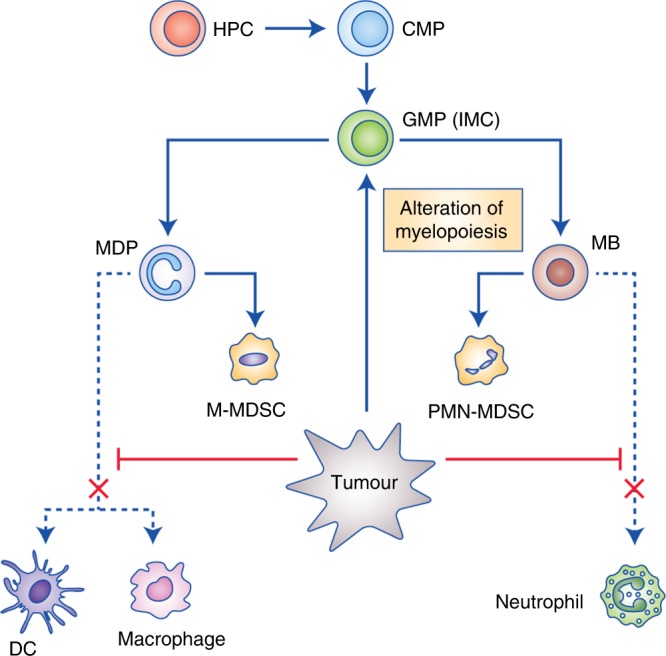
Fig. 1
Fig. 1
Myelopoiesis is altered under chronic inflammation. Under physiological conditions, hematopoietic progenitor cells (HPC) differentiate via common myeloid progenitor cells (CMP) into granulocyte/macrophage progenitor cells (GMP). These immature myeloid cells (IMC) further differentiate into monocytic/dendritic progenitor cells (MDP) or myeloblasts (MB) from which these cells further develop into dendritic cells (DCs)/macrophages or neutrophils, respectively. Under cancerous conditions, the tumour alters myelopoiesis in general and impairs further differentiation of progenitor cells, leading to the accumulation of monocytic myeloid-derived suppressor cells (M-MDSCs) and polymorphonuclear MDSCs (PMN-MDSCs)
Fig. 2
Fig. 2
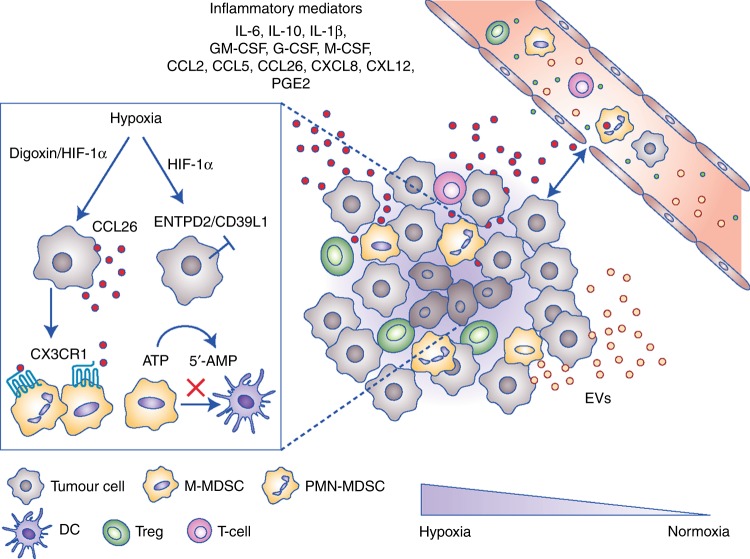
Myeloid-derived suppressor cells (MDSCs) are generated under chronic inflammatory conditions typical for cancer. Inflammatory factors that induce MDSC recruitment and expansion in the tumour microenvironment include interleukin (IL)-6, IL-10, IL-1β, granulocyte-macrophage colony-stimulating factor (GM-CSF), granulocyte colony-stimulating factor (G-CSF), macrophage colony-stimulating factor (M-CSF), chemokine (C-C motif) ligand 2 (CCL)2, CCL5, CCL26, chemokine (C-X-C motif) ligand 8 (CXCL)8, CXL12, and prostaglandin E2 (PGE2), released as soluble mediators or via extracellular vesicles (EVs). Hypoxia in the tumour microenvironment facilitates the expression of hypoxia-inducible factors digoxin and Hypoxia-inducible factor 1-alpha (HIF-1α) that induce the expression of the chemokine CCL26 and adenosine-producing ectoenzymes by tumour cells, leading to MDSC recruitment and accumulation
Fig. 3
Fig. 3
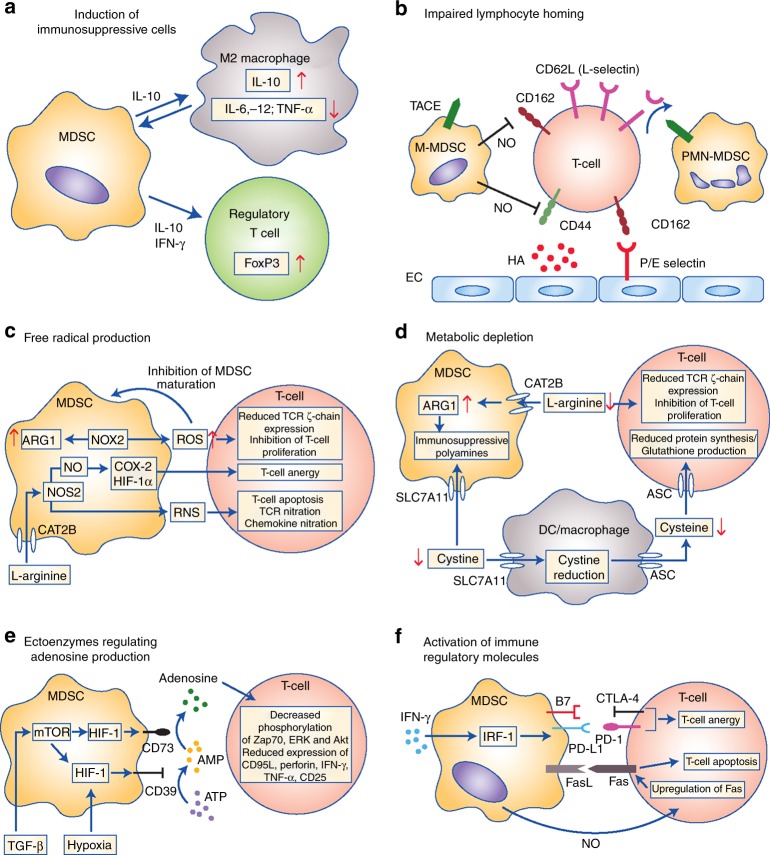
Main mechanisms of immunosuppression mediated by myeloid-derived suppressor cells (MDSCs). Mechanisms include the generation of immunosuppressive M2 macrophages and regulatory T cells via interleukin (IL)-10 and interferon (IFN)-γ secretion (a); impairment of lymphocyte adhesion to endothelial cells (ECs) and extravasation through nitric oxide (NO)-mediated downregulation of adhesion molecules CD162 and CD44, and tumor necrosis factor-alpha-converting enzyme (TACE)-mediated cleavage of CD62L (L-Selectin) on T cells (b); the production of reactive oxygen (ROS) and nitrogen species (RNS) through NADPH oxidase 2 (NOX-2) and nitric oxide synthase 2 (NOS2), leading to increased cyclooxygenase 2 (Cox-2), Hypoxia-inducible factor 1-alpha (HIF-1α) and arginase 1 (ARG1) expression and reduced T cell receptor (TCR) expression (c); the depletion and intracellular degradation of the amino acids L-arginine and cystine through increased uptake via the CAT2B and SLC7A11 transporters, respectively (d); induction of the ectoenzymes CD39 and CD73 via HIF-1 through transforming growth factor beta (TGF-β and hypoxic conditions, leading to adenosine production and reduced phosphorylation of extracellular signal–regulated kinase (ERK), protein kinase B (Akt) and Zap70, and reduced expression of CD95L, perforin, IFN-γ and tumour necrosis factor alpha TNF-α in T cells (e); and the expression of immune regulatory molecules B7, programmed death-ligand 1 (PD-L1) and FasL, causing T cell anergy and apoptosis via binding to their respective receptors (f)

References

    1. Weiskopf Kipp, et al. Myeloid cell origins, differentiation, and clinical implications. Microbiol. Spectr. 2016;42:407–420. - PMC - PubMed
    1. Velten L, et al. Human haematopoietic stem cell lineage commitment is a continuous process. Nat. Cell Biol. 2017;19:271–281. doi: 10.1038/ncb3493. - DOI - PMC - PubMed
    1. Ioannou M, et al. Crucial role of granulocytic myeloid-derived suppressor cells in the regulation of central nervous system autoimmune disease. J. Immunol. 2012;188:1136–1146. doi: 10.4049/jimmunol.1101816. - DOI - PubMed
    1. Dorhoi, A. & Plessis, N. Du. Monocytic myeloid-derived suppressor cells in chronic infections. Front. Immunol. 8. 10.3389/fimmu.2017.01895 (2018). - PMC - PubMed
    1. Meyer C, et al. Chronic inflammation promotes myeloid-derived suppressor cell activation blocking antitumor immunity in transgenic mouse melanoma model. Proc. . Natl Acad. Sci. USA. 2011;108:17111–17116. doi: 10.1073/pnas.1108121108. - DOI - PMC - PubMed

Publication types