Review
. 2019 Jan;120(1):45-53.
doi: 10.1038/s41416-018-0327-z. Epub 2018 Nov 9.

The clinical role of the TME in solid cancer

Affiliations
Review

The clinical role of the TME in solid cancer

Nicolas A Giraldo et al. Br J Cancer. 2019 Jan.

Abstract

The highly complex and heterogenous ecosystem of a tumour not only contains malignant cells, but also interacting cells from the host such as endothelial cells, stromal fibroblasts, and a variety of immune cells that control tumour growth and invasion. It is well established that anti-tumour immunity is a critical hurdle that must be overcome for tumours to initiate, grow and spread and that anti-tumour immunity can be modulated using current immunotherapies to achieve meaningful anti-tumour clinical responses. Pioneering studies in melanoma, ovarian and colorectal cancer have demonstrated that certain features of the tumour immune microenvironment (TME)-in particular, the degree of tumour infiltration by cytotoxic T cells-can predict a patient's clinical outcome. More recently, studies in renal cell cancer have highlighted the importance of assessing the phenotype of the infiltrating T cells to predict early relapse. Furthermore, intricate interactions with non-immune cellular players such as endothelial cells and fibroblasts modulate the clinical impact of immune cells in the TME. Here, we review the critical components of the TME in solid tumours and how they shape the immune cell contexture, and we summarise numerous studies evaluating its clinical significance from a prognostic and theranostic perspective.


Conflict of interest statement

The authors declare no competing interests.

Figures

Fig. 1
Fig. 1
The tumour microenvironment and immune contexture in cancer. Schematic depicting the three main components in the tumour microenvironment. The mechanisms shaping the immune cell contexture are highlighted. MDSCs, myeloid-derived suppressor cells; Treg, regulatory CD4+ T cells
Fig. 2
Fig. 2
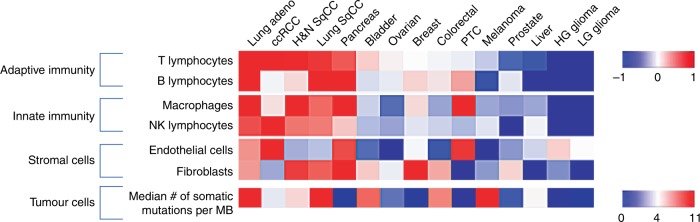
The tumour microenvironment and mutational landscape across tumour types. Heatmap representing the average number of somatic mutations (ranging from 0.7 per megabase in thyroid cancer, to 11 per megabase in melanoma) and relative abundance of infiltrating immune and stromal cells across 15 different human tumours as determined by Microenvironment Cell Populations-counter (MCP-counter). The cancer types are organised from left to right according to the abundance of T cell infiltrate. SqCC, squamous cell carcinoma; Adeno, adenocarcinoma; H&N, head and neck; ccRCC, clear cell renal cell carcinoma; LG, low-grade; HG, high-grade; PTC, papillary thyroid cancer
Fig. 3
Fig. 3
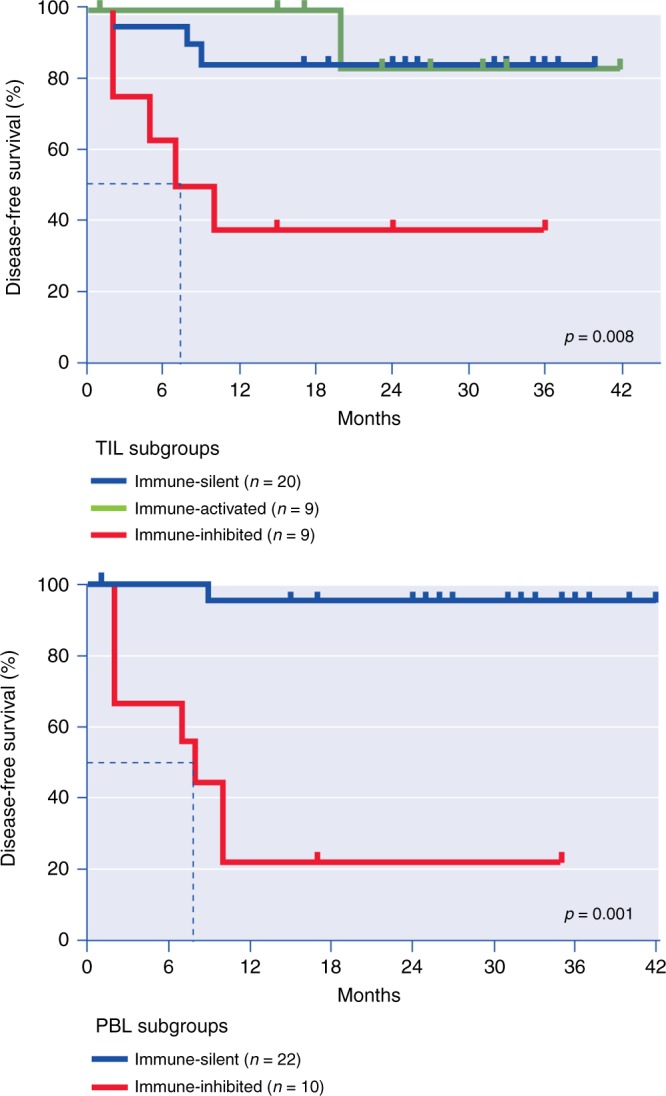
Intra-tumour and peripheral blood T cell immune profiles and prognosis in ccRCC. Disease-free survival according to tumour-infiltrating lymphocyte (TIL) and peripheral blood lymphocyte (PBL) subgroups. P values according to univariate Cox regression analysis are displayed. Updated April 2018 from reference

References

    1. Giraldo N.A., Taube J.M. PD-L1 and Other Immunological Diagnosis Tools. In: Zitvogel L., Kroemer G. (eds) Oncoimmunology (Springer, Cham, 2018).
    1. Giraldo NA, et al. The immune contexture of primary and metastatic human tumours. Curr. Opin. Immunol. 2014;27:8–15. doi: 10.1016/j.coi.2014.01.001. - DOI - PubMed
    1. Dranoff G. Cytokines in cancer pathogenesis and cancer therapy. Nat. Rev. Cancer. 2004;4:11–22. doi: 10.1038/nrc1252. - DOI - PubMed
    1. Dieu-Nosjean MC, et al. Tertiary lymphoid structures, drivers of the anti-tumor responses in human cancers. Immunol. Rev. 2016;271:260–275. doi: 10.1111/imr.12405. - DOI - PubMed
    1. de Chaisemartin L, et al. Characterization of chemokines and adhesion molecules associated with T cell presence in tertiary lymphoid structures in human lung cancer. Cancer Res. 2011;71:6391–6399. doi: 10.1158/0008-5472.CAN-11-0952. - DOI - PubMed

Publication types

MeSH terms