Review
. 2019 Mar;1862(3):280-290.
doi: 10.1016/j.bbagrm.2018.10.012. Epub 2018 Nov 7.

Detection of ribonucleoside modifications by liquid chromatography coupled with mass spectrometry

Affiliations
Review

Detection of ribonucleoside modifications by liquid chromatography coupled with mass spectrometry

Manasses Jora et al. Biochim Biophys Acta Gene Regul Mech. 2019 Mar.

Abstract

A small set of ribonucleoside modifications have been found in different regions of mRNA including the open reading frame. Accurate detection of these specific modifications is critical to understanding their modulatory roles in facilitating mRNA maturation, translation and degradation. While transcriptome-wide next-generation sequencing (NGS) techniques could provide exhaustive information about the sites of one specific or class of modifications at a time, recent investigations strongly indicate cautionary interpretation due to the appearance of false positives. Therefore, it is suggested that NGS-based modification data can only be treated as predicted sites and their existence need to be validated by orthogonal methods. Liquid chromatography-tandem mass spectrometry (LC-MS/MS) is an analytical technique that can yield accurate and reproducible information about the qualitative and quantitative characteristics of ribonucleoside modifications. Here, we review the recent advancements in LC-MS/MS technology that could help in securing accurate, gold-standard quality information about the resident post-transcriptional modifications of mRNA.

Keywords: LC-MS; Nucleoside analysis; Positional isomers; Post-transcriptional modifications; RNA modification mapping.


Conflict of interest statement

Conflict of interest: The authors declare no conflict of interest with this manuscript.

Figures
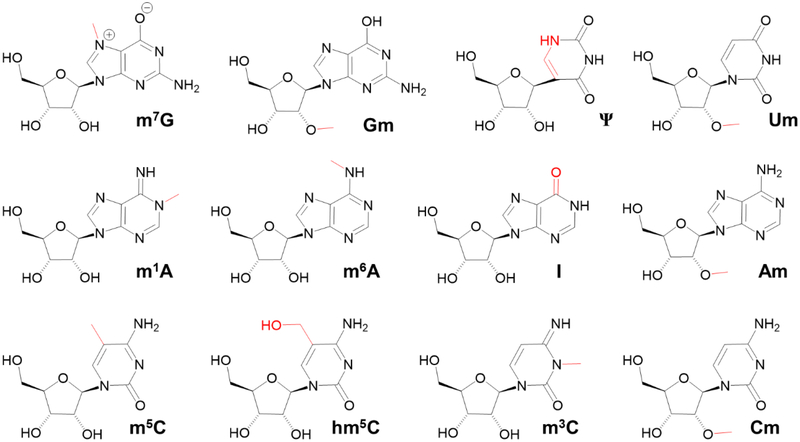
Figure 1:
Figure 1:
Ribonucleoside modifications of mRNA. m7G – 7-methylguanosine; Gm – 2’-O-methylguanosine; Ψ – pseudouridine; Um – 2’-O-methyluridine; m1A – N1,-methyladenosine; m6A – N6-methyladenosine; I – inosine; Am – 2’-O-methyladenosine; m5C – 5-methylcytidine; hm5C – 5-hydroxymethylcytidine; m3C – 3-methylcytidine; Cm – 2’-O-methylcytidine. The modification group is indicated by red line.
Figure 2:
Figure 2:
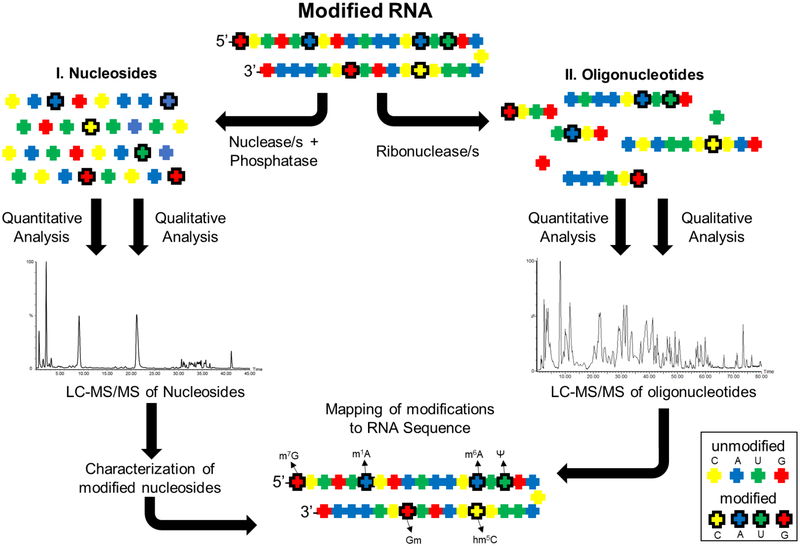
Characterization of ribonucleoside modification in RNA by LC-MS/MS analysis. The modified RNA is subjected to nucleosides (I) and oligonucleotide (II) analyses. Total hydrolysis of RNA leads to a mixture of both modified and unmodified nucleosides. Subsequent LC-MS/MS analysis identifies and catalogs the resident modifications. In a second analysis, the RNA is digested with nucleobase-specific ribonucleases resulting in oligonucleotides of varied length. Their nucleotide sequences are determined by different type of LC-MS/MS analysis (see the text) to identify the location of modification. The four colors represent four canonical nucleobases. The bold outline denotes the existence of modification.
Figure 3:
Figure 3:
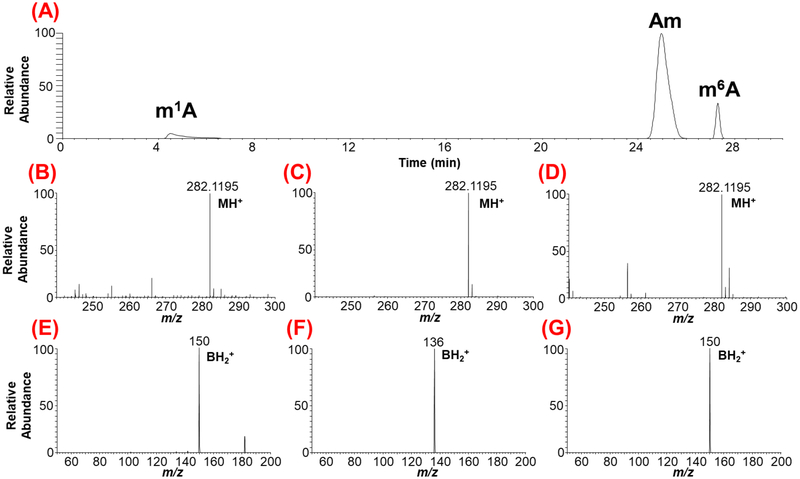
LC-MS/MS-based characterization of the methylated positional isomers of adenosine originating from yeast mRNA. (A) Extracted ion chromatogram (XIC) for m/z 282.1195 corresponding to methylated adenosine is shown. The methylated positional isomers exhibit different retention times depending on their hydrophobicity. (B), (C), (D), depict the mass spectra of chromatographic peaks with retention times at 4.8, 25.8 and 27.5 min, respectively. (E), (F), (G) represent the tandem mass spectra showing the nucleobase ion of molecular precursor ion for a given XIC. Note the differentiation of ribose methylated adenosine (Am) from base methylations (m1A and m6A) through nitrogenous base productc ion. However, the tandem mass spectra for base methylations, (E) and (G) do not distinguish the position of methylation on nitrogenous base as both exhibit identical nucleobase product ion.
Figure 4:
Figure 4:
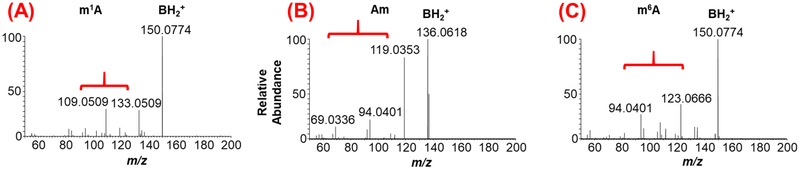
Differentiation of positional isomers of methylated adenosines (m/z 282.12) through molecular fingerprints generated by higher-energy collisional dissociation (HCD) analysis. (A) HCD of m1A indicating the presence of modified nitrogenous base and its fragments. (B) HCD of Am depicting the unmodified adenine and its fragment ions following the loss of methylated ribose. (C) HCD of m6A depicting the modified nitrogenous base and its fragment ions. The fragment ions are indicated by curved parenthesis. Note the molecular fingerprint of nitrogenous base fragment ions is different for each positional isomer.
Figure 5:
Figure 5:
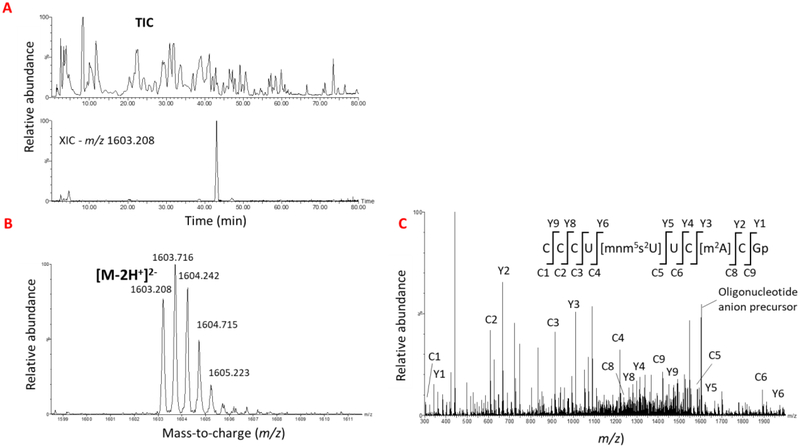
A typical LC-MS/MS-based sequencing of modified oligonucleotides to identify the location of modification. (A). The total ion Chromatogram (TIC) of Rnase T1 digest of E. coli total tRNA representing the elution pattern of all the ions coming from a reverse phase column is shown. The bottom panel shows the XIC for m/z 1603.208 corresponding to oligonucleotide, CCCU[mnm5s2U]UC[m2A]CGp from tRNAGlu is shown. (B) oligonucleotide precursor ion observed in the mass spectrum of the XIC peak is depicted. (C) Tandem mass spectrum of product ions generated by CID from oligonucleotide precursor is shown. The sequence informative fragment ions that bear the common 5’-end (cn ion series) or 3’-end (yn ion series) of oligonucleotide are labeled on the sequence. The vertical lines represent the points of phosphodiester cleavage leading to formation of c and y product ion series.

References

    1. Hoernes TP, Huttenhofer A, Erlacher MD, mRNA modifications: Dynamic regulators of gene expression?, RNA Biol, 13 (2016) 760–765. - PMC - PubMed
    1. Boccaletto P, Machnicka MA, Purta E, Piątkowski P, Bagiński B, Wirecki TK, de Crécy-Lagard V, Ross R, Limbach PA, Kotter A, Helm M, Bujnicki JM, MODOMICS: a database of RNA modification pathways. 2017 update, Nucleic Acids Research, 46 (2018) D303–D307. - PMC - PubMed
    1. Shatkin AJ, Capping of eucaryotic mRNAs, Cell, 9 (1976) 645–653. - PubMed
    1. Dubin DT, Stollar V, Methylation of Sindbis virus “26S” messenger RNA, Biochemical and biophysical research communications, 66 (1975) 1373–1379. - PubMed
    1. Desrosiers R, Friderici K, Rottman F, Identification of methylated nucleosides in messenger RNA from Novikoff hepatoma cells, Proceedings of the National Academy of Sciences of the United States of America, 71 (1974) 3971–3975. - PMC - PubMed

Publication types

LinkOut - more resources