. 2018 Oct 26:9:2435.
doi: 10.3389/fmicb.2018.02435. eCollection 2018.

Characterization of the Microbiome at the World's Largest Potable Water Reuse Facility

Affiliations

Characterization of the Microbiome at the World's Largest Potable Water Reuse Facility

Blake W Stamps et al. Front Microbiol. .

Abstract

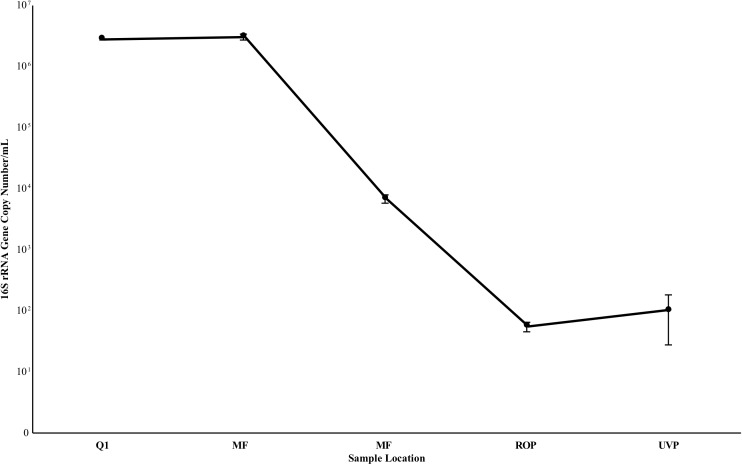
Conventional water resources are not sufficient in many regions to meet the needs of growing populations. Due to cyclical weather cycles, drought, and climate change, water stress has increased worldwide including in Southern California, which serves as a model for regions that integrate reuse of wastewater for both potable and non-potable use. The Orange County Water District (OCWD) Advanced Water Purification Facility (AWPF) is a highly engineered system designed to treat and produce up to 100 million gallons per day (MGD) of purified water from a municipal wastewater source for potable reuse. Routine facility microbial water quality analysis is limited to standard indicators at this and similar facilities. Given recent advances in high throughput DNA sequencing techniques, complete microbial profiling of communities in water samples is now possible. By using 16S/18S rRNA gene sequencing, metagenomic and metatranscriptomic sequencing coupled to a highly accurate identification method along with 16S rRNA gene qPCR, we describe a detailed view of the total microbial community throughout the facility. The total bacterial load of the water at stages of the treatment train ranged from 3.02 × 10⁶ copies in source, unchlorinated wastewater feed to 5.49 × 101 copies of 16S rRNA gene/mL after treatment (consisting of microfiltration, reverse osmosis, and ultraviolet/advanced oxidation). Microbial diversity and load decreased by several orders of magnitude after microfiltration and reverse osmosis treatment, falling to almost non-detectable levels that more closely resembled controls of molecular grade laboratory water than the biomass detected in the source water. The presence of antibiotic resistance genes and viruses was also greatly reduced. Overall, system design performance was achieved, and comprehensive microbial community analysis was found to enable a more complete characterization of the water/wastewater microbial signature.

Keywords: metagenomics; metatranscriptomics; pathogens; water purification; water reuse.


Figures
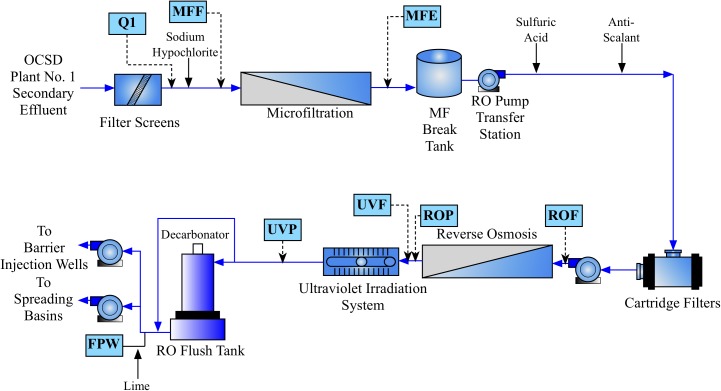
FIGURE 1
FIGURE 1
Process flow diagram of the Orange County Water District (OCWD) Groundwater Replenishment System (GWRS) Advanced Water Purification Facility (AWPF). Sample locations are shown in blue boxes, with approximate location in the flow diagram shown by dashed arrows. Hydrogen peroxide is also added prior to UV treatment (not shown).
FIGURE 2
FIGURE 2
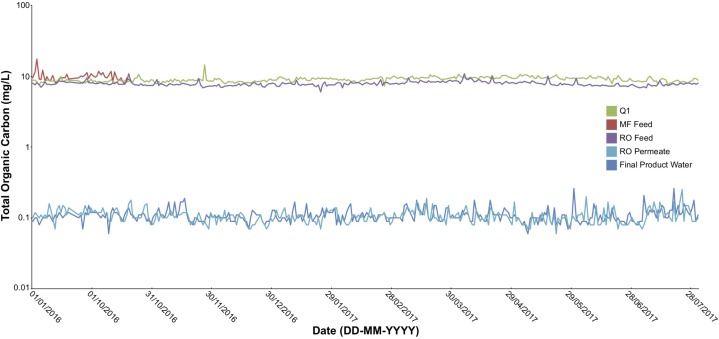
Total organic carbon (TOC) at Q1, MF feed, RO feed, RO permeate, and finished product water sampling points in the AWPF. Measurements taken once every 6 h using online instrumentation across the indicated sample period.
FIGURE 3
FIGURE 3
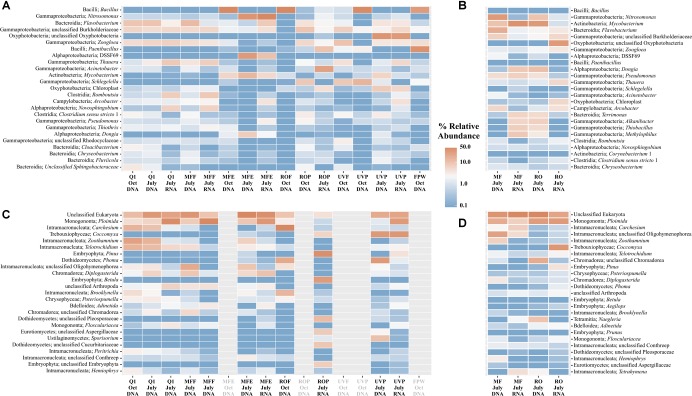
Taxonomy summary from rRNA gene sequence data of the bacteria/archaea in water samples (A) or biofilms (C), or eukaryotes in water (B) or biofilms (D) across the AWPF. Sample locations in gray failed QC, or did not produce sufficient quantities of DNA sequence to process within the eukaryotes. The top 25 genera by relative abundance for all domains of life are shown. Scale shown is in percent relative abundance from low (blue) to high (red) percentages.
FIGURE 4
FIGURE 4
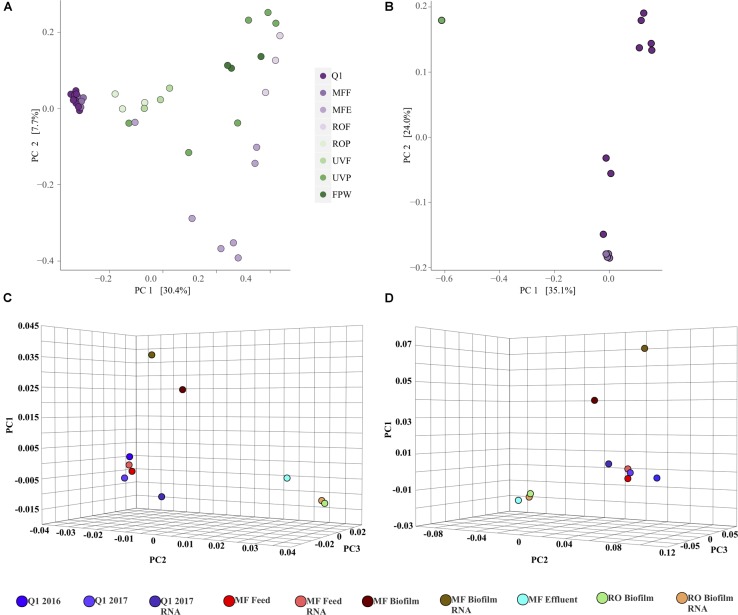
Principal coordinate ordination, produced using an unweighted UniFrac distance matrix for the bacteria/archaea (A) or eukaryotes (B) from rRNA gene sequence data. Axis values represent percent variance explained by the ordination. Principal component ordination of the bacteria (C) or antibiotic resistance genes (D) produced using a Bray-Curtis distance matrix within the CosmosID web application. Additional information on the specific types of ARGs used in the ordination of 5d can be found in Supplementary Table S2.
FIGURE 5
FIGURE 5
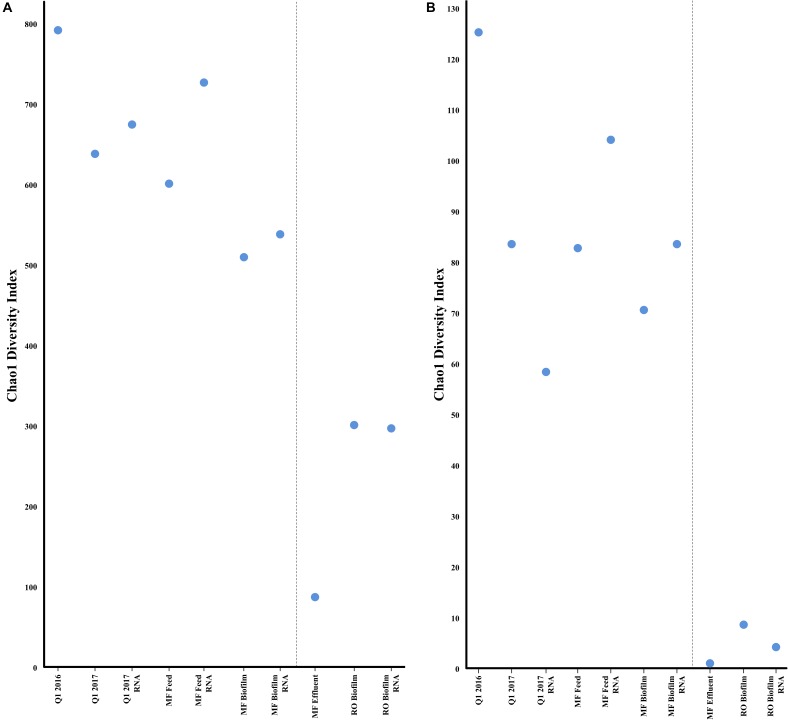
Alpha diversity (Chao1) of metagenomic and transcriptomic samples for bacteria (A) or antibiotic resistance genes (B) estimated by the CosmosID pipeline. Greater values indicate a greater number of bacterial species, or antibiotic resistance genes.
FIGURE 6
FIGURE 6
16S rRNA gene copy estimate from samples taken in July 2017. Values are the average of triplicate biological samples and triplicate technical replicates, per biological sample. Reported deviation is the standard deviation of the above samples. Deviation at Q1 was too low to be visualized on the plot. Y axis is log scale.

References

    1. Aieta E. M., Berg J. D. (1986). A review of chlorine dioxide in drinking-water treatment. J. Am. Water Works Assoc. 78 62–72. 10.1002/j.1551-8833.1986.tb05766.x - DOI
    1. Amha Y. M., Anwar M. Z., Kumaraswamy R., Henschel A., Ahmad F. (2017). Mycobacteria in municipal wastewater treatment and reuse: microbial diversity for screening the occurrence of clinically and environmentally relevant species in arid regions. Environ. Sci. Technol. 51 3048–3056. 10.1021/acs.est.6b05580 - DOI - PubMed
    1. Bal Krishna K. C., Sathasivan A., Ginige M. P. (2013). Microbial community changes with decaying chloramine residuals in a lab-scale system. Water Res. 47 4666–4679. 10.1016/j.watres.2013.04.035 - DOI - PubMed
    1. Boucher H. W., Talbot G. H., Bradley J. S., Edwards J. E., Gilbert D., Rice L. B., et al. (2009). Bad bugs, no drugs: no ESKAPE! An update from the infectious diseases society of America. Clin. Infect. Dis. 48 1–12. 10.1086/595011 - DOI - PubMed
    1. Caporaso J. G., Bittinger K., Bushman F. D., DeSantis T. Z., Andersen G. L., Knight R. (2010a). PyNAST: a flexible tool for aligning sequences to a template alignment. Bioinformatics 26 266–267. 10.1093/bioinformatics/btp636 - DOI - PMC - PubMed

LinkOut - more resources