


Analyses of risk factors and prognosis for new-onset atrial fibrillation in elderly patients after dual-chamber pacemaker implantation
- PMID: 30416511
- PMCID: PMC6221846
- DOI: 10.11909/j.issn.1671-5411.2018.10.008
Analyses of risk factors and prognosis for new-onset atrial fibrillation in elderly patients after dual-chamber pacemaker implantation
Abstract
Objective: To retrospectively identify risk factors and the prognosis for new-onset atrial fibrillation (AF) after implantation of dual-chamber pacemakers in elderly patients.
Methods: Consecutive patients aged ≥ 65 years who underwent their first implantation of a dual-chamber permanent pacemaker in Beijing Anzhen Hospital from October 2013 to May 2016 were enrolled. Their complete programming and follow-up data were recorded. Follow-up end points included new-onset AF and major adverse cardiovascular and cerebrovascular events.
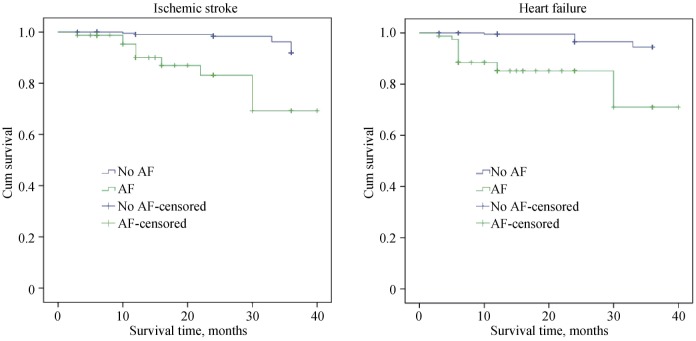
Results: Altogether, 322 patients were enrolled, with new-onset AF observed in 79 (24.5%) during their follow-up. Multivariable analysis identified four independent predictors of new-onset AF in elderly patients after pacemaker implantation: hypertension (HR = 3.040, 95% CI: 1.09-3.05, P = 0.00); age (HR = 1.966, 95% CI: 1.57-3.68, P = 0.01); left atrial enlargement (HR = 1.645, 95% CI: 1.05-1.25, P = 0.03); high ventricular pacing rate (HR = 1.137, 95% CI: 1.01-1.06, P = 0.01). Univariable analysis indicated that the CHA2DS2-VASc score was also a risk factor for AF (HR = 1.368, 95% CI: 1.178-1.589, P = 0.002), whereas multivariable regression analysis did not. Kaplan-Meier survival analysis showed that the risk for ischemic stroke was significantly higher in the new-onset AF group than in the non-AF group (P < 0.05).
Conclusion: Hypertension, age, left atrial enlargement, and high ventricular pacing rate were independent predictors of new-onset AF in elderly patients after implantation of a permanent pacemaker. New-onset AF increased the risk for ischemic stroke.
Keywords: Atrial fibrillation; Dual-chamber pacemaker; Elderly; Ischemic stroke.
Figures
References
-
- Nielsen JC. Mortality and incidence of atrial fibrillation in paced patients. J Cardiovasc Electrophysiol. 2002;13:17–22. - PubMed
-
- Wang M, Siu GW, Lee KL, et al. Effects of right low septalvs right atrial appendage pacing on atrial mechanical function and dyssynchrony in patients with sinus node dysfunction and pamxysmal atrial fibrillation. Europace. 2011;13:1268–1274. - PubMed
-
- Stambler BS, Ellenbogen KA, Orav EJ, et al. Predictors and clinical impact of atrial fibrillation after pacemaker implantation in elderly patients treated with dual chamber versus ventricular pacing. Pacing Clin Electrophysiol. 2003;26:2000–2007. - PubMed
-
- Fleischmann KE, Orav EJ, Lamas GA, et al. Atrial fibrillation and quality of life after pacemaker implantation for sick sinus syndrome: data from the Mode Selection Trial (MOST) Am Heart J. 2009;158:78–83. - PubMed
-
- Healey JS, Martin JL, Duncan A, et al. Pacemaker-detected atrial fibrillation in patients with pacemakers: prevalence, predictors, and current use of oral anticoagulation. Can J Cardiol. 2013;29:224–228. - PubMed
LinkOut - more resources
Full Text Sources