Review
. 2018 Oct 29:7:F1000 Faculty Rev-1713.
doi: 10.12688/f1000research.15797.1. eCollection 2018.

Epigenomic regulation of heart failure: integrating histone marks, long noncoding RNAs, and chromatin architecture

Affiliations
Review

Epigenomic regulation of heart failure: integrating histone marks, long noncoding RNAs, and chromatin architecture

Timothy A McKinsey et al. F1000Res. .

Abstract

Epigenetic processes are known to have powerful roles in organ development across biology. It has recently been found that some of the chromatin modulatory machinery essential for proper development plays a previously unappreciated role in the pathogenesis of cardiac disease in adults. Investigations using genetic and pharmacologic gain- and loss-of-function approaches have interrogated the function of distinct epigenetic regulators, while the increased deployment of the suite of next-generation sequencing technologies have fundamentally altered our understanding of the genomic targets of these chromatin modifiers. Here, we review recent developments in basic and translational research that have provided tantalizing clues that may be used to unlock the therapeutic potential of the epigenome in heart failure. Additionally, we provide a hypothesis to explain how signal-induced crosstalk between histone tail modifications and long non-coding RNAs triggers chromatin architectural remodeling and culminates in cardiac hypertrophy and fibrosis.

Keywords: cardiac hypertrophy; epigenetics; fibrosis; heart failure.


Conflict of interest statement

No competing interests were disclosed.No competing interests were disclosed.No competing interests were disclosed.

Figures
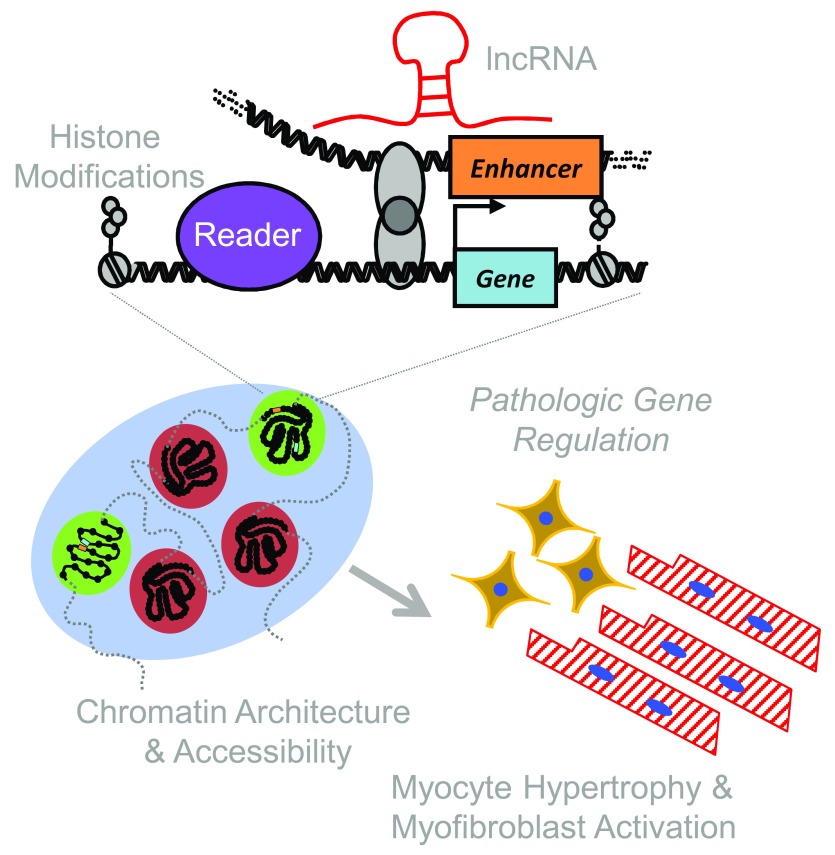
Figure 1.
Figure 1.. A model for integrating histone marks, long noncoding RNAs (lncRNAs), and chromatin architecture in heart failure.
The epigenomic regulation of cardiac phenotype occurs at multiple interacting scales. Histone isoforms, post-translational modification, and nucleosome distribution influence local transcription. lncRNAs have emerged as powerful regulators of gene expression, interacting with chromatin-modifying enzymes and influencing their histone targets. Together with other chromatin regulatory proteins, histone modifications and lncRNAs establish local chromatin accessibility and global chromatin architecture, facilitating short- and long-range regulatory interactions that enable cell type-specific transcriptomes in healthy and diseased conditions.

References

    1. Benjamin EJ, Blaha MJ, Chiuve SE, et al. : Heart Disease and Stroke Statistics-2017 Update: A Report From the American Heart Association. Circulation. 2017;135(10):e146–e603. 10.1161/CIR.0000000000000485 - DOI - PMC - PubMed
    2. F1000 Recommendation

    1. Tan M, Luo H, Lee S, et al. : Identification of 67 histone marks and histone lysine crotonylation as a new type of histone modification. Cell. 2011;146(6):1016–28. 10.1016/j.cell.2011.08.008 - DOI - PMC - PubMed
    2. F1000 Recommendation

    1. Miyamoto S, Kawamura T, Morimoto T, et al. : Histone acetyltransferase activity of p300 is required for the promotion of left ventricular remodeling after myocardial infarction in adult mice in vivo. Circulation. 2006;113(5):679–90. 10.1161/CIRCULATIONAHA.105.585182 - DOI - PubMed
    1. Wei JQ, Shehadeh LA, Mitrani JM, et al. : Quantitative control of adaptive cardiac hypertrophy by acetyltransferase p300. Circulation. 2008;118(9):934–46. 10.1161/CIRCULATIONAHA.107.760488 - DOI - PMC - PubMed
    2. F1000 Recommendation

    1. Wapenaar H, Dekker FJ: Histone acetyltransferases: challenges in targeting bi-substrate enzymes. Clin Epigenetics. 2016;8:59. 10.1186/s13148-016-0225-2 - DOI - PMC - PubMed

Publication types

Substances