p11 in Cholinergic Interneurons of the Nucleus Accumbens Is Essential for Dopamine Responses to Rewarding Stimuli
- PMID: 30417079
- PMCID: PMC6223111
- DOI: 10.1523/ENEURO.0332-18.2018
p11 in Cholinergic Interneurons of the Nucleus Accumbens Is Essential for Dopamine Responses to Rewarding Stimuli
Erratum in
-
Erratum: Hanada et al., p11 in Cholinergic Interneurons of the Nucleus Accumbens Is Essential for Dopamine Responses to Rewarding Stimuli (eNeuro September/October 2018, 5(5) e0332-18.2018 1-20 https://doi.org/10.1523/ENEURO.0332-18.2018).eNeuro. 2018 Dec 26;5(6):ENEURO.0493-18.2018. doi: 10.1523/ENEURO.0493-18.2018. eCollection 2018 Nov-Dec. eNeuro. 2018. PMID: 30627651 Free PMC article.
Abstract
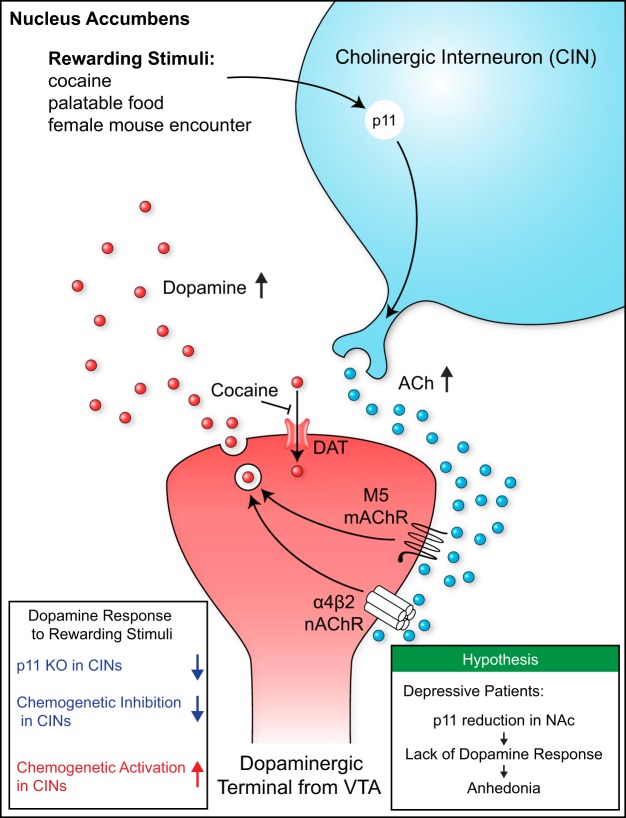
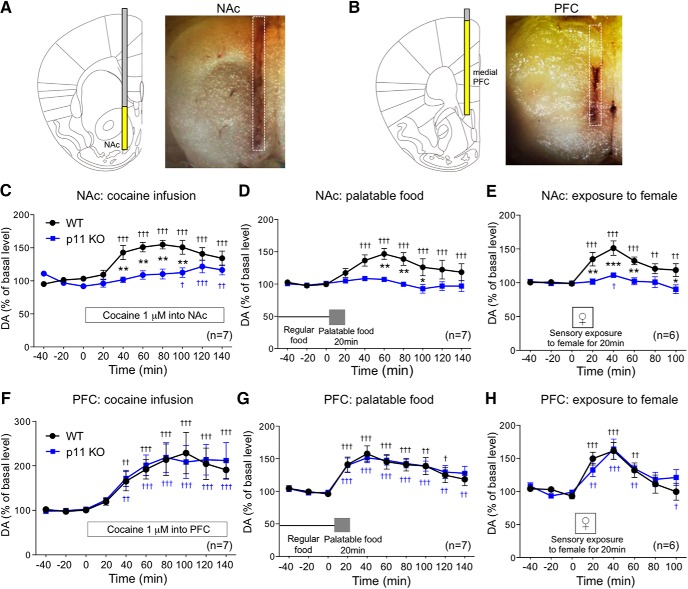
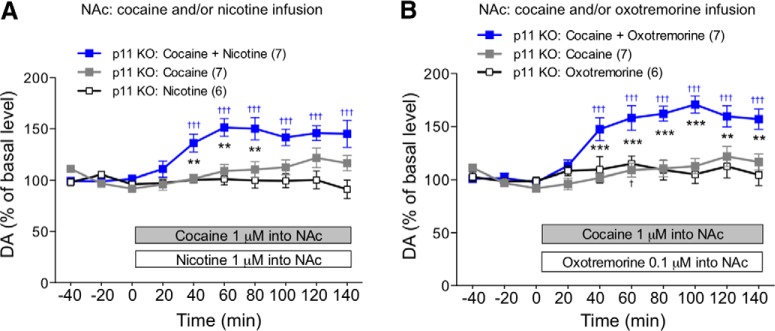
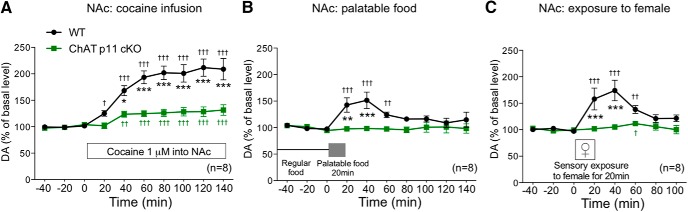
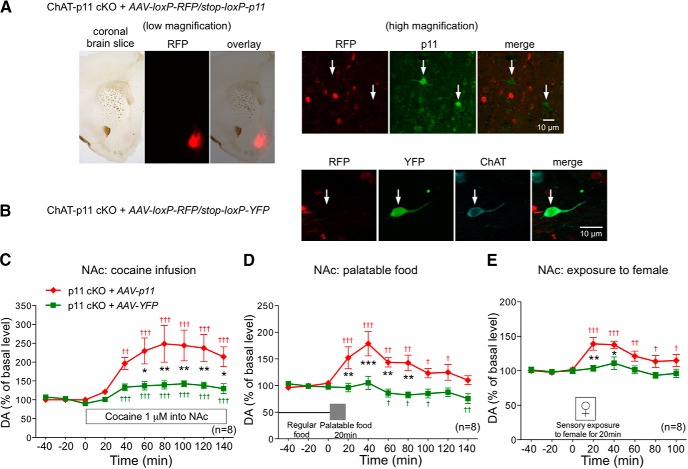
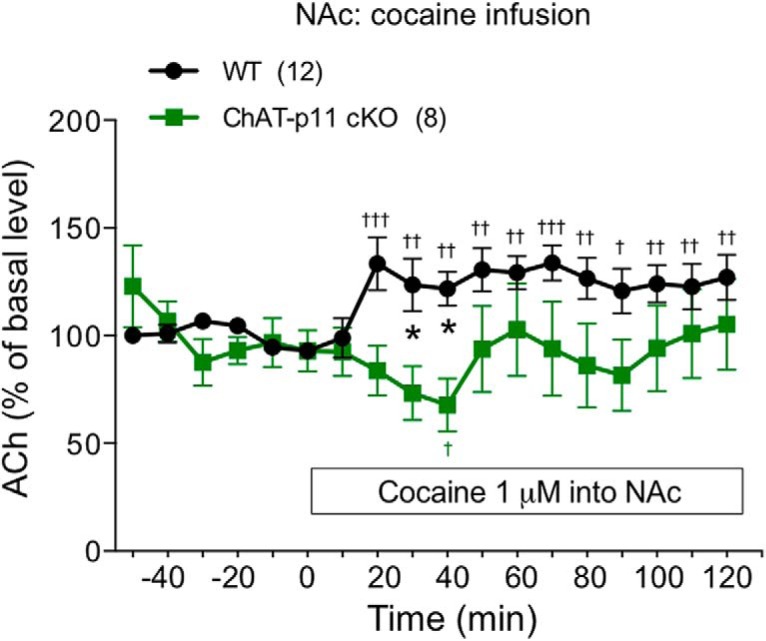
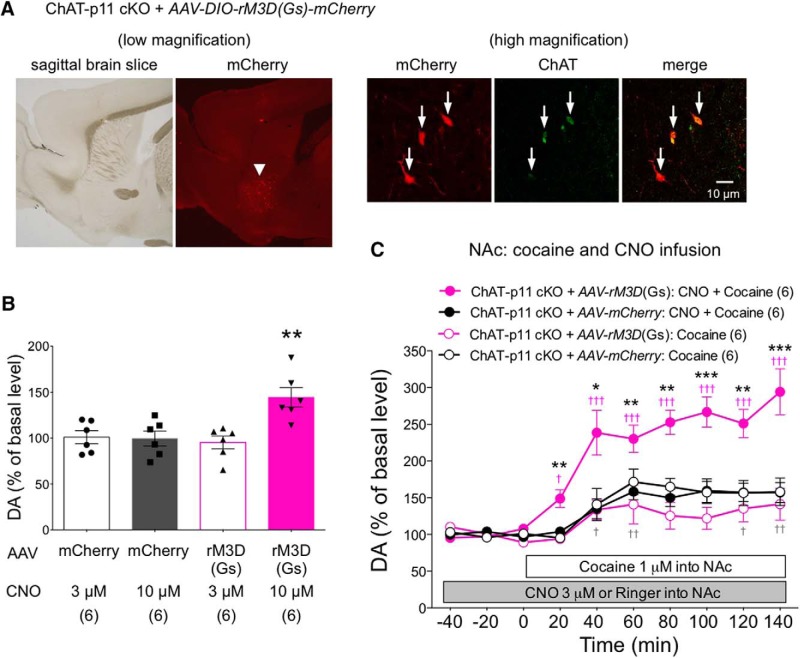
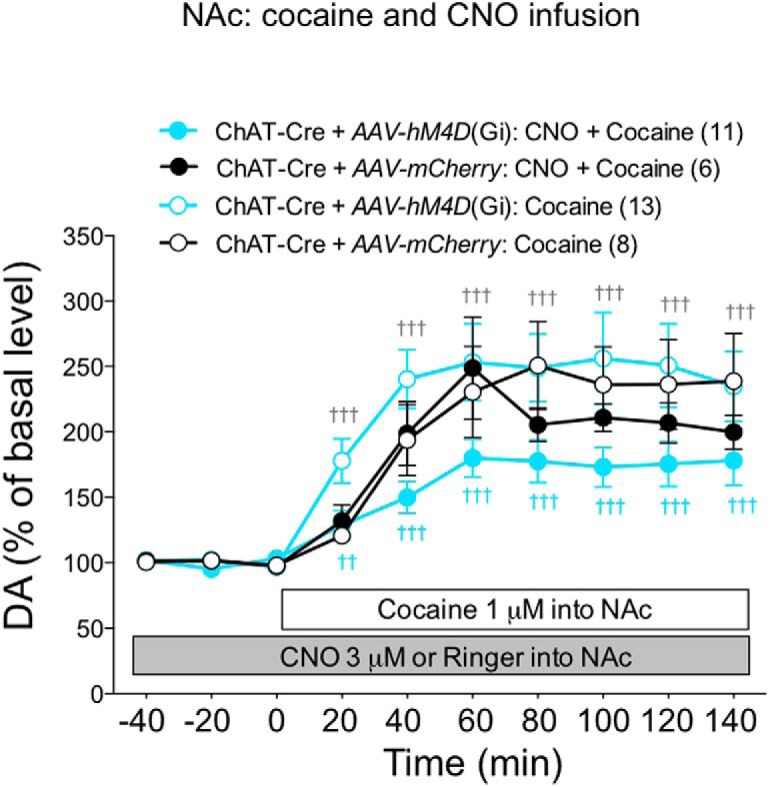
A recent study showed that p11 expressed in cholinergic interneurons (CINs) of the nucleus accumbens (NAc) is a key regulator of depression-like behaviors. Dopaminergic neurons projecting to the NAc are responsible for reward-related behaviors, and their function is impaired in depression. The present study investigated the role of p11 in NAc CINs in dopamine responses to rewarding stimuli. The extracellular dopamine and acetylcholine (ACh) levels in the NAc were determined in freely moving male mice using in vivo microdialysis. Rewarding stimuli (cocaine, palatable food, and female mouse encounter) induced an increase in dopamine efflux in the NAc of wild-type (WT) mice. The dopamine responses were attenuated (cocaine) or abolished (food and female mouse encounter) in constitutive p11 knock-out (KO) mice. The dopamine response to cocaine was accompanied by an increase in ACh NAc efflux, whereas the attenuated dopamine response to cocaine in p11 KO mice was restored by activation of nicotinic or muscarinic ACh receptors in the NAc. Dopamine responses to rewarding stimuli and ACh release in the NAc were attenuated in mice with deletion of p11 from cholinergic neurons (ChAT-p11 cKO mice), whereas gene delivery of p11 to CINs restored the dopamine responses. Furthermore, chemogenetic studies revealed that p11 is required for activation of CINs in response to rewarding stimuli. Thus, p11 in NAc CINs plays a critical role in activating these neurons to mediate dopamine responses to rewarding stimuli. The dysregulation of mesolimbic dopamine system by dysfunction of p11 in NAc CINs may be involved in pathogenesis of depressive states.
Keywords: acetylcholine; anhedonia; cholinergic interneuron; dopamine; nucleus accumbens; p11.
Figures
Comment in
-
Potential Protein Target to Therapeutically Restore Positive Mood States in Depression.eNeuro. 2019 Mar 28;6(2):ENEURO.0105-19.2019. doi: 10.1523/ENEURO.0105-19.2019. eCollection 2019 Mar-Apr. eNeuro. 2019. PMID: 30937359 Free PMC article.
References
-
- Alexander B, Warner-Schmidt J, Eriksson T, Tamminga C, Arango-Lievano M, Ghose S, Vernov M, Stavarache M, Musatov S, Flajolet M, Svenningsson P, Greengard P, Kaplitt MG (2010) Reversal of depressed behaviors in mice by p11 gene therapy in the nucleus accumbens. Sci Transl Med 2:54ra76. 10.1126/scitranslmed.3001079 - DOI - PMC - PubMed
-
- Arango-Lievano M, Schwarz JT, Vernov M, Wilkinson MB, Bradbury K, Feliz A, Marongiu R, Gelfand Y, Warner-Schmidt J, Nestler EJ, Greengard P, Russo SJ, Kaplitt MG (2014) Cell-type specific expression of p11 controls cocaine reward. Biol Psychiatry 76:794–801. 10.1016/j.biopsych.2014.02.012 - DOI - PMC - PubMed
-
- Berlanga ML, Olsen CM, Chen V, Ikegami A, Herring BE, Duvauchelle CL, Alcantara AA (2003) Cholinergic interneurons of the nucleus accumbens and dorsal striatum are activated by the self-administration of cocaine. Neuroscience 120:1149–1156. - PubMed
Publication types
MeSH terms
Substances
LinkOut - more resources
Full Text Sources
Molecular Biology Databases
Research Materials