


Coagulation phenotype of wild-type mice on different genetic backgrounds
- PMID: 30419767
- PMCID: PMC6416704
- DOI: 10.1177/0023677218811059
Coagulation phenotype of wild-type mice on different genetic backgrounds
Erratum in
-
Corrigendum to Coagulation phenotype of wild-type mice on different genetic backgrounds.Lab Anim. 2019 Feb;53(1):NP1-NP2. doi: 10.1177/0023677218816944. Epub 2018 Dec 18. Lab Anim. 2019. PMID: 30561240 Free PMC article. No abstract available.
Abstract
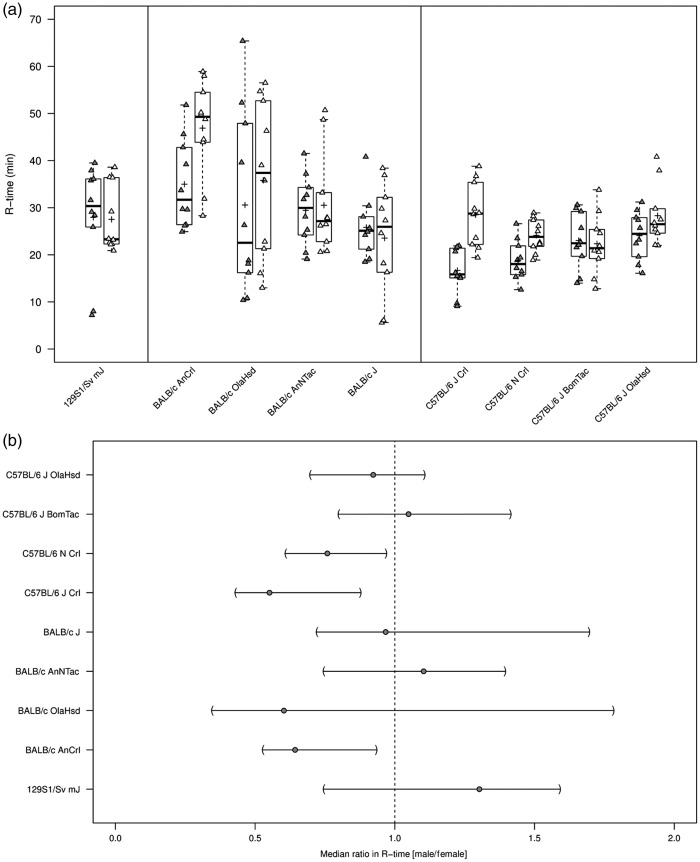
Genetically engineered mouse models are used to investigate beneficial treatment in haemophilia by comparison with wild-type mice. It has been recognized that wild-type and haemophilic mice of different genetic backgrounds show different bleeding phenotypes. We assessed ex-vivo coagulation parameters in nine wild-type substrains of 129S1/Sv, BALB/c and C57BL/6 mice applying thromboelastography (TEG), activated partial thromboplastin time (aPTT), prothrombin time (PT) and fibrinogen levels. The comprehensive ex-vivo data are discussed in view of results from a tail-tip bleeding assay. Time to first clot formation ( R-time) showed higher within-substrain (CV range: 28-54%) and higher between-substrain (median range: 25.53-42.60 min) variation for BALB/c than for C57BL/6 mice (CV range: 14-31%; median range: 22.45-24.93 min). Median R-time for 129S1/Sv mice was 30.42 min (CV: 33%). No distinct strain differences were observed for maximum amplitude (MA), aPTT, or PT, but males generally showed higher MA and shorter aPTT than females. Males of all substrains had higher fibrinogen levels than females. The heightened in-vivo variability (CV range: 81-171%; median range: 36.00-469.50 mg) in the tail-tip bleeding assay and increased blood loss in wild-type C57BL/6 male mice was not reflected in ex-vivo coagulation parameters. In general, ex-vivo coagulation results appeared consistent within substrains, but showed substrain and sex differences of variable magnitudes. We conclude that alignment of the mouse substrain genetic background to the experimental model is critical to reduce data variability and animal numbers.
Les modèles de souris génétiquement modifiées sont utilisés pour étudier les traitements bénéfiques de l'hémophilie par rapport aux souris de type sauvage. Il a été reconnu que les souris de type sauvage et hémophiles d’origines génétiques différentes présentaient différents phénotypes de saignement.
Nous avons évalué les paramètres de coagulation ex vivo de neuf sous-souches de type sauvage de souris 129S1/SV, BALB/c et C57BL/6 en utilisant des tests de thromboélastographie (TEG), de temps de céphaline activée (TCA), de prothrombine (PT) et de niveaux de fibrinogène. Les données complète ex vivo sont discutées à la lumière des résultats d'un test de saignement du bout de la queue. Le délai avant la formation du premier caillot (temps-R) présentait des variations plus importantes au sein des sous-souches (plage de CV : 28 – 54 %) et plus élevées entre sous-souches (fourchette médiane : 25,53 - 42,60 min.) de souris BALB/c que de souris C57BL/6 (plage de CV : 14 – 31 %; fourchette médiane : 22,45 - 24,93 min.). Le temps-R médian pour les souris 129S1/Sv était de 30,42 min. (CV : 33 %). Aucune différence de souche distincte n’a été observée quant à l'amplitude maximum (AM), le TCA ou le TP, mais les mâles présentaient généralement une AM plus élevée et des TCA plus courts que les femelles. Les taux de fibrinogène des mâles issus de toutes les sous-souches étaient plus élevés que ceux des femelles. La variabilité accrue in vivo (plage de CV : 81 -171 %, fourchette médiane : 36,00 – 469,50 mg) lors du test de saignement du bout de la queue, et une perte de sang accrue chez les souris mâles de types sauvage C57BL/6, n’étaient pas corroborées par les paramètres de coagulation ex vivo. Les résultats de la coagulation ex vivo semblaient généralement cohérents au sein des sous-souches, mais montraient des différences d’amplitude variées entre sous-souches et sexes. Nous en concluons que l'alignement de l’origine génétique de la sous-souche de souris au modèle expérimental est essentiel pour réduire la variabilité des données et le nombre d'animaux utilisés.
Genetisch veränderte Mausmodelle dienen zur Untersuchung optimaler Behandlungsmöglichkeiten der Hämophilie im Vergleich zu Wildtyp-Mäusen. Es wurde erkannt, dass Wildtyp- und hämophile Mäuse unterschiedlicher genetischer Herkunft unterschiedliche Hämostase-Phänotypen aufweisen. Wir bewerteten Ex vivo-Koagulationsparameter in neun Wildtyp-Unterstämmen von 129S1/Sv-, BALB/c- und C57BL/6-Mäusen mittels Thrombelastographie (TEG), aktivierter partieller Thromboplastinzeit (aPTT), Prothrombinzeit (PT) und Fibrinogenspiegel. Die kompletten Ex vivo-Daten werden anhand der Ergebnisse eines Schwanzspitzen-Hämostase-Assays diskutiert. Die Zeit bis zur ersten Gerinnselbildung (R-Zeit) zeigte eine höhere Variation innerhalb von Unterstämmen (CV-Bereich: 28 – 54 %) und zwischen Unterstämmen (Median-Bereich: 25,53 - 42,60 min) für BALB/c als bei C57BL/6-Mäusen (CV-Bereich: 14 – 31 %; Median-Bereich: 22,45 - 24,93 min). Die mediane R-Zeit für 129S1/Sv-Mäuse betrug 30,42 min (CV: 33 %). Bezüglich maximaler Amplitude (MA), aPTT bzw. PT wurden keine ausgeprägten Unterschiede zwischen Stämmen beobachtet, aber männliche Tiere wiesen im Allgemeinen eine größere MA und eine kürzere aPTT auf als weibliche. Männliche Tiere aller Unterstämme hatten einen höheren Fibrinogenspiegel als weibliche. Die erhöhte In vivo-Variabilität (CV-Bereich: 81 -171 %, Median-Bereich: 36,00 – 469,50 mg) im Schwanzspitzen-Hämostase-Assay und der erhöhte Blutverlust bei männlichen Wildtyp-C57BL/6-Mäusen spiegelte sich nicht in Ex vivo-Koagulationsparametern wider. Im Allgemeinen waren Ex vivo-Koagulationsergebnisse innerhalb von Unterstämmen konsistent, wiesen aber Unterschiede variabler Größen zwischen Unterstämmen und Geschlecht auf. Wir kommen zu dem Schluss, dass die Ausrichtung des genetischen Hintergrunds von Mäuse-Unterstämmen auf das Versuchsmodell entscheidend ist, um Datenvariabilität und Tierverbrauch zu reduzieren.
Los modelos de ratón creados genéticamente se utilizan para investigar el tratamiento beneficioso en la hemofilia comparándolos con los ratones de tipo salvaje. Se ha reconocido que los ratones hemofílicos y los de tipo salvaje con distintos historiales genéticos muestran distintos fenotipos de sangrado. Evaluamos parámetros de coagulación ex vivo en nueve subcepas de tipo salvaje de ratones 129S1/Sv, BALB/c y C57BL/6 aplicando tromboelastografia (TEG), tiempo de tromboplastina parcial activado (aPTT), tiempo de protrombina (PT) y niveles de fibrinógeno. Los exhaustivos datos ex vivo son discutidos en vistas a los resultados de las pruebas de sangrado en la punta de la cola. El tiempo hasta la primera formación de coágulos (tiempo R) mostró una variación superior dentro de las subcepas (rango CV: 28 - 54%) y una variación superior entre las subcepas (rango medio: 25,53 - 42,60 min) para BALB/c que para los ratones C57BL/6 (rango CV: 14 - 31%; rango medio: 22,45 - 24,93 min). El tiempo R medio para los ratones 129S1/Sv fue 30,42 min (CV: 33%). No se observan unas diferencias de cepas distintivas para la máxima amplitud (MA), aPTT o PT, pero los los machos por lo general mostraron una MA superior y un aPTT inferior que las hembras. Los machos de todas las subcepas tuvieron unos niveles de fibrinógeno superiores que las hembras. La variabilidad in vivo intensificada (rango CV: 81 -171%, rango medio: 36,00 – 469,50 mg) en la prueba de sangrado en la punta de la cola y el incremento de pérdida de sangre en los ratones macho de tipo salvaje C57BL/6 no se reflejó en los parámetros de coagulación ex vivo. Por lo general, los resultados de coagulación ex vivo parecieron consistentes entre las subcepas pero mostraron diferencias entre sexos y subcepas de magnitudes variables. Podemos concluir que la alineación del historial genético de la subcepa del ratón con el modelo experimental es crítico para reducir la variabilidad de datos y los números de animales.
Keywords: coagulation parameters; genetic background; reduction; strain differences; thromboelastography.
Figures

References
-
- Turecek PL, Gritsch H, Richter G, et al. Assessment of bleeding for the evaluation of therapeutic preparations in small animal models of antibody-induced hemophilia and von Willebrand disease. Thromb Haemost 1997; 3(77): 591–599. - PubMed
-
- Jesmok G, Cui ZH, Canivel D, et al. A pharmacologic evaluation of BAY 79-4980 (Liposome-Formulated Kogenate® FS) in the hemophilia A mouse. Blood 2006; 11(108): poster abstract.
-
- Jesmok G, Cui ZH, Canivel D, et al. Comparison of human rFVIII and murine rFVIII in a standardized FVIII dependent bleed model in FVIII −/− mice. J Thromb Haemost 2007; 5 Supplement 1.
-
- Landskroner KA, Cui ZH, Newgren J, et al. Evaluation of PEG-FVIII molecules with prolonged half-lives in a murine FVIII-dependent bleeding model. Blood 2006; 11(108): ): poster abstract.
-
- Broze GJ, Jr, Yin ZF, Lasky N. A tail vein bleeding time model and delayed bleeding in hemophiliac mice. Thromb Haemost 2001; 85(4): 747–748. - PubMed
MeSH terms
Substances
LinkOut - more resources
Full Text Sources
