


The roles of early-life adversity and rumination in neural response to emotional faces amongst anxious and depressed adults
- PMID: 30419983
- PMCID: PMC6513724
- DOI: 10.1017/S0033291718003203
The roles of early-life adversity and rumination in neural response to emotional faces amongst anxious and depressed adults
Abstract
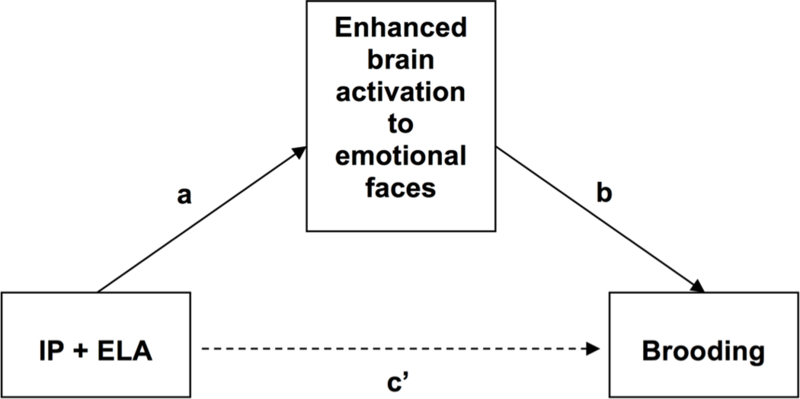
Background: Early-life adversity (ELA) is a risk factor for internalizing psychopathology (IP). ELA is also linked to alterations in neural phenotypes of emotion processing and maladaptive emotion regulatory strategies, such as ruminative brooding, in adulthood. We therefore expected that ELA would predict cortical brain activation to emotional faces in transdiagnostic IP and in turn, mediate the extent of rumination amongst patients with IPs and ELA (IP + ELA).
Method: One hundred and thirty-two individuals, including 102 treatment-seeking adults with heterogeneous IPs and 30 healthy controls (HCs) performed an Emotional Face-Matching Task during functional magnetic resonance imaging. Whole-brain analyses compared HC (n = 30), IP (n = 52), and IP + ELA (n = 50) neural responses to emotional (angry, fearful, happy, and sad) faces v. shapes, controlling for depression and anxiety symptoms. Parameter estimates of activation were extracted for significant between-group differences and tested as a mediator of ruminative brooding in IP + ELA.
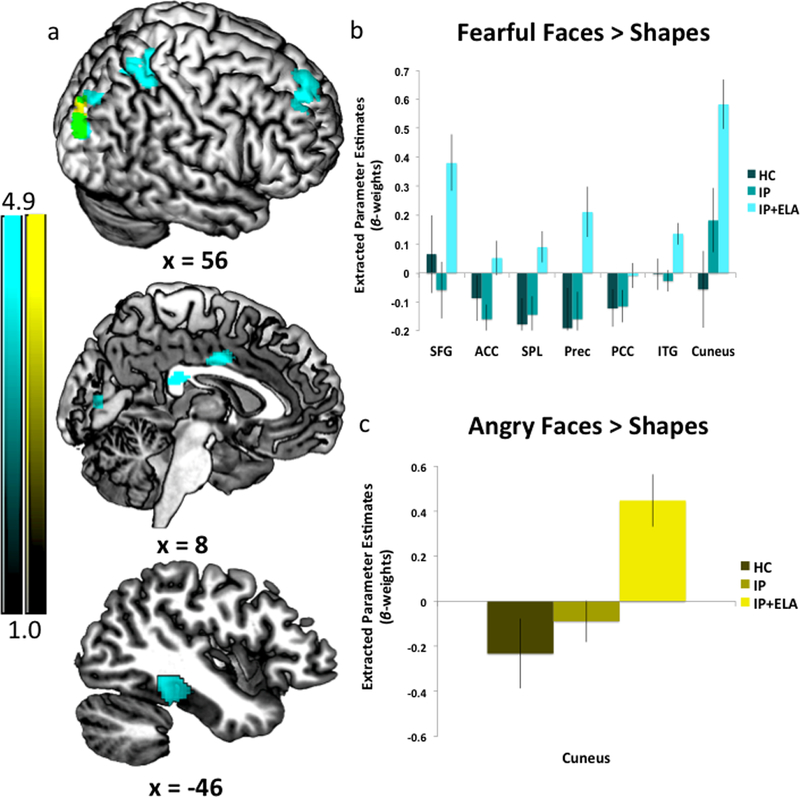
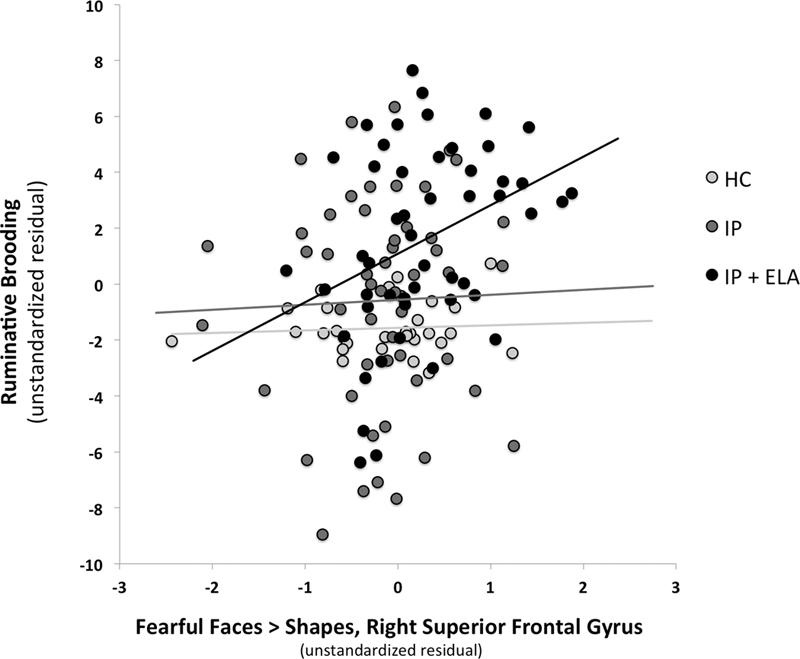
Results: IP + ELA demonstrated increased activation in the superior frontal gyrus and anterior cingulate cortex (fear), superior parietal lobule, precuneus, posterior cingulate, and inferior temporal gyrus (fear only), and cuneus (fear and angry). These regions were preferentially correlated with ruminative brooding in IP + ELA, many of which mediated the link between IP + ELA and ruminative brooding.
Conclusions: Results provide evidence that ELA history amongst IP patients augments engagement of brain regions involved in emotion processing, above and beyond what is accounted for by current symptoms. Though longitudinal designs are needed, alterations in the neural correlates of maladaptive processing of socio-emotional information may be a common pathway by which ELA poses risk for psychopathology.
Keywords: Anxiety; depression; early childhood adversity; emotion processing; functional neuroimaging; rumination.
Conflict of interest statement
Conflict of Interest
None.
Figures
References
-
- Ahmed-Leitao F, Spies G, van den Heuvel L & Seedat S (2016). Hippocampal and amygdala volumes in adults with posttraumatic stress disorder secondary to childhood abuse or maltreatment: A systematic review. Psychiatry Research 256, 33–43. - PubMed
-
- Aldao A, Nolen-Hoeksema S & Schweizer S (2010). Emotion-regulation strategies across psychopathology: A meta-analytic review. Clinical psychology review 30, 217–237. - PubMed
-
- Allbaugh LJ, Wright MO & Folger SF (2016). The role of repetitive thought in determining posttraumatic growth and distress following interpersonal trauma. Anxiety Stress Coping 29, 21–37. - PubMed
-
- Arnow BA (2004). Relationships between childhood maltreatment, adult health and psychiatric outcomes, and medical utilization. Journal of Clinical Psychiatry 65 Suppl 12, 10–5. - PubMed
Publication types
MeSH terms
Grants and funding
LinkOut - more resources
Full Text Sources
Medical
