Meta-Analysis
. 2018 Nov 13:7:e37385.
doi: 10.7554/eLife.37385.

Meta-analysis challenges a textbook example of status signalling and demonstrates publication bias

Affiliations
Meta-Analysis

Meta-analysis challenges a textbook example of status signalling and demonstrates publication bias

Alfredo Sánchez-Tójar et al. Elife. .

Abstract

The status signalling hypothesis aims to explain within-species variation in ornamentation by suggesting that some ornaments signal dominance status. Here, we use multilevel meta-analytic models to challenge the textbook example of this hypothesis, the black bib of male house sparrows (Passer domesticus). We conducted a systematic review, and obtained primary data from published and unpublished studies to test whether dominance rank is positively associated with bib size across studies. Contrary to previous studies, the overall effect size (i.e. meta-analytic mean) was small and uncertain. Furthermore, we found several biases in the literature that further question the support available for the status signalling hypothesis. We discuss several explanations including pleiotropic, population- and context-dependent effects. Our findings call for reconsidering this established textbook example in evolutionary and behavioural ecology, and should stimulate renewed interest in understanding within-species variation in ornamental traits.

Keywords: Passer domesticus; badge of status; dominance; ecology; meta-analysis; ornament; publication bias.


Conflict of interest statement

AS, SN, MS, DM, SR, AG, VB, BK, AL, DW, TB, JS No competing interests declared

Figures
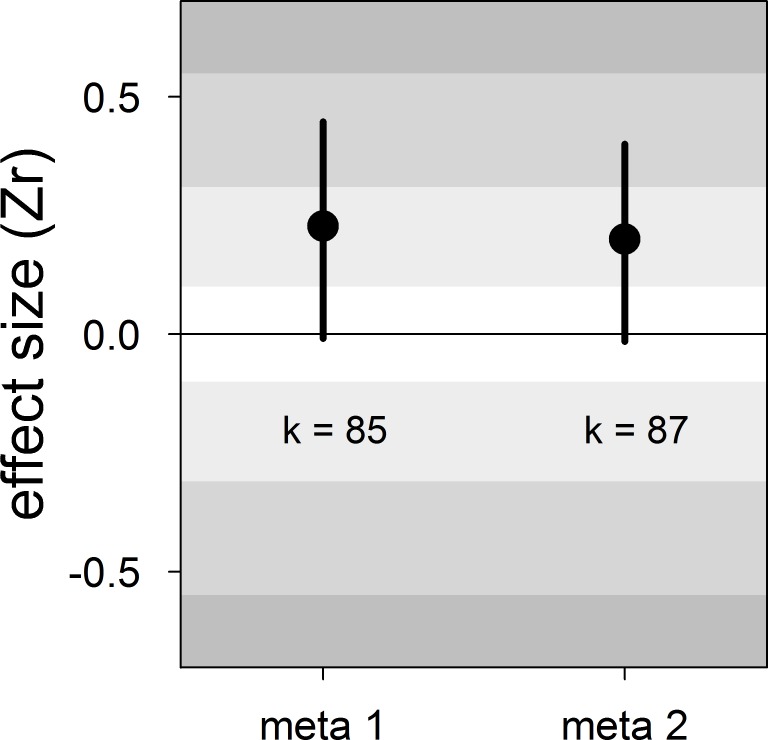
Figure 1.
Figure 1.. Forest plot showing the across-study effect size for the relationship between dominance rank and bib size in male house sparrows.
Both meta 1 and meta 2 include published and unpublished estimates, with meta 2 including two non-reported estimates assumed to be zero (see section ‘Meta-analyses’). We show posterior means and 95% credible intervals from multilevel meta-analyses. Estimates are presented as standardized effect sizes using Fisher’s transformation (Zr). Light, medium and dark grey show small, medium and large effect sizes, respectively (Cohen, 1988). k is the number of estimates.
Figure 2.
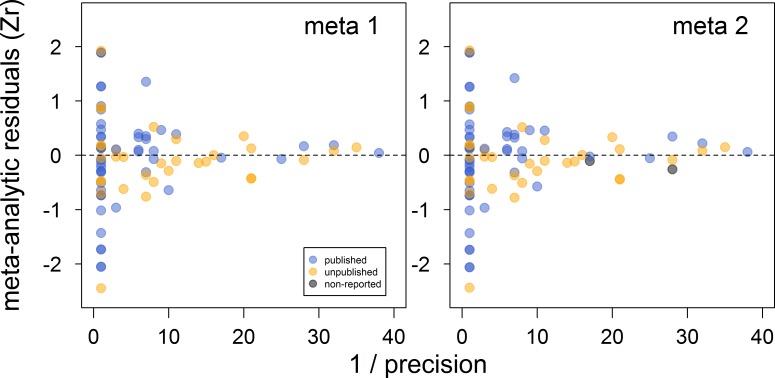
Figure 2.. Funnel plots of the meta-analytic residuals against their precision for the meta-analyses used to test the across-study relationship between dominance rank and bib size in male house sparrows.
Both meta 1 and meta 2 include published (blue) and unpublished (orange) estimates, with meta 2 including two additional non-reported estimates (grey; see section ‘Meta-analyses’). Estimates are presented as standardized effect sizes using Fisher’s transformation (Zr). Precision = square root of the inverse of the variance.
Figure 3.
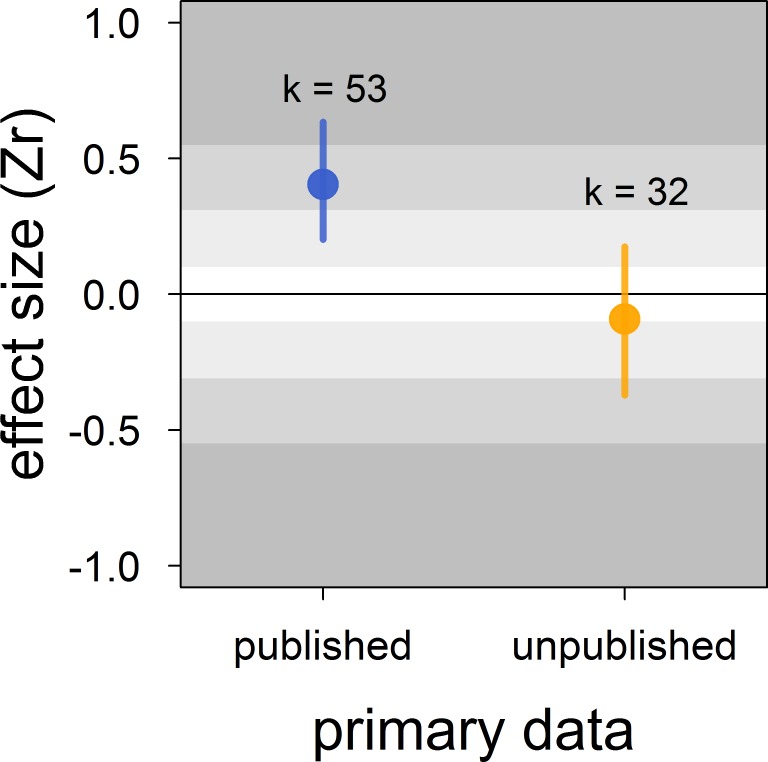
Figure 3.. Published effect sizes for the status signalling hypothesis in male house sparrows are larger than unpublished ones.
We show posterior means and 95% credible intervals from a multilevel meta-regression. Estimates are presented as standardized effect sizes using Fisher’s transformation (Zr). Light, medium and dark grey show small, medium and large effects sizes, respectively (Cohen, 1988). k is the number of estimates.
Figure 4.
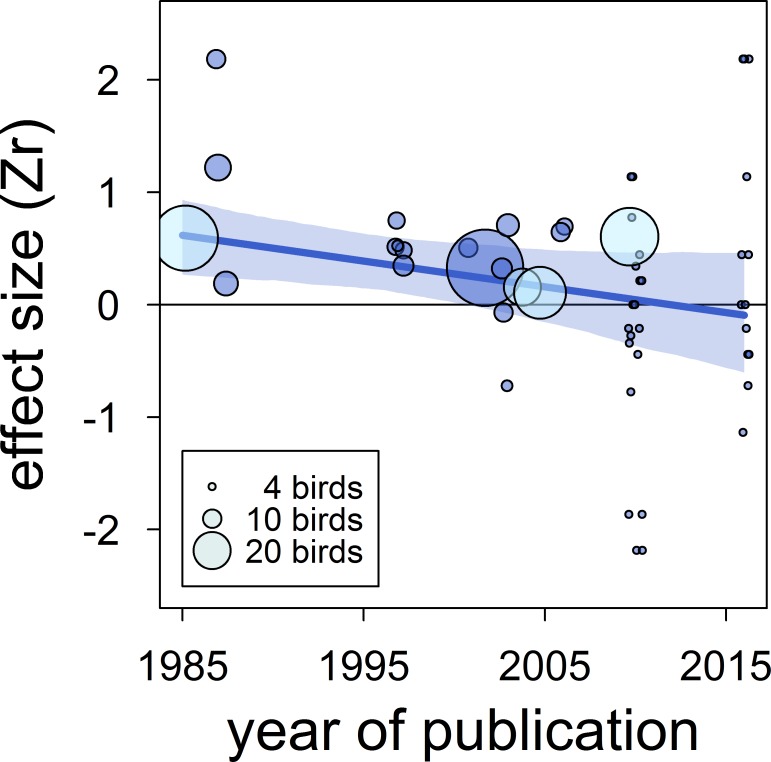
Figure 4.. The overall published effect size for the status signalling hypothesis in male house sparrows has decreased over time since first described (k = 53 estimates from 12 publications).
The solid blue line represents the model estimate, and the shading shows the 95% credible intervals of a multilevel meta-regression based on published studies (see section ‘Detection of publication bias’). Estimates are presented as standardized effect sizes using Fisher’s transformation (Zr). Circle area represents the size of the group of birds tested to obtain each estimate, where light blue denotes estimates for which group size is inflated due to birds from different groups being pooled, as opposed to dark blue where group size is accurate.
Appendix 2—figure 1.
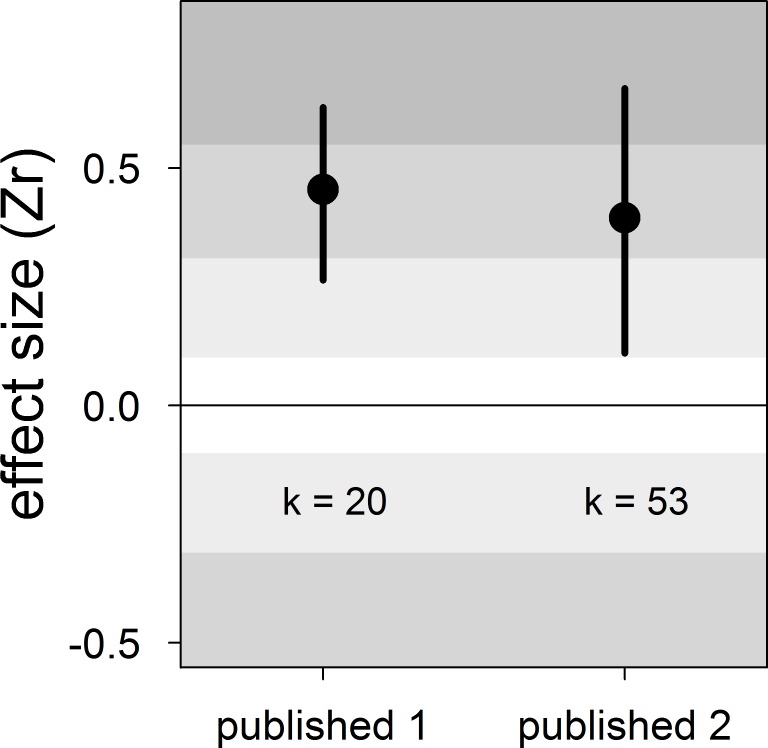
Appendix 2—figure 1.. Forest plot showing the overall effect size of the relationship between dominance rank and bib size in male house sparrows based on published studies only.
Published 1 includes published effect sizes obtained from summary data, whereas published 2 includes published re-analysed effect sizes together with the remaining published effect sizes obtained from summary data. We show posterior means and 95% credible intervals from multilevel meta-analyses. Estimates are presented as standardized effect sizes using Fisher’s transformation (Zr). Light, medium and dark grey show small, medium and large effect sizes, respectively (Cohen, 1988). k is the number of estimates.
Appendix 2—figure 2.
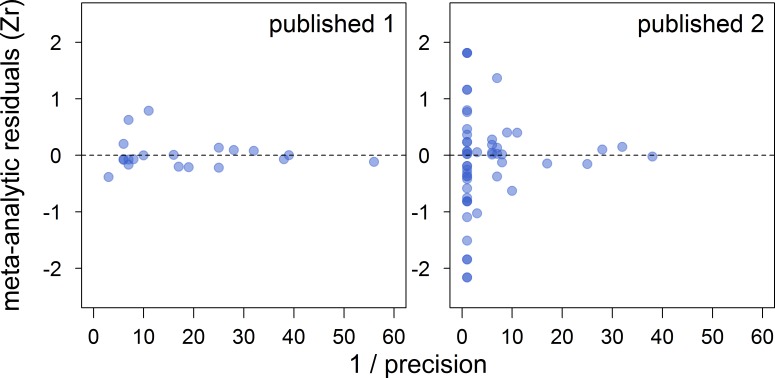
Appendix 2—figure 2.. Funnel plots of the meta-analytic residuals against their precision for the meta-analyses based on published studies only.
Published 1 includes published effect sizes obtained from summary data, whereas published 2 includes published re-analysed effect sizes together with the remaining published effect sizes obtained from summary data. Estimates are presented as standardized effect sizes using Fisher’s transformation (Zr). Precision = square root of the inverse of the variance.

References

    1. Aarts AA, Anderson JE, Attridge CJ, Open Science Collaboration Estimating the reproducibility of psychological science. Science. 2015;349:aac4716. doi: 10.1126/science.aac4716. - DOI - PubMed
    1. Andersson S, Åhlund M. Hunger affects dominance among strangers in house sparrows. Animal Behaviour. 1991;41:895–897. doi: 10.1016/S0003-3472(05)80356-2. - DOI
    1. Andersson M. Sexual Selection. New Jersey: Princeton University Press; 1994.
    1. Barrowman NJ, Myers RA, Hilborn R, Kehler DG, Field CA. The variability among populations of coho salmon in the maximum reproductive rate and depensation. Ecological Applications. 2003;13:784–793. doi: 10.1890/1051-0761(2003)013[0784:TVAPOC]2.0.CO;2. - DOI
    1. Beninde J. Naturgeschichte Des Rothirshes. Monographie Wildsiiugetiere IV. Leipzig: P. Schöps; 1937.

Publication types