


Alpine ice evidence of a three-fold increase in atmospheric iodine deposition since 1950 in Europe due to increasing oceanic emissions
- PMID: 30420500
- PMCID: PMC6275475
- DOI: 10.1073/pnas.1809867115
Alpine ice evidence of a three-fold increase in atmospheric iodine deposition since 1950 in Europe due to increasing oceanic emissions
Abstract
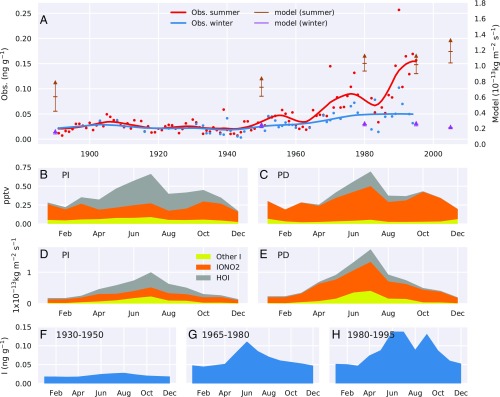
Iodine is an important nutrient and a significant sink of tropospheric ozone, a climate-forcing gas and air pollutant. Ozone interacts with seawater iodide, leading to volatile inorganic iodine release that likely represents the largest source of atmospheric iodine. Increasing ozone concentrations since the preindustrial period imply that iodine chemistry and its associated ozone destruction is now substantially more active. However, the lack of historical observations of ozone and iodine means that such estimates rely primarily on model calculations. Here we use seasonally resolved records from an Alpine ice core to investigate 20th century changes in atmospheric iodine. After carefully considering possible postdepositional changes in the ice core record, we conclude that iodine deposition over the Alps increased by at least a factor of 3 from 1950 to the 1990s in the summer months, with smaller increases during the winter months. We reproduce these general trends using a chemical transport model and show that they are due to increased oceanic iodine emissions, coupled to a change in iodine speciation over Europe from enhanced nitrogen oxide emissions. The model underestimates the increase in iodine deposition by a factor of 2, however, which may be due to an underestimate in the 20th century ozone increase. Our results suggest that iodine's impact on the Northern Hemisphere atmosphere accelerated over the 20th century and show a coupling between anthropogenic pollution and the availability of iodine as an essential nutrient to the terrestrial biosphere.
Keywords: Alpine ice core; GEOS-Chem; iodine; trend; tropospheric ozone.
Copyright © 2018 the Author(s). Published by PNAS.
Conflict of interest statement
The authors declare no conflict of interest.
Figures
References
-
- Molina MJ, Rowland FS. Stratospheric sink for chlorofluoromethanes: Chlorine atom-catalysed destruction of ozone. Nature. 1974;249:810–812.
-
- Bottenheim JW, Gallant AG, Brice KA. Measurements of NOy species and O3 at 82° N latitude. Geophys Res Lett. 1986;13:113–116.
-
- Read KA, et al. Extensive halogen-mediated ozone destruction over the tropical Atlantic Ocean. Nature. 2008;453:1232–1235. - PubMed
-
- Saiz-Lopez A, et al. Iodine chemistry in the troposphere and its effect on ozone. Atmos Chem Phys. 2014;14:19985–20044.
Publication types
MeSH terms
Substances
LinkOut - more resources
Full Text Sources
