. 2018 Nov 12;8(1):16673.
doi: 10.1038/s41598-018-34898-3.

Enhanced EPR directed and Imaging guided Photothermal Therapy using Vitamin E Modified Toco-Photoxil

Affiliations

Enhanced EPR directed and Imaging guided Photothermal Therapy using Vitamin E Modified Toco-Photoxil

Deepak S Chauhan et al. Sci Rep. .

Abstract

Herein we report synthesis, characterization and preclinical applications of a novel hybrid nanomaterial Toco-Photoxil developed using vitamin E modified gold coated poly (lactic-co-glycolic acid) nanoshells incorporating Pgp inhibitor d-α-tocopheryl polyethylene glycol 1000 succinate (TPGS) as a highly inert and disintegrable photothermal therapy (PTT) agent. Toco-Photoxil is highly biocompatible, physiologically stable PTT material with an average diameter of 130 nm that shows good passive accumulation (2.3% ID) in solid tumors when delivered systemically. In comparison to its surface modified counterparts such as IR780-Toco-Photoxil, FA-Toco-Photoxil or FA-IR780-Toco-Photoxil accumulation are merely ~0.3% ID, ~0.025% ID and ~0.005% ID in folate receptor (FR) negative and positive tumor model. Further, Toco-Photoxil variants are prepared by tuning the material absorbance either at 750 nm (narrow) or 915 nm (broad) to study optimal therapeutic efficacy in terms of peak broadness and nanomaterial's concentration. Our findings suggest that Toco-Photoxil tuned at 750 nm absorbance is more efficient (P = 0.0097) in preclinical setting. Toco-Photoxil shows complete passiveness in critical biocompatibility test and reasonable body clearance. High tumor specific accumulation from systemic circulation, strong photothermal conversion and a very safe material property in body physiology makes Toco-Photoxil a superior and powerful PTT agent, which may pave its way for fast track clinical trial in future.


Conflict of interest statement

The authors declare no competing interests.

Figures
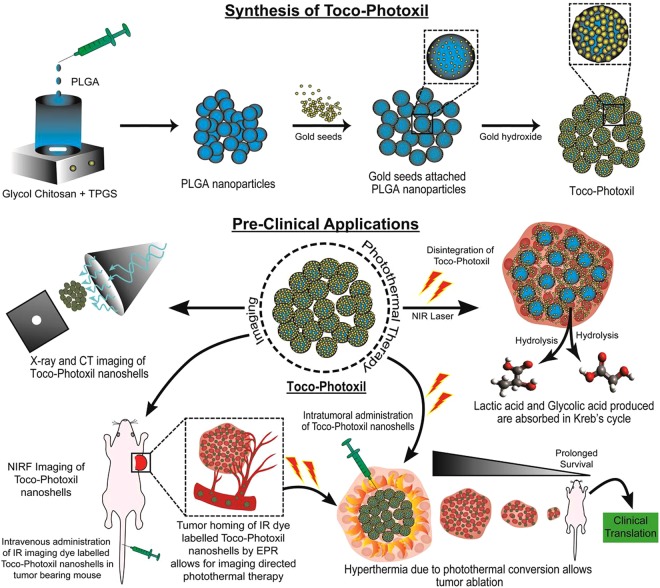
Figure 1
Figure 1
Illustration showing the synthesis and preclinical applications of Toco-Photoxil for imaging guided photothermal therapy.
Figure 2
Figure 2
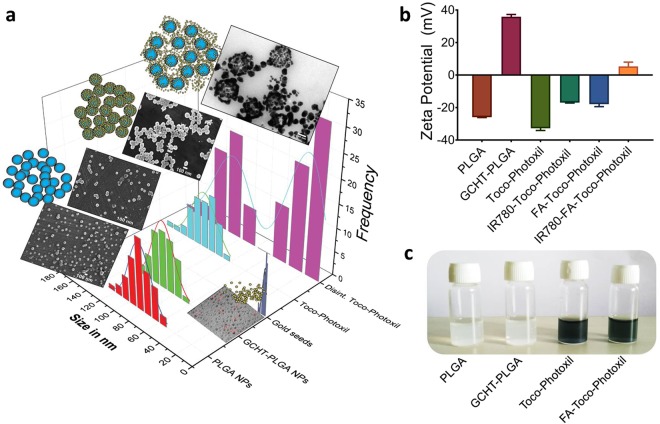
Characterization of nanoformulations. (a) Size distribution of nanomaterials synthesized at different stages overlapped with their representative FEG-SEM and FEG-TEM images. (b) Graph shows the zeta potential values of the various nanoformulations. (c) Representative photograph of PLGA NPs, GCHT-PLGA NPs, Toco-Photoxil, and FA-Toco-Photoxil nanoformulations.
Figure 3
Figure 3
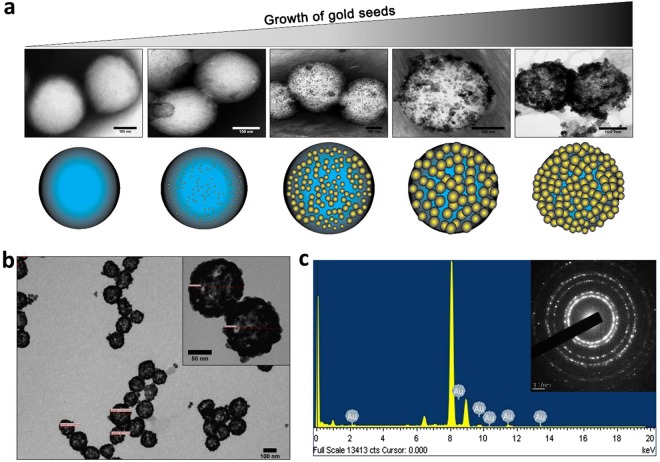
Gold coating via seed-growth mediated method. (a) FEG-TEM images of Toco-Photoxil captured at different time period during the synthesis process. (b) FEG-TEM image of Toco-Photoxil synthesized using glycol chitosan. (c) EDAX and diffraction pattern (inset) of Toco-Photoxil showing the presence of gold shell.
Figure 4
Figure 4
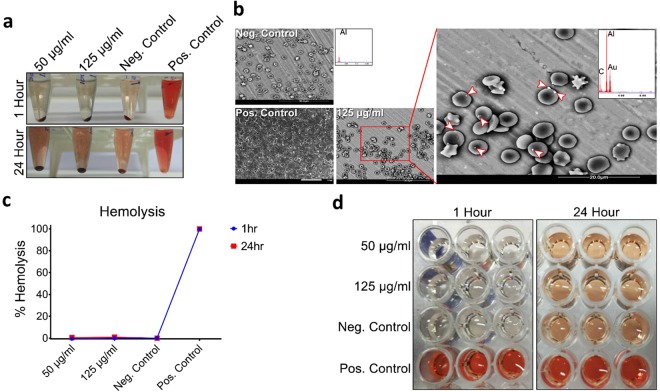
Assessment of Toco-Photoxil on haemolysis. (a) Photographic images of RBC suspended with different concentrations (µg/ml) of Toco-Photoxil, PBS (negative control), and water (positive control) at 1 h and 24 h time period. (b) ESEM images of RBCs treated with PBS (negative control), water (positive control), and 125 µg/ml of Toco-Photoxil. Arrow heads indicate the presence of Toco-Photoxil over RBCs as confirmed by EDAX analysis. (c) Graph shows the percentage hemolysis. (d) Photographic images of supernatant used for recording the absorbance at 577 nm.
Figure 5
Figure 5
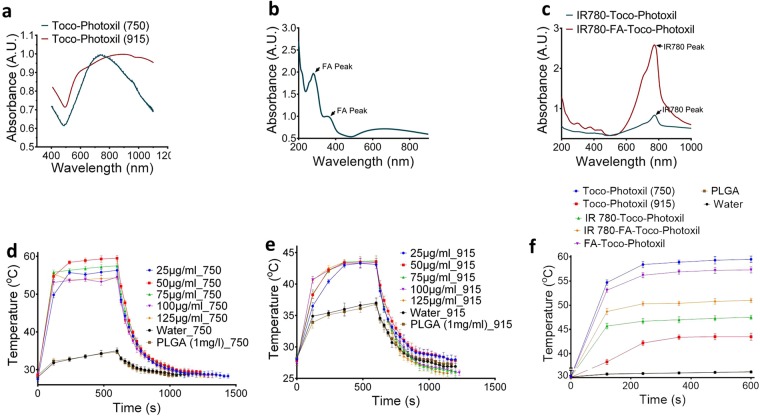
Absorbance and photothermal transduction efficiency. (a) Absorbance spectra of Toco-Photoxil tuned at 750 nm (narrow) and 915 nm (broad). (b) Absorbance spectra of FA-Toco-Photoxil showing peak due to FA and Toco-Photoxil. (c) Absorbance spectra of IR780 attached Toco-Photoxil and FA-Toco-Photoxil. (d,e) Photothermal transduction of Toco-Photoxil (750) & Toco-Photoxil (915) at various concentration and same low power setting of laser (~650 mW/cm2). (f) Temperature rise corresponding to laser irradiation on Toco-Photoxil (750), Toco-Photoxil (915), IR780-Toco-Photoxil, FA-Toco-Photoxil, IR780-FA-Toco-Photoxil, water, and PLGA NPs.
Figure 6
Figure 6
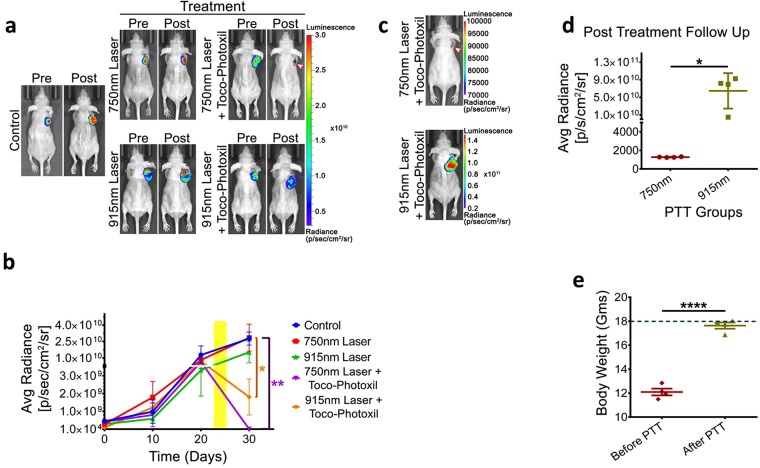
Comparative photothermal ablation of tumor following intratumoral injections of Toco-Photoxil tuned to 750 nm and 915 nm in HT1080-fluc2-turboFP xenograft model. (a) Representative pre- and post-photothermal treatment in vivo bioluminescence images of mice bearing HT1080-fluc2-turboFP tumor xenografts. (b) Quantitative assessment of bioluminescence signal to measure therapy response (yellow regions marks the photothermal treatment period) (*indicates P < 0.05 and ** indicates P < 0.01). (c) Representative bioluminescence images of post-treatment follow-up of mice treated with 750 nm and 915 nm tuned Toco-Photoxil and laser (arrow head indicates the treated tumor region). (d) Quantitative assessment of bioluminescence signal output 15 days post photothermal treatment (* indicates P < 0.05). (e) Graph represents change in body weight pre- and post-photothermal treatment (dotted line represents the average body weight of a non-tumor bearing BALB/c NUDE mice) (**** indicates P < 0.0001).
Figure 7
Figure 7
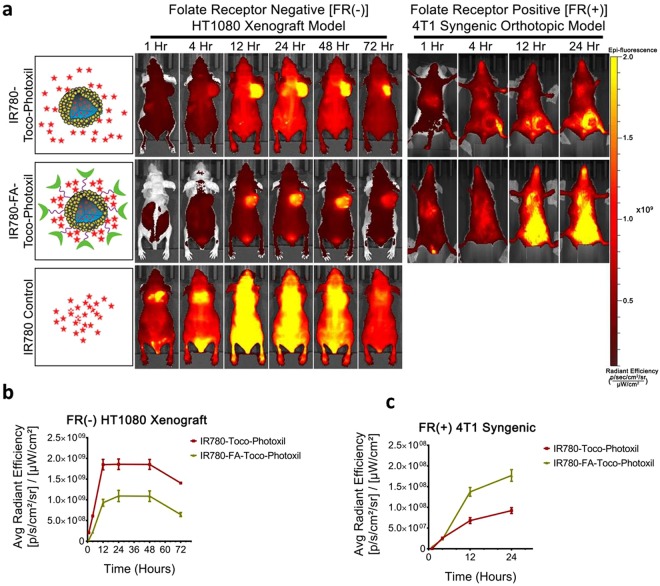
Near Infra-Red Fluorescence (NIRF) imaging of IR780 dye tagged Toco-Photoxil and FA-Toco-Photoxil after systemic delivery in HT1080 FR(−) xenograft and 4T1 FR(+) orthotopic tumor-bearing mice. (a) Representative NIRF images of HT1080 xenograft and 4T1 syngeneic tumor bearing mice at different time points after systemic delivery of IR780-Toco-Photoxil (top), IR780-FA-Toco-Photoxil (middle), and IR780 dye control (bottom). (b) Quantitative assessment of fluorescence signal in HT1080 tumors of mice injected with IR780-Toco-Photoxil, and IR780-FA-Toco-Photoxil. (c) Quantitative assessment of fluorescence signal in 4T1 tumors of mice injected with IR780-Toco-Photoxil, and IR780-FA-Toco-Photoxil.
Figure 8
Figure 8
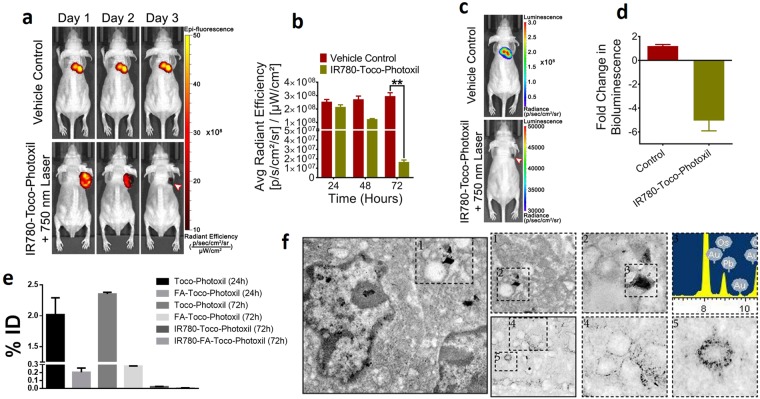
Photothermal therapy after systemic delivery of Toco-Photoxil and percentage accumulation in tumor in comparison to other surface modified Toco-Photoxil. (a) Qualitative representation of TurboFP fluorescence images of mice bearing HT1080-fluc2-turboFP tumors during the course of photothermal treatment (arrow head indicates the treated tumor region). (b) Quantitative assessment of changes in light output of the TurboFP fluorescent protein (P < 0.01). (c) Representative follow up bioluminescence images of mice at day 10 (arrow head indicates the treated tumor region). (d) Fold change in bioluminescence light output between the vehicle control treated mice and mice treated with a combination of Toco-Photoxil and 750 nm laser. (e) Percentage tumor uptake of Toco-Photoxil, FA-Toco-Photoxil, IR780-Toco-Photoxil, and IR780-FA-Toco-Photoxil (**** indicates P < 0.0001). (f) FEG-TEM images of 4T1 tumor section showing accumulation of Toco-Photoxil.

References

    1. Prasad R, Aiyer S, Chauhan DS, Srivastava R, Selvaraj K. Bioresponsive carbon nano-gated multifunctional mesoporous silica for cancer theranostics. Nanoscale. 2016;8:4537–4546. doi: 10.1039/C5NR06756A. - DOI - PubMed
    1. Sasidharan S, Bahadur D, Srivastava R. Albumin stabilized gold nanostars: a biocompatible nanoplatform for SERS, CT imaging and photothermal therapy of cancer. RSC Adv. 2016;6:84025–84034. doi: 10.1039/C6RA11405A. - DOI
    1. Zhou F, et al. Cancer photothermal therapy in the near-infrared region by using single-walled carbon nanotubes. J. Biomed. Opt. 2009;14:021009–0210010. doi: 10.1117/1.3078803. - DOI - PMC - PubMed
    1. Huang X, El-Sayed IH, Qian W, El-Sayed MA. Cancer cell imaging and photothermal therapy in the near-infrared region by using gold nanorods. J. Am. Chem. Soc. 2006;128:2115–2120. doi: 10.1021/ja057254a. - DOI - PubMed
    1. Hirsch LR, et al. Nanoshell-mediated near-infrared thermal therapy of tumors under magnetic resonance guidance. Proc. Natl. Acad. Sci. USA. 2003;100:13549–13554. doi: 10.1073/pnas.2232479100. - DOI - PMC - PubMed

Publication types