


Association of Frequency of Organic Food Consumption With Cancer Risk: Findings From the NutriNet-Santé Prospective Cohort Study
- PMID: 30422212
- PMCID: PMC6583612
- DOI: 10.1001/jamainternmed.2018.4357
Association of Frequency of Organic Food Consumption With Cancer Risk: Findings From the NutriNet-Santé Prospective Cohort Study
Erratum in
-
Rewording of Conclusions and Corrected Data in Table 1.JAMA Intern Med. 2018 Dec 1;178(12):1732. doi: 10.1001/jamainternmed.2018.6902. JAMA Intern Med. 2018. PMID: 30508044 Free PMC article. No abstract available.
Abstract
Importance: Although organic foods are less likely to contain pesticide residues than conventional foods, few studies have examined the association of organic food consumption with cancer risk.
Objective: To prospectively investigate the association between organic food consumption and the risk of cancer in a large cohort of French adults.
Design, setting, and participants: In this population-based prospective cohort study among French adult volunteers, data were included from participants with available information on organic food consumption frequency and dietary intake. For 16 products, participants reported their consumption frequency of labeled organic foods (never, occasionally, or most of the time). An organic food score was then computed (range, 0-32 points). The follow-up dates were May 10, 2009, to November 30, 2016.
Main outcomes and measures: This study estimated the risk of cancer in association with the organic food score (modeled as quartiles) using Cox proportional hazards regression models adjusted for potential cancer risk factors.
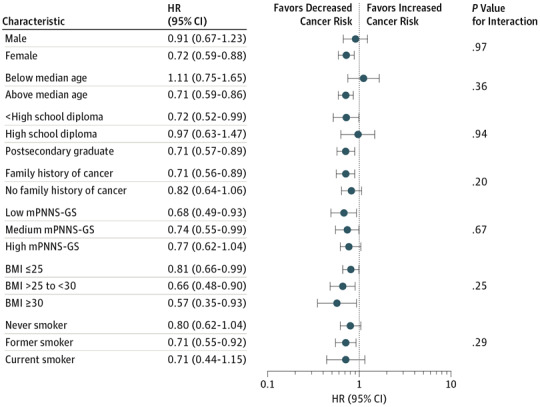
Results: Among 68 946 participants (78.0% female; mean [SD] age at baseline, 44.2 [14.5] years), 1340 first incident cancer cases were identified during follow-up, with the most prevalent being 459 breast cancers, 180 prostate cancers, 135 skin cancers, 99 colorectal cancers, 47 non-Hodgkin lymphomas, and 15 other lymphomas. High organic food scores were inversely associated with the overall risk of cancer (hazard ratio for quartile 4 vs quartile 1, 0.75; 95% CI, 0.63-0.88; P for trend = .001; absolute risk reduction, 0.6%; hazard ratio for a 5-point increase, 0.92; 95% CI, 0.88-0.96).
Conclusions and relevance: A higher frequency of organic food consumption was associated with a reduced risk of cancer. If these findings are confirmed, further research is necessary to determine the underlying factors involved in this association.
Conflict of interest statement
Figures
Comment in
-
Organic Foods for Cancer Prevention-Worth the Investment?JAMA Intern Med. 2018 Dec 1;178(12):1606-1607. doi: 10.1001/jamainternmed.2018.4363. JAMA Intern Med. 2018. PMID: 30422205 No abstract available.
-
[Organic food consumption and cancer risk: A high-quality study and inappropriate reactions].Bull Cancer. 2019 Jan;106(1):5-8. doi: 10.1016/j.bulcan.2018.11.007. Epub 2018 Dec 21. Bull Cancer. 2019. PMID: 30583792 French. No abstract available.
-
High-Quality Food Combined With Organic Food Consumption and the Risk of Cancer.JAMA Intern Med. 2019 May 1;179(5):723. doi: 10.1001/jamainternmed.2019.0110. JAMA Intern Med. 2019. PMID: 31058932 No abstract available.
References
-
- World Health Organization . International Agency for Research on Cancer. https://www.iarc.fr/. Accessed August 4, 2017.
-
- Dossier: par INSERM [salle de presse]. Pesticides: effets sur la santé, une expertise collective de l’INSERM. http://presse.inserm.fr/pesticides-effets-sur-la-sante-une-expertise-col.... Published June 13, 2013. Accessed August 21, 2016.
