. 2018 Nov 13;14(11):e1007796.
doi: 10.1371/journal.pgen.1007796. eCollection 2018 Nov.

Evolution at two time frames: Polymorphisms from an ancient singular divergence event fuel contemporary parallel evolution

Affiliations

Evolution at two time frames: Polymorphisms from an ancient singular divergence event fuel contemporary parallel evolution

Steven M Van Belleghem et al. PLoS Genet. .

Abstract

When environments change, populations may adapt surprisingly fast, repeatedly and even at microgeographic scales. There is increasing evidence that such cases of rapid parallel evolution are fueled by standing genetic variation, but the source of this genetic variation remains poorly understood. In the saltmarsh beetle Pogonus chalceus, short-winged 'tidal' and long-winged 'seasonal' ecotypes have diverged in response to contrasting hydrological regimes and can be repeatedly found along the Atlantic European coast. By analyzing genomic variation across the beetles' distribution, we reveal that alleles selected in the tidal ecotype are spread across the genome and evolved during a singular and, likely, geographically isolated divergence event, within the last 190 Kya. Due to subsequent admixture, the ancient and differentially selected alleles are currently polymorphic in most populations across its range, which could potentially allow for the fast evolution of one ecotype from a small number of random individuals, as low as 5 to 15, from a population of the other ecotype. Our results suggest that cases of fast parallel ecological divergence can be the result of evolution at two different time frames: divergence in the past, followed by repeated selection on the same divergently evolved alleles after admixture. These findings highlight the importance of an ancient and, likely, allopatric divergence event for driving the rate and direction of contemporary fast evolution under gene flow. This mechanism is potentially driven by periods of geographic isolation imposed by large-scale environmental changes such as glacial cycles.


Conflict of interest statement

The authors have declared that no competing interests exist.

Figures
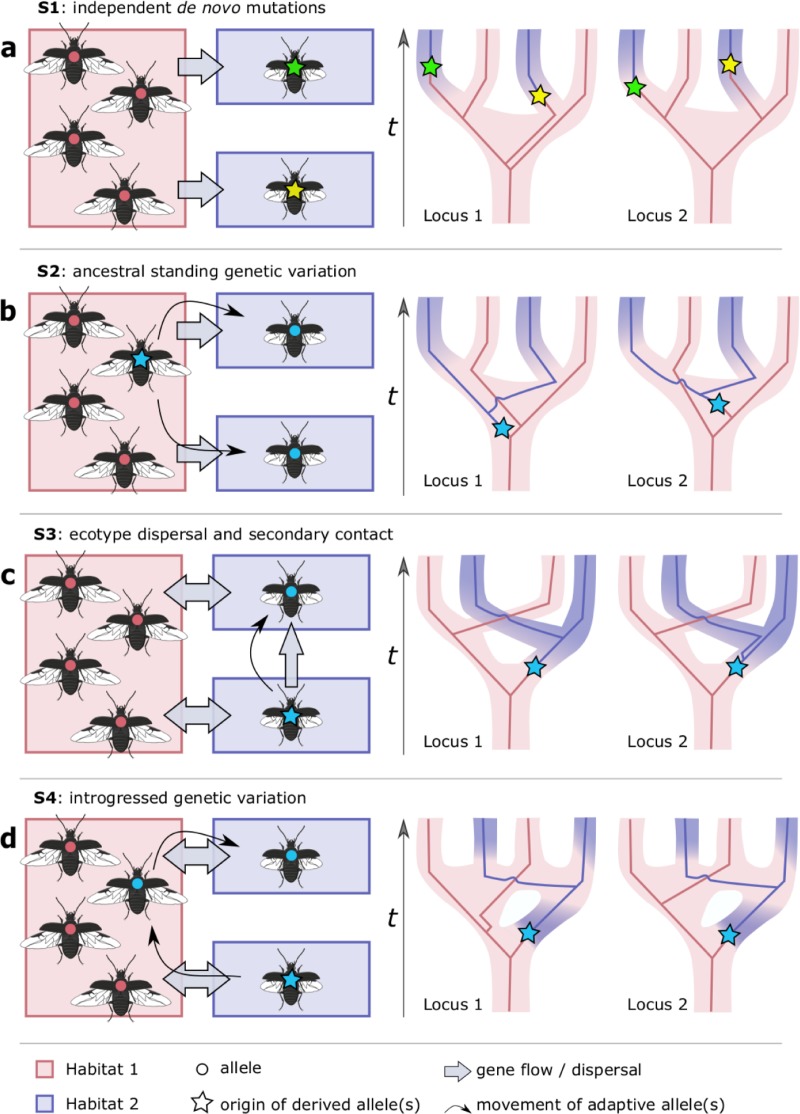
Fig 1
Fig 1. Evolutionary scenarios describing the origin of adaptive alleles in cases of parallel ecotypic divergence.
Schematics on the left show the colonization of a new ‘blue’ habitat and the origin of alleles adapted to this new habitat. On the right, population histories are shown with examples of the expected genealogies at two unlinked loci that include an adaptive allele. (a.) In scenario S1, repeated adaptation to the ‘blue’ habitat occurs through independent de novo mutations and genealogies will not show monophyletic clustering of alleles adapted to the ‘blue’ habitat. (b.) In scenario S2, mutations originate as rare neutral or mildly deleterious alleles within the ancestral population and are later repeatedly selected when populations are exposed to the alternative environmental condition. This will be evident by monophyletic clustering of alleles adapted to the ‘blue’ habitat, but divergence patterns at unlinked loci that include an adaptive allele may differ strongly. (c.) In scenario S3, the derived ecotype evolves in geographic isolation, but disperses into suitable habitat patches and comes repeatedly into secondary contact with the ancestral ecotype. (d.) In scenario S4, derived alleles initially arise within a single isolated population as in S3, but are introgressed into the ancestral population, providing the raw genetic material for repeated and rapid evolution when populations later face similar environmental conditions. For both S3 and S4 monophyletic clustering of alleles adapted to the ‘blue’ habitat is expected, as well as a shared divergence pattern across unlinked selected loci.
Fig 2
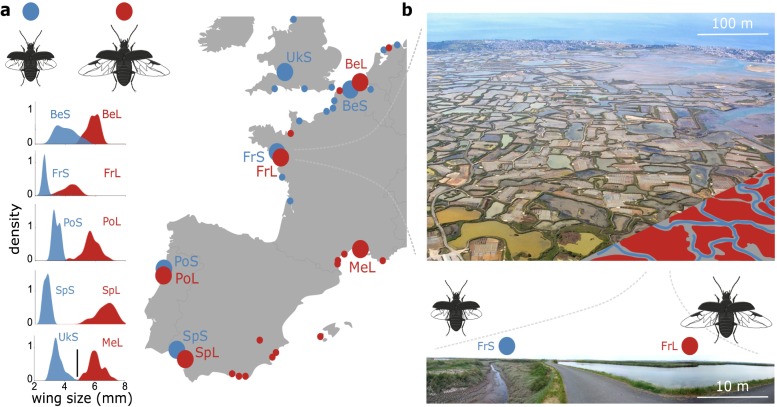
Fig 2. Pogonus chalceus sampling and ecotypic divergence.
(a.) Sampling locations and density plots of the wing size distribution in the sampled populations. Blue indicates tidal habitats with short-winged beetles, red indicates seasonal habitats with long-winged beetles. BeS: Belgium-short, BeL: Belgium-long, FrS: France-short, FrL: France-long, UkS: UK-short, MeL: Mediterranean-long, PoS: Portugal-short, PoL: Portugal-long, Sps: Spain-short, SpL: Spain-long. Large circles represent populations included in the present study, small circles represent populations sampled previously [28,36]. (b.) Detail of the Fr population (Guérande) being a historic salt-extraction area that was created by man approximately one thousand years ago and consists of a network of tidal inundated canals (indicated in blue in the lower right corner) interlaced with seasonally inundated salt extraction ponds (partly indicated in red in the lower right corner) (image courtesy by Alexandre Braun). Populations of the short- (FrS) and long-winged (FrL) ecotype are found in the tidal (blue) and seasonally (red) inundated habitats, respectively, and occur in close proximity (< 20 m) within this sympatric mosaic. The bottom image shows a panoramic detail demonstrating the close proximity of the tidal (left) and seasonally flooded (right) sampling locations.
Fig 3
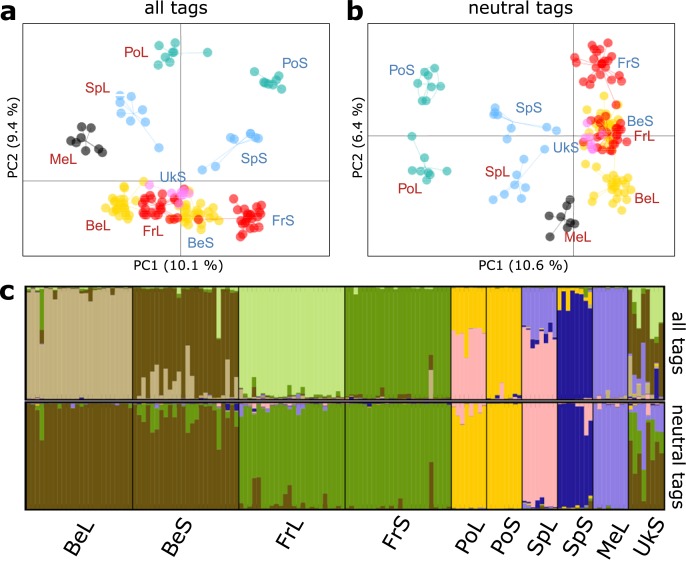
Fig 3. Population structure among the studied Pogonus chalceus populations.
(a.) Principal Coordinate Analysis (PCoA) for sequenced samples using all RAD-tags. (b.) PCoA for sequenced samples when restricting the SNPs to a ‘neutral’ set wherein we excluded RAD-tags containing a SNP with a signature of divergent selection (c.) Population structure of the ten P. chalceus populations based on Bayesian clustering [32]. The best supported number of clusters was 8 for all RAD-tags and 6 for neutral RAD-tags (see S1 Fig). See Fig 1 for population codes.
Fig 4
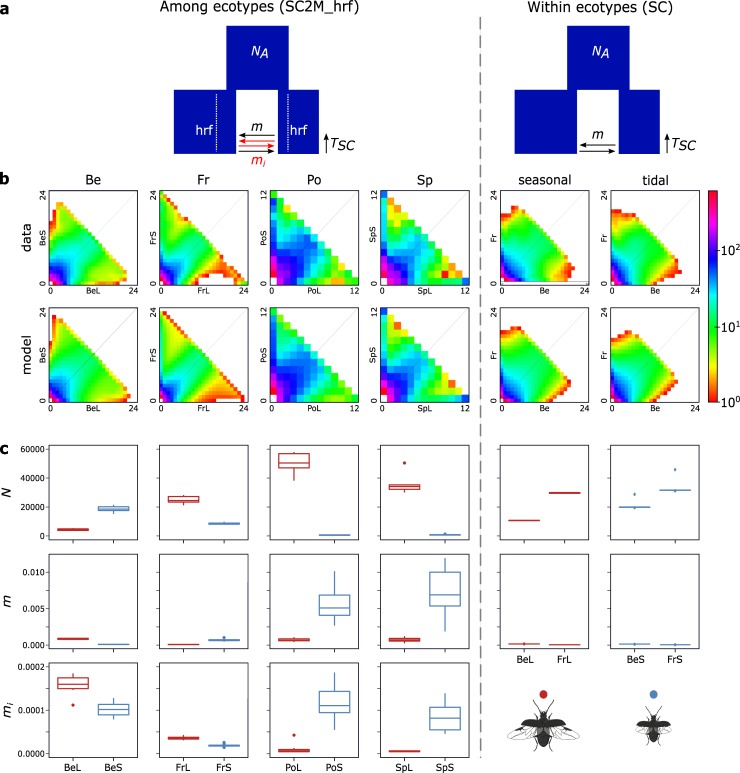
Fig 4. Demographic parameter estimates for population pairs.
(a.) The assumed demographic model that best fit the data is a secondary contact model with heterogeneous gene flow and heterogeneous population size due to the effect of linked selection (SC2M_hrf) for the ecotypic population pairs and a secondary contact model with homogeneous gene flow (SC) for the within ecotype population pair comparisons (see S2 Table for details on model fitting). (b.) Data (first row) and model (second row) based joint allele frequency spectra (JAFS) of the ecologically diverged pairs Be, Fr, Po and Sp and the within ecotype population pair comparisons. JAFS are projected to 24 individuals, except for the populations Po and Sp where the JAFS was projected to 12 individuals. (c.) box-and-whisker plots of the estimated population size (population mutation rate theta) and effective number of migrated gene copies per generation into each ecotype of the inferred neutral (m) and non-neutral (mi) part of the genome.
Fig 5
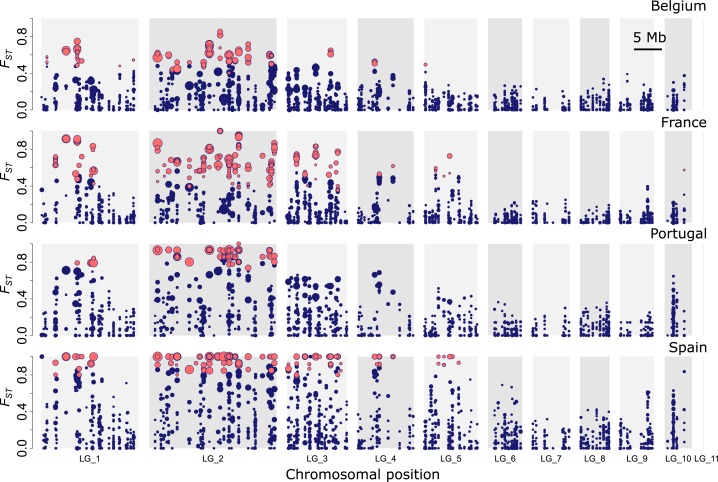
Fig 5. Genomic divergence (FST) between Pogonus chalceus ecotype pairs.
Outlier SNPs within each population pair, as identified by BayeScan [34], are indicated in red. Size of points is proportional to the log10BF reported by BayEnv2 [35] and indicates the degree of support that allele frequencies are significantly correlated with habitat type across all sampled populations. Markers on LG10 are significantly sex-linked. Average FST values across SNPs between all population comparisons are reported in S1 Table and the distribution of FST values is given in S3 Fig.
Fig 6
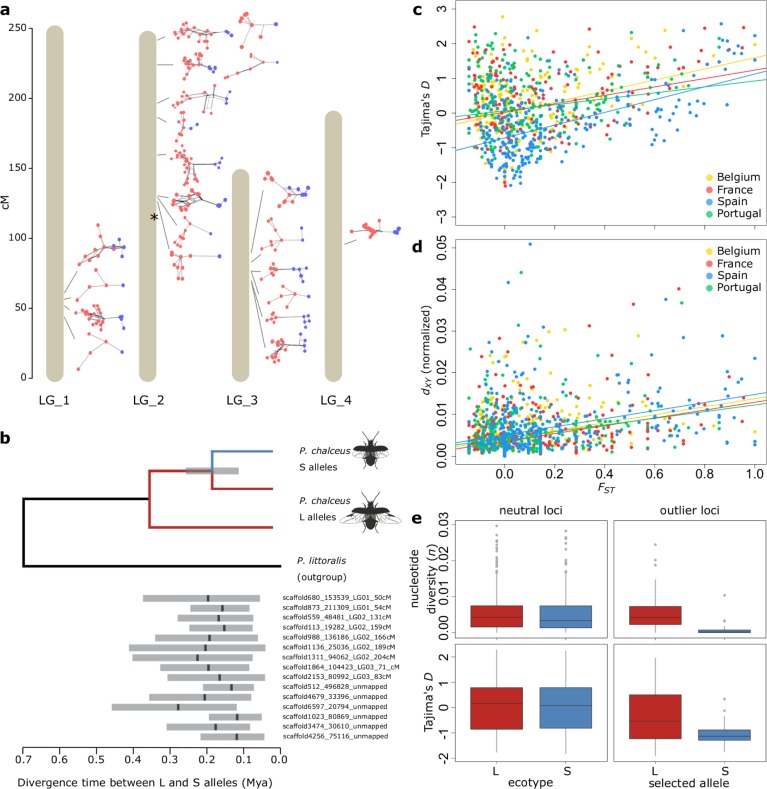
Fig 6. Haplotype structure and diversity at divergently selected loci.
(a.) Haplotype networks of RAD-tags containing outlier SNPs and at least 10 variable sites (BayEnv2; log10BF > 4) at the different linkage groups. Haplotypes selected in short-winged populations are depicted in blue, haplotypes selected in long-winged populations are depicted in red. The asterisk indicates the position of the mtIdh gene studied in [36] (b.) Estimated divergence time (Mya) between alleles selected in short-winged (blue) versus long-winged (red) populations. The tree represents the general phylogenetic relationship between short- and long-wing selected alleles and the estimated divergence point. (c.) Relationship between FST and Tajima’s D (considering both ecotypes for each population) and (d.) absolute nucleotide divergence, dXY, scaled relative to the divergence from the outgroup species Pogonus littoralis in the four population pairs. (e.) Comparison of nucleotide diversity (π) and Tajima’s D at neutral loci of long-winged (L) and short-winged (S) populations (left) and between haplotypes at outlier RAD-tags selected in L or S populations (right).
Fig 7
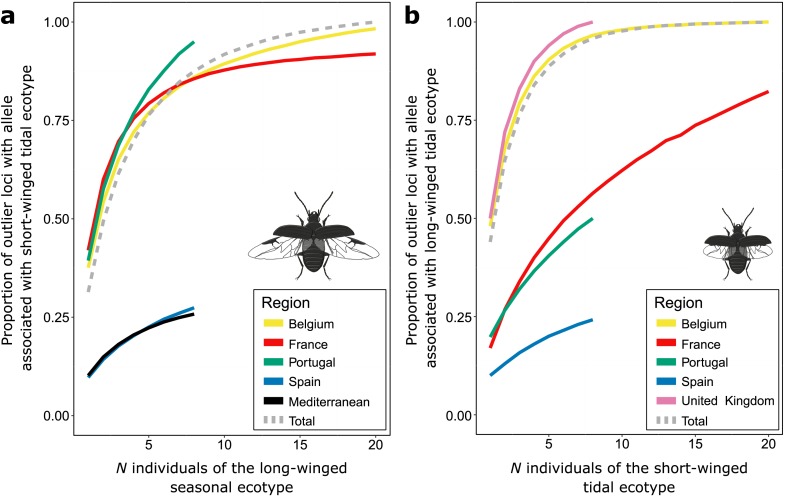
Fig 7. Quantifying standing genetic variation.
Accumulation curves of (a.) the proportion of outlier loci containing at least one copy of the allele associated with the short-winged tidal ecotype in a random sample of N individuals of the long-winged seasonal ecotype and (b.) the proportion of outlier loci containing at least one copy of the allele associated with the long-winged seasonal ecotype in a random sample of N individuals of the short-winged tidal ecotype. Proportions are averaged over 100 replicates of N individuals.

References

    1. Schluter D. Evidence for ecological speciation and its alternative. Science. 2009;323: 737–741. 10.1126/science.1160006 - DOI - PubMed
    1. Nosil P. Ecological Speciation. Oxford, UK: Oxford University Press; 2012.
    1. Coyne JA, Orr HA. Speciation. Sunderland, MA, USA: Sinauer Associates; 2004.
    1. Feder JL, Flaxman SM, Egan SP, Comeault A a., Nosil P. Geographic mode of speciation and genomic divergence. Annu Rev Ecol Evol Syst. 2013;44: 73–97.
    1. Arnegard ME, McGee MD, Matthews B, Marchinko KB, Conte GL, Kabir S, et al. Genetics of ecological divergence during speciation. Nature. Nature Publishing Group; 2014;511: 307–311. 10.1038/nature13301 - DOI - PMC - PubMed

Publication types