


Hospital-Associated Complications of Older People: A Proposed Multicomponent Outcome for Acute Care
- PMID: 30423197
- PMCID: PMC6367036
- DOI: 10.1111/jgs.15662
Hospital-Associated Complications of Older People: A Proposed Multicomponent Outcome for Acute Care
Abstract
Objectives: To propose a new multicomponent measure of hospital-associated complications of older people (HAC-OP) and evaluate its validity in a large hospital sample.
Design: Observational study using baseline (pre-intervention) data from the Collaboration for Hospitalised Elders Reducing the Impact of Stays in Hospital cluster randomized controlled trial.
Setting: Acute medical and surgical wards in 4 hospitals in Queensland, Australia.
Participants: Individuals aged 65 and older (mean age 76, 48% female) with a hospital stay of 72 hours or longer (N=434).
Measurements: We developed a multicomponent measure including 5 well-recognized hospital-associated complications of older people: hospital-associated delirium, functional decline, incontinence, falls, and pressure injuries. To evaluate construct validity, we examined associations with common risk factors (aged ≥75, functional impairment, cognitive impairment, history of falls). To evaluate predictive validity, we examined the association between length of stay, facility discharge, and 6-month mortality and any HAC-OP and total number of HAC-OP.
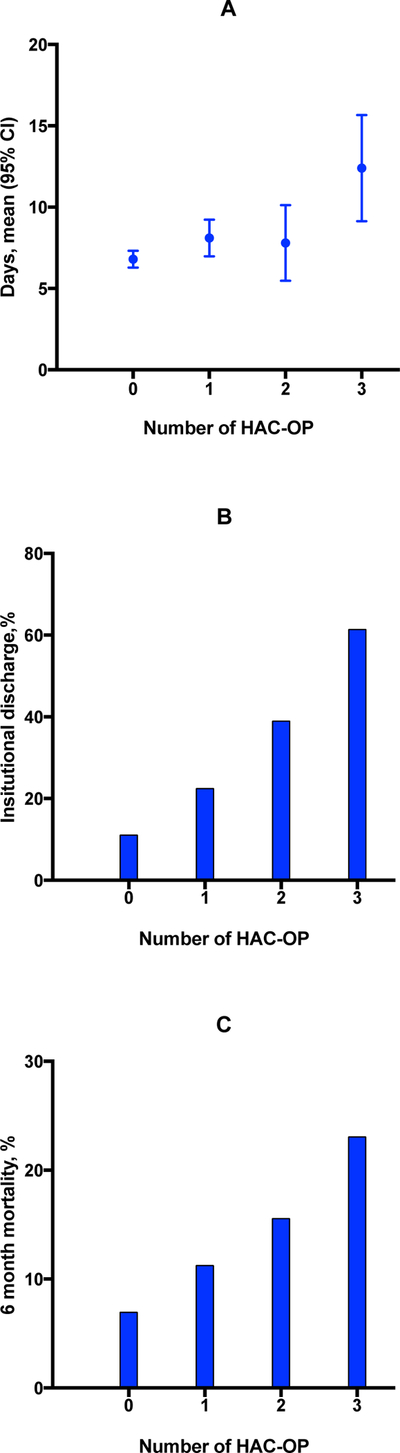
Results: Overall, 192 (44%) participants had 1 or more HAC-OP during their admission. Any HAC-OP was strongly associated with the proposed shared risk factors, and there was a strong and graded association between HAC-OP and length of stay (9.1±7.4 days for any HAC-OP vs 6.8 ±4.1 days with none, p < .001), facility discharge (59/192 (31%) vs 27/242 (11%), p < .001) and 6-month mortality (26/192 (14%) vs 17/242 (7%), p = .02).
Conclusion: This study provides evidence of construct and predictive validity of the proposed measure of HAC-OP as a potential outcome measure for research investigating and improving hospital care of older people. J Am Geriatr Soc 67:352-356, 2019.
Keywords: delirium; functional decline; geriatric syndrome; hospitalization; incontinence.
© 2018, Copyright the Author Journal compilation © 2018, The American Geriatrics Society.
Conflict of interest statement
Conflict of interest: The authors have no conflicts of interest to declare
Figures
References
-
- Flacker JM. What is a geriatric syndrome anyway? J Am Geriatr Soc. 2003;51(4):574–576. - PubMed
-
- Olde Rikkert M, Rigaud A, van Hoeyweghen R, de Graaf J. Geriatric syndromes: medical misnomer or progress in geriatrics? Neth J Med. 2003;61(3):83–87. - PubMed
-
- Anpalahan M, Gibson SJ. Geriatric syndromes as predictors of adverse outcomes of hospitalization. Intern Med J. 2008;38(1):16–23. - PubMed
Publication types
MeSH terms
Grants and funding
LinkOut - more resources
Full Text Sources
Medical
Miscellaneous
