Review
. 2018 Nov 10;19(11):3548.
doi: 10.3390/ijms19113548.

Interferons and Dry Eye in Sjögren's Syndrome

Affiliations
Review

Interferons and Dry Eye in Sjögren's Syndrome

Yoko Ogawa et al. Int J Mol Sci. .

Abstract

Various cytokines, including interferon (IFN)-γ and IL-17, are augmented, and autoreactive T cells and B cells are activated in the immune pathogenesis of Sjögren's syndrome (SS). In particular, IFNs are involved in both the early stages of innate immunity by high level of type I IFN in glandular tissue and sera and the later stages of disease progression by type I and type II IFN producing T cells and B cells through B cell activating factor in SS. Genetically modified mouse models for some of these molecules have been reported and will be discussed in this review. New findings from human SS and animal models of SS have elucidated some of the mechanisms underlying SS-related dry eye. We will discuss IFN-γ and several other molecules that represent candidate targets for treating inflammation in SS-related dry eye.

Keywords: Interferon-γ; Sjögren’s syndrome; animal model; dry eye.


Conflict of interest statement

The founding sponsors had no role in the design of the study, in the collection, analyses, or interpretation of data, in the writing of the manuscript, or in the decision to publish the results.

Figures
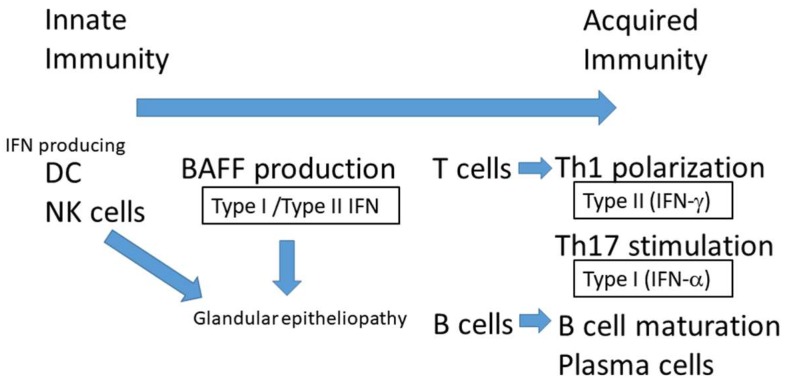
Figure 1
Figure 1
IFNs are involved in both the early stage of innate immunity, in which the type I IFN is elevated in glandular tissue and sera, and the later phase of disease progression, in which type I and type II IFN produce T cells and B cells, stimulated by B-cell-activating factor (BAFF) in SS. Natural killer (NK) cells can activate immature dendritic cells (DCs) through the secretion of IFN-γ. Increasing levels of type II IFNs, such as IFN-γ, are observed in primary SS [2]. The polarization of IFN-γ-secreting Th1 cells is implicated in SS pathogenesis. DC; dendritic cells, NK cells: natural killer cells, IFN; interferon, BAFF: B-cell-activating factor.
Figure 2
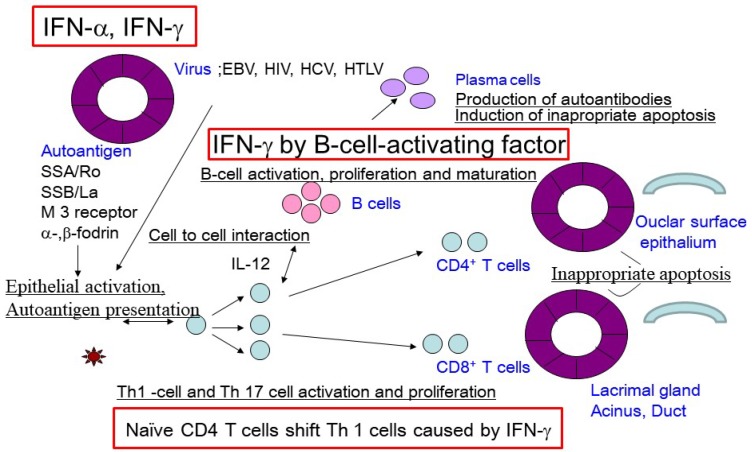
Figure 2
Hypothetical pathogenic process of Sjögren’s syndrome related dry eye diseasemodified form Sumida, T. et al [67].Viral infection acts as a trigger for the autoimmune response in SS. SS-associated ribonucleoprotein autoantigens, including Ro60/SSA, La/SSB, α-fodrin, β-fodrin, and M3 muscarinic acetylcholine receptor, are released by epithelial activation and damage. Epithelial cells are activated by IFN signaling pathways, followed by the subsequent infiltration of lymphocytes, primarily T cells, into the lacrimal glands and the secretion of B-cell-activating factor by epithelial cells. The subsequent B-cell activation and maturation as plasma cells results in the secretion of altered autoantibodies. These processes stimulate a chronic immune cascade, leading to lacrimal gland and ocular surface dysfunction and thus to dry eye. EBV; Epstein‒Barr Virus, HIV; Human Immunodeficiency Virus, HCV; Hepatitis C Virus, HTLV; Human T-lymphotrophic Virus.

References

    1. Sumida T., Azuma N., Moriyama M., Takahashi H., Asashima H., Honda F., Abe S., Ono Y., Hirota T., Hirata S., et al. Clinical practice guideline for Sjogren’s syndrome 2017. Mod. Rheumatol. 2018;28:383–408. doi: 10.1080/14397595.2018.1438093. - DOI - PubMed
    1. Nocturne G., Mariette X. Advances in understanding the pathogenesis of primary Sjögren’s syndrome. Nat. Rev. Rheumatol. 2013;9:544–556. doi: 10.1038/nrrheum.2013.110. - DOI - PubMed
    1. Tsuboi H., Hagiwara S., Asashima H., Takahashi H., Hirota T., Noma H., Umehara H., Kawakami A., Nakamura H., Sano H., et al. Comparison of performance of the 2016 ACR-EULAR classification criteria for primary Sjögren’s syndrome with other sets of criteria in Japanese patients. Ann. Rheum. Dis. :2017. doi: 10.1136/annrheumdis-2016-210758. - DOI - PMC - PubMed
    1. Shiboski C.H., Shiboski S.C., Seror R., Criswell L.A., Labetoulle M., Lietman T.M., Rasmussen A., Scofield H., Vitali C., Bowman S.J., et al. 2016 American College of Rheumatology/European League Against Rheumatism classification criteria for primary Sjögren’s syndrome: A consensus and data-driven methodology involving three international patient cohorts. Ann. Rheum. Dis. 2017;76:9–16. doi: 10.1136/annrheumdis-2016-210571. - DOI - PubMed
    1. Bron A.J., de Paiva C.S., Chauhan S.K., Bonini S., Gabison E.E., Jain S., Knop E., Markoulli M., Ogawa Y., Perez V., et al. TFOS DEWS II pathophysiology report. Ocul. Surf. 2017;15:438–510. doi: 10.1016/j.jtos.2017.05.011. - DOI - PubMed