Assignment of ASA-physical status relates to anesthesiologists' experience: a survey-based national-study
- PMID: 30424587
- PMCID: PMC6369346
- DOI: 10.4097/kja.d.18.00224
Assignment of ASA-physical status relates to anesthesiologists' experience: a survey-based national-study
Abstract
Background: The American Society of Anesthesiologists physical status (ASA-PS) is a grading system adopted worldwide by anesthesiologists to classify the overall health status of patients. Its importance is demonstrated not only by its routinely use in clinical practice, but also by its deployment in other healthcare-related environments. However, a weak/moderate inter-observer agreement for ASA-PS has been previously shown and, although definitions and clinical examples of each class were provided by ASA, doubts remain on the individual factors influencing the assignment to an ASA-PS class. The aim of this study was to investigate whether and how an anesthesiologist's experience conditions the classification into a specific ASA-PS class.
Methods: An online survey presenting 8 fictitious patients was administered to a group of Italian anesthesiologists and residents of different experience. Respondents were asked to assign each one of the 8 patients to a specific ASA-PS class. For the comparisons, anesthesiologists were subdivided into 5 classes according to the experience as anesthesiologists.
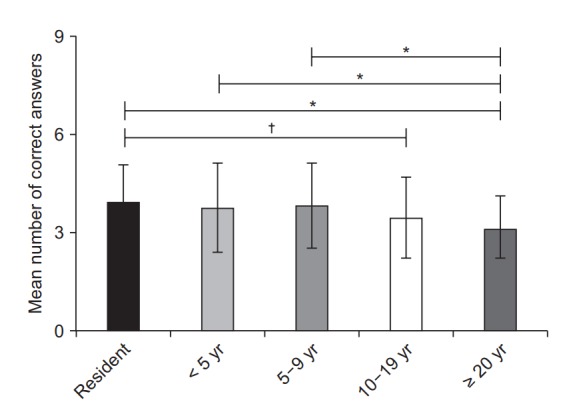
Results: Six hundred one surveys were correctly completed. The highest mean number of correct answers was obtained by residents, and this number decreased progressively with increasing work experience. The lowest value was recorded in the most experienced group (≥ 20 years of experience).
Conclusions: Low inter-reliability and experience-dependence of ASA-PS must be taken into account when evaluating a patient, particularly in settings where wide differences in experience are present.
Keywords: ASA-physical scale; ASA-score; Anesthesiologist.
Figures
Comment in
-
American Society of Anesthesiologists physical status: how the obscurity in the system itself contributes to inaccuracies and variations in classification.Korean J Anesthesiol. 2019 Oct;72(5):506-507. doi: 10.4097/kja.19085. Epub 2019 Apr 1. Korean J Anesthesiol. 2019. PMID: 30929414 Free PMC article. No abstract available.
References
-
- Saklad M. Grading of patients for surgical procedures. Anesthesiology. 1941;2:281–4.
-
- Dripps RD. New classification of physical status. Anesthesiology. 1963;24:111.
-
- Dripps RD, Lamont A, Eckenhoff JE. The role of anesthesia in surgical mortality. JAMA. 1961;178:261–6. - PubMed
-
- ASA House of Delegates/Executive Committee. Schaumburg (IL): American Society of Anesthesiologists; 2014. ASA Physical Status Classification System [Internet] Oct 15 [cited 2018 Aug 6]. Available from https://www.asahq.org/standards-and-guidelines/asa-physical-status-class....
-
- Owens WD, Felts JA, Spitznagel EL., Jr ASA physical status classifications: a study of consistency of ratings. Anesthesiology. 1978;49:239–43. - PubMed
MeSH terms
LinkOut - more resources
Full Text Sources